
How We Got Here
In January 2023, Missouri Governor Michael L. Parson issued Executive Order 23-01 that called on state agencies, private and non-profit leaders, and other key stakeholders and community members to develop an MPA to support Missourians to age with dignity. Specifically, it required the DHSS and its Advisory Council to do the following:
Review and assess the current state of aging services in Missouri.
Coordinate and complete at least 10 listening sessions with stakeholders in the Area Agencies on Aging (AAA) regions with at least two listening sessions available statewide.
Conduct a statewide senior citizen and adults with disabilities needs assessment.
Establish priorities for each state agency and communicate these priorities to key stakeholders.
Develop a Master Plan on Aging.
This executive level support indicated broad backing to guide Missouri to respond effectively to demographic changes that will impact the availability of resources and service delivery.
Community engagement and stakeholder outreach have been central to the MPA development process. Missouri used multiple ways to hear from the public to better understand what residents need and how to improve their quality of life as they get older. To achieve this, the state embarked on a two-year process of engaging stakeholders, hosting regional town hall meetings, conducting a needs assessment survey, and aligning efforts with other state planning processes to gather sufficient public opinion and input on Missouri’s aging needs and solutions.
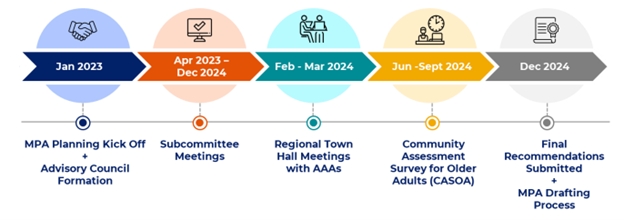
Missouri’s MPA planning process was unique in the deep amount of public engagement that informed the plan. Community engagement and stakeholder outreach were central to the MPA development process. Hearing directly from older adults, individuals with disabilities, and family caregivers allowed the state to better understand the unique challenges these groups face and how to help them live healthy and safe lives as they age. A summary and timeline of Missouri’s engagement process is shown in Figure 8. After engagement, the subcommittees set to work refining and incorporating the feedback into the final MPA.
Advisory Council
The Governor’s executive order created an MPA Advisory Council. Missouri’s DHSS was assigned the responsibility of selecting a diverse group of stakeholders to serve on the council. Comprised of 40 members, the Advisory Council brings together individuals with extensive expertise in aging and disability needs. Its members include state legislators, agency officials, and executives for local non-profits, associations, foundations, educational institutions, and private entities.
Organizations represented on the Advisory Council include the AAAs, the Missouri Council on Aging (MCoA), the Missouri AARP, the Centers for Independent Living, the Missouri Foundation for Health, and the Institute for Human Development. The Advisory Council held quarterly meetings throughout the drafting process to hear updates on subcommittee activities and provide high-level guidance. Missouri also developed an Ad Hoc Lived Experience Advisory Council of caregivers, older adults, and adults with disabilities, to provide ongoing feedback from a lived experience perspective. The Ad Hoc Lived Experience Advisory Council met quarterly through calendar year 2024.
Subcommittees
Subcommittees (See below) were formed to focus on the following domains related to healthy aging:
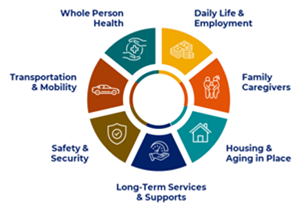
- Daily Life and Employment,
- Family Caregivers,
- Housing and Aging in Place,
- LTSS,
- Safety and Security,
- Transportation and Mobility, and
- Whole Person Health
Town Hall Meetings
DHSS teamed up with Missouri’s 10 AAAs to host town hall meetings to gather feedback statewide for the MPA. AAAs cover every county in the State and are the local experts regarding programs and services in their local areas. A total of 12 sessions – 10 held in person and two conducted virtually – took place between February and March 2024 to gather input from older adults, individuals with disabilities, family caregivers, and other key stakeholders on the challenges and opportunities of aging in Missouri.
Over 1,700 community members attended the town halls throughout the state and provided over 15,000 unique comments about aging priorities for Missouri. All the comments and suggestions offered by community members who attended were grouped by town hall and analyzed. This input was shared with the MPA subcommittees, who used the discussion themes to develop the final recommendations for the MPA.
Community Assessment Survey
In addition to gathering feedback during town hall meetings, DHSS, in partnership with the Missouri Association of AAAs (MA4) worked with Polco in 2024 to conduct the Community Assessment Survey for Older Adults (CASOA), a needs assessment. Polco conducted surveys of a representative sample of older adult residents to inform decision making around the MPA. In addition to older adult residents, this survey included adults with disabilities and caregivers.
In total, 158,489 Missouri households were selected to participate in the survey. Of those selected, Missouri received 7,621 responses: 6,842 were older adults (50+), 2,612 were residents with disabilities (18+), 2,326 were caregivers (18+), and 290 did not fall into any of those categories (residents were able to multi-select options, so some residents fall into multiple categories). When conducting the analysis, data of those who identified as older adults were weighted to reflect the demographic profile of all residents in the State. Survey participants were contacted via mail and were provided the opportunity to complete their survey online, over the phone with an interviewer, request a paper survey, or an in-person interview.
To increase survey responses, Missouri worked with Learfield, a marketing company, to provide professional TV, radio, and social media marketing to invite all Missourians to complete the needs survey. The media campaign targeted markets serving older adults, adults with disabilities, and caregivers.
Building on Prior State Planning on Aging
Before launching the MPA work, Missouri led several important state-level planning efforts focused on aging and disability concerns. These efforts are foundational to the development of the MPA.
In 2022, Missouri created an Alzheimer’s State Plan Task Force, which issued a report that assessed the current and future impact of Alzheimer’s disease and related dementias on Missourians and developed recommendations to respond to the public health crisis. The report identified four focus areas: advancing risk reduction and early detection; increasing access to care; support, and treatment; improving quality of care; and ensuring a coordinated statewide response.
Similarly, in 2023, the Division of Senior and Disability Services (DSDS) issued its 2024-2027 State Plan on Aging (SPA). This federally required plan guides how Missouri uses Older Americans Act (OAA) funding to support older adults and family caregivers. The SPA established a goal for all Missourians to age safely in a way that promotes health and dignity in the setting of their choice. It included nine measurable health and social outcomes for older adults, specific strategies to meet these outcomes, and measurements for tracking the state’s progress. The state’s top identified needs were caregiver support, home repair and modification, in-home services, and addressing isolation, nutrition, and transportation.
While the SPA focuses on OAA-funded programs and is developed with input from aging network providers, the MPA is a broader, more comprehensive strategy designed to address the challenges and opportunities of an aging population and Missourians with disabilities through cross-sector collaboration. It provides an overarching framework and a set of strategies to support age- and ability-friendly communities that promote aging with dignity and independence for older adults, individuals with disabilities, and family caregivers, no matter where they live in the state.
Key recommendations from Missouri’s Alzheimer’s State Plan Task Force and strategies from Missouri’s 2024-2027 SPA are currently being implemented.