

An Onsite Wastewater Treatment System Owner’s Manual
Chapter 2: Aeration Treatment Units - A Pretreatment Component
Homes not served by public sewers rely on individual or small cluster wastewater treatment systems to treat and disperse household WASTEWATER. Household WASTEWATER includes both GRAYWATER and BLACKWATER. GRAYWATER is defined as water captured from nonfood preparation sinks, showers, baths, and clothes washing machines while BLACKWATER is that portion of WASTEWATER that originates from toilet fixtures, dishwashers, and food preparation sinks.
Household WASTEWATER contains human waste, dirt, food, toiler paper, soap, detergents, and cleaning products; which includes dissolved nutrients, microorganisms, and solid particles. Improperly maintained wastewater treatment systems can allow these substances contaminate groundwater and/or surface water and pose a health hazard.
A septic tank followed by gravity dispersal trenches is the most common ONSITE WASTEWATER TREATMENT SYSTEM used in rural areas. However, there are many households for which the typical septic tank system is not the best WASTEWATER treatment option. For example, septic tank systems are not suitable for lots with limited land area, poor soil conditions, or where the water table is too high to allow the soil adequate time to treat the WASTEWATER before it reaches groundwater. In these cases, an aeration treatment unit may be a good option.
Aeration treatment units (ATUs) are similar to septic tanks in that they both use natural processes to treat WASTEWATER. But unlike septic tanks that rely on ANAEROBIC treatment, ATUs use AEROBIC treatment processes that require oxygen. Oxygen is added using a mechanism to inject and circulate air inside the treatment tank; electricity is needed for this operation. For this reason, ATUs cost more to operate and need more frequent routine MAINTENANCE than most septic tank systems. However, when properly OPERATED and MAINTAINED, ATUs provide a high-quality wastewater treatment alternative.
How an Aeration Treatment Unit Works
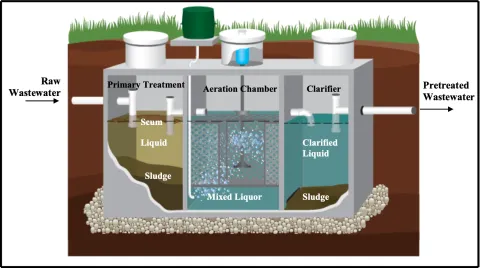
The main function of the aeration treatment unit is to collect and treat household WASTEWATER. ATUs themselves come in many sizes and shapes. ATUs include a main compartment called an aeration chamber in which air is mixed with the WASTEWATER. Some models include a primary settling compartment or an additional tank to reduce the amount of solids in the WASTEWATER entering into the aeration chamber.
Because most individual household and other small ATUs are buried underground like septic tanks, air must be forced into the aeration chamber by an air blower, pump, compressor or by a motor and aspirator. The forced air mixes with WASTEWATER in the aeration chamber and the oxygen supports the growth of AEROBIC bacteria that digest the organic material in the WASTEWATER.
This mixture of WASTEWATER, bacteria, and air is called MIXED LIQUOR. The treatment occurring in the MIXED LIQUOR is referred to as suspended growth because the bacteria grow and die as they are suspended in the liquid, unattached to any surface. The bacteria cannot digest all of the solids in the mixed liquor and the growth and die-off of bacteria create more solids; these solids accumulate as SLUDGE and eventually overload the clarifier or filter if not pumped out.
Some ATUs have a fixed medium, typically a prefabricated plastic, which provides surface area for attached growth. Attached growth technologies work on the principle that microorganisms remove organic matter from WASTEWATER while growing on the filter media, essentially recycling the dissolved organic material into a film that develops on the media. As the attached growth builds up and sloughs off, SLUDGE accumulates at the bottom of the tank.
Many AEROBIC units include a final settling chamber or clarifier where solids and bacteria can settle and return to the aeration chamber. Other designs use a screen to retain solids in the ATU. When the amount of solids in the MIXED LIQUOR reaches a certain point, the clarifier cannot retain the solids or the filter/ screen can clog and restrict WASTEWATER flow. Suspended growth solids in the MIXED LIQUOR or SLUDGE buildup will need to be pumped out periodically so that solids don’t discharge to the soil treatment system or clog the ATU.

Figure 2: Aeration Treatment Unit (ATU). Many manufacturers and models of ATUs comply with the requirements of NSF Standard 40. Different models use different parts and methods to treat WASTEWATER to be in compliance with this standard.
- To introduce oxygen, an ATU may use [A] – an Air Pump and Air Diffuser, [B] – an Aerator Motor and Mixing Rotor, not pictured – a submerged Aerator Motor and Aspirator, or other aeration methods.
- Some models use suspended growth where bacteria and dissolved oxygen circulate in the WASTEWATER, together called MIXED LIQUOR, and others use [C] – a media for attached bacteria growth for WASTEWATER and dissolved oxygen to circulate through for treatment.
- Various models have [D] – a Clarifier and Sludge Return and/or [E] – a Filter/Screen(s) to retain solids including the suspended bacteria growth.
ATUs provide a higher level of WASTEWATER treatment than septic tanks. However, proper OPERATION and MAINTENANCE is essential. The United States Environmental Protection Agency has established five management models with progressively increasing management controls as sensitivity of the environment and/or treatment system complexity increases.
MANAGEMENT MODEL II specifies program elements and activities where more complex designs are employed to enhance the capacity of conventional systems to accept and treat WASTEWATER. Because of treatment complexity, contracts with qualified SERVICE PROVIDERS are needed to ensure proper and timely MAINTENANCE.
The objective of this model is to ensure that:
- Advanced systems are designed and installed in accordance with appropriate state and local regulations;
- Homeowners are knowledgeable of their particular system and maintain a contractual agreement with a qualified SERVICE PROVIDER to provide routine MAINTENANCE (INSPECTIONS and pumping) necessary for the system to operate properly; and
- Homeowners ensure a MALFUNCTIONING system is repaired in accordance with Missouri law.
This model is generally most appropriate for aeration treatment units. In some sensitive environments, MANAGEMENT MODELS III or IV may be recommended.
Design and Construction
ATU tanks are typically made of concrete, fiberglass, or plastic.
ATUs must meet NSF Standard 40.
ATUs must be located:
- On firm, bedding material capable of bearing the weight of the tank and its contents;
- In an area easily accessible for the removal of liquids and accumulated solids; and
- To meet the set back distances specified in 19 CSR 20-3.060 Minimum Construction Standards for Onsite Systems.
The capacity of an ATU is based on the volume of WASTEWATER that can be treated in one day. For a single-family house, the treatment capacity is based upon the number of bedrooms with a minimum required capacity of 120 gallons per day per bedroom or 500 gallons per day, whichever is greater.

Maintenance - Inspections
Regular MAINTENANCE is essential for getting the best performance from your onsite system. It is important that mechanical components in AEROBIC systems receive regular INSPECTION and MAINTENANCE. Most homeowners do not have the expertise to inspect, maintain, and repair their own systems. If your unit carries the NSF International certification, it will include the first two years of service visits and an option to renew the service contract.
Inspections
ATUs must be inspected at least every six months according to NSF certification requirements and as recommended by the manufacturer. The INSPECTION should be conducted by a maintenance provider certified by the ATU manufacturer. The INSPECTION should include assuring:
- The tank is structurally sound with no corrosion, cracking, or missing parts;
- If applicable, the primary treatment chamber or tank shows no signs of water intrusion;
- The tank, risers, service access, access ports, lids, and covers are in good condition and watertight;
- The aeration chamber has a functioning aeration system that introduces air into the chamber and mixes WASTEWATER according to the manufacturer’s specifications;
- If applicable, the clarification chamber, and/or screens are not overloaded and solids are retained in the treatment unit;
- Vents and aeration access ports are free of blockages and cleaned as needed;
- Lids and covers are locked or otherwise secured to prevent accidental entry;
- Alarms function properly;
- There are no signs of corrosion on the wiring; and
- A thirty (30) minute settleability measurement is conducted to evaluate the MIXED LIQUOR within the aeration chamber in suspended-growth models.

A thirty minute setteability measurement is conducted by collecting a MIXED LIQUOR sample at or near the outlet of the aeration chamber, allowed to settle for 30 minutes in a clear measuring container, and the volume occupied by the SLUDGE is then reported. It is a useful test that indicates changes in the SLUDGE settling characteristics and quality and can assist in determining what MAINTENANCE should be performed.
Maintenance - Pumping
It is the responsibility of the homeowner or user of the ATU to contract with a maintenance provider certified by the ATU manufacturer or other qualified SERVICE PROVIDER for the periodic removal and treatment of the contents of the unit. The OWNER or user of the system must schedule for the removal and sanitary disposal of WASTEWATER from all chambers when:
- Any other tank in the system needs pumped;
- If applicable, the top of the SLUDGE layer is no closer than twelve inches below the outlet of the primary chamber or tank;
- The MIXED LIQUOR settleable solids in the aeration chamber measure greater than fifty percent (50%);
- If applicable, the SLUDGE layer fills more than two thirds of the volume below the attached growth media; or
- As recommended by the manufacturer.
The maintenance provider certified by the ATU manufacturer or other qualified SERVICE PROVIDER is responsible for the proper treatment and disposal of all hauled WASTEWATER by transporting to a municipal sewage treatment plant capable of receiving the waste; transporting to a SLUDGE handling facility which possesses a current and valid permit issued for such activity; or land applying under a current and valid permit for such activity.

Figure 3: Aeration Treatment Unit (ATU). Contract for removal of solids from the ATU when, if applicable in the primary chamber, SLUDGE is 12 inches or less from bottom of outlet [A] or when SCUM is 3 inches or less from bottom of outlet [B]; or when a 30 minute settleability test result shows 50% or more solids settle out in the MIXED LIQUOR from the aeration chamber, when, if applicable, SLUDGE fills 2/3 or more of the volume below attached growth media [C]; or when, if applicable, the clarifier or screen(s) are overloaded or clogged [D].
Final Treatment and Dispersal
Although properly OPERATED and MAINTAINED AEROBIC units reduce the pollutants in WASTEWATER compared to septic tanks, the WASTEWATER leaving the unit must receive further treatment before it is ready to be returned to the environment. Methods for final treatment and dispersal include discharge to a soil treatment system or lagoon.
DID YOU KNOW?
In order to ensure individuals are properly trained, the Missouri Department of Health and Senior Services registers several types of ONSITE WASTEWATER TREATMENT SYSTEM PROFESSIONALS. For more information about installers, onsite soil evaluators, onsite system inspectors/evaluators, and percolation testers please go to Wastewater Professionals.
Warning Signs of System Malfunctioning
While proper use, INSPECTIONS, and MAINTENANCE should prevent most ATU problems, it is still important to be aware of changes in your system and to act quickly if you suspect the system is MALFUNCTIONING. The most obvious onsite system failures are easy to spot.

- Alarms or lights activated;
- Any change in the system’s normal operating sound;
- Any changes in the normal color of the WASTEWATER in the aeration chamber;
- Excessive solids, foam, or SCUM in the unit;
- Plumbing backups;
- SEWAGE odors in the house or yard; and/or
- Tests show the presence of bacteria in well water.
Onsite systems fail when partially treated WASTEWATER comes into contact with groundwater. This type of failure is not easy to detect, but can result in the pollution of wells, nearby streams, or other bodies of water.
If you notice any of these signs or you suspect your system may be having problems, contact a qualified SERVICE PROVIDER or the local onsite WASTEWATER ADMINISTRATIVE AUTHORITY for assistance.
ATU Do's and Don'ts
Proper OPERATION and MAINTENANCE of an onsite system can prevent costly repairs or replacement and can protect your property value. Observing the following recommendations will help to keep your system operating properly.
Do's
- Obtain the necessary permits from the appropriate ADMINISTRATIVE AUTHORITY before making any repairs.
- Use a maintenance provider certified by the ATU manufacturer or other qualified SERVICE PROVIDERS for routine INSPECTIONS, MAINTENANCE, and pumping; and if you experience problems with the system, such as the alarm is activated or other warning signs the system may be MALFUNCTIONING.
- Renew and maintain the contract service arrangement offered by the manufacturer after the initial two-year period has expired.
- Have the system maintained regularly in accordance with the manufacturer’s recommendations.
- Keep the system accessible for INSPECTIONS and pumping; yet locked or otherwise secured to prevent accidental entry.
- Keep detailed records regarding the system, its location, make/model, contract service agreement, service visits, and MAINTENANCE performed.
- Conserve water to avoid overloading the onsite system, use high-efficiency fixtures and promptly repair any leaky faucets or toilets.
- Have your private water well tested periodically or if you experience any warning signs of the system MALFUNCTIONING (contact your local public health agency).
Don'ts
- Don’t enter a sewage tank. Poisonous gasses or a lack of oxygen can be fatal.
- Your sewage system is not a trash can. Don’t put dental floss, feminine hygiene products, flushable wipes, condoms, diapers, cotton swabs, cigarette butts, coffee grounds, cat litter, paper towels, paint, pesticides, or other hazardous chemicals into your system.
- Don’t use caustic drain openers for a clogged drain. Instead, use boiling water or a drain snake to open clogs.
- Don’t drive or park vehicles or allow livestock on any part of your ONSITE WASTEWATER TREATMENT SYSTEM. Doing so can compact the soil in your soil treatment area or damage the pipes, tank, or other onsite system components.
- Don’t build over any part of your system; this includes patios, carports, and other structures.
- Don’t attempt to clean or perform MAINTENANCE on any sealed AEROBIC unit components.
- Don’t attempt to perform any MAINTENANCE prior to shutting off all electricity to the system.
- If lights or alarms are activated, don't turn alarm off prior to assuring the system is not MALFUNCTIONING.