
An Onsite Wastewater Treatment System Owner’s Manual
Chapter 11: Curtain Drains
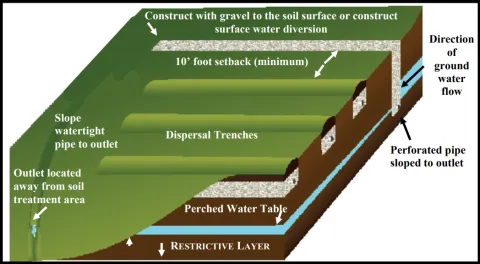
Wastewater treatment in the soil depends on unsaturated conditions. During rainfall, some water moves along the top of the ground while some of the water soaks into the soil. When water moving downward in the soil encounters a less permeable or RESTRICTIVE LAYER of soil, water movement slows and soil above the RESTRICTIVE LAYER can become SATURATED. Over a period of time this can create a perched water table. The perched water then moves down slope through the soil above the RESTRICTIVE LAYER. On sloping sites, a curtain drain (also called interceptor drains) can enhance the soil’s ability to treat and disperse wastewater by intercepting both surface water runoff and groundwater moving towards a soil treatment area.
How a Curtain Drain Works
A typical curtain drain consists of a sloped trench filled with gravel with a perforated drainage pipe near the bottom of the trench. When soil near the trench becomes SATURATED, free water runs into the gravel, into the pipe, and out the end of the pipe onto the ground surface. The drain discharges water down slope and away from the soil treatment area. Curtain drains are most effective when used to intercept groundwater moving through SATURATED soil above a RESTRICTIVE LAYER. Although less effective, curtain drains may be constructed to help remove water from poorly drained soils where there is no RESTRICTIVE LAYER.
Curtain drains can be used to intercept surface water runoff; however, drain design is critical to ensure that surface water is diverted and does not add to the hydraulic load in the soil treatment area. Often a surface water diversion is used instead of a curtain drain to help redirect some of the runoff, especially on long slopes.
Although curtain drains can divert water away from the soil treatment area, it should not be assumed that a water table will be lowered or the vertical separation (the unsaturated soil treatment zone) between the wastewater dispersal system and water table will be increased. There are several variables that need to be considered including, the length and steepness of the slope, the depth and permeability of soil layers, the length and number of dispersal trenches, and the wastewater load to be dispersed into the soil.

Design and Construction
It is important to consider site and soil conditions in the design and construction of a curtain drain. The surface area that contributes runoff and recharges groundwater moving into the soil treatment area control the extent of the trench needed and the slope and size of the drain pipe. The landscape slope, available area, and depth to bedrock can limit the depth of the curtain drain and limit its usefulness on some sites.
The suitability of a curtain drain must be based on an accurate site/soil evaluation;
When practical, the bottom of the curtain drain should be dug six (6) inches into the RESTRICTIVE LAYER;
When a RESTRICTIVE LAYER is not present, consider using an impermeable barrier on the trench bottom and down slope side;
The drain pipe size and uniform slope must provide the necessary capacity to carry water at the rate it is intercepted;
Fabric covered pipe is only recommended where fine sand could settle in the pipe;
Use surface water diversion as needed to intercept rainwater runoff;
Curtain drains must be located:
- To maximize the groundwater intercepted and reduce the amount of water moving into the soil treatment area;
- To observe required setback distances as specified in 19 CSR 20-3.060;
- With the outlet below the elevation of the lowest dispersal trench bottom; and
- Where the outlet can be free flowing and will not be submerged during a storm;
The outlet needs to be protected from small animals by a screen or grate; and
Where drain outlet slopes steeply, erosion control will be needed.
A discharge easement may be needed for extensive drainage systems or in subdivisions.
Maintenance
Curtain drains require little MAINTENANCE. However, this simple MAINTENANCE is important to the performance of the wastewater treatment system.
Inspection
The drain and any surface water diversion should be checked at least annually and after heavy rains to assure:
- Gravel at the curtain drain surface is not clogged with grass or sediment allowing surface water onto the soil treatment area;
- If applicable, surface water diversion is not eroded or filled with sediment and allowing surface water onto the soil treatment area;
- The outlet is free flowing and is free of sediment and other debris;
- An animal guard is in place and functional at the outlet; and
- Any wet areas along the drain are investigated for possible blockage or other problems.