

BCBH communities work in Missouri counties with the highest burden of chronic disease to reduce the leading preventable causes of chronic disease. BCBH coalitions implement policy, system and environmental change strategies that increase physical activity and reduce tobacco use and secondhand smoke exposure in their communities. Policy, system and environmental changes make the healthy choice the easy choice and ensure healthier communities for years to come.
BCBH coalitions implement policy, system and environmental change strategies that increase physical activity and reduce tobacco use and secondhand smoke exposure in their communities. Policy, system and environmental changes make the healthy choice the easy choice and ensure healthier communities for years to come.
Wins and Successes

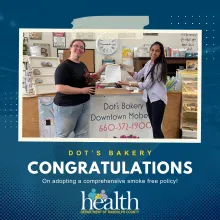
- The Randolph County Health Department recently assisted two local businesses in adopting comprehensive tobacco-free policies: Dot’s Bakery and Vintage 424.
- The city of Noel is celebrating the implementation of 100% smoke-free parks. Rosa’s Mexican Supermarket and Shadow Lake have also implemented smoke-free worksite policies. Read more here.
- The city of Tarkio, MO passed a smoke-free community ordinance January 2024. Click here to read more.
- Salem, MO passed a smoke free ordinance that includes city owned buildings, vehicles and properties, including parks. Read more here.
- On April 29th, 2024, MRT hosted an active transportation training for the current BCBH cohort. Read more here.
- Next to Rise continues to train students from school to school. Students are learning how beneficial clean air for all Missourians would be and what they can do to help. See the excitement build on the Next to Rise blog.
Check out these big wins!
Click below to read success stories from Cohort 1 BCBH communities,
and the work achieved to improve the health and wellness of community residents. The work that has been done to improve the health and wellness of residents living in these areas is amazing.
- “P” is for Partnering to Promote Health at Parks
- Making Water Flow for Health in Dallas County
- The Road to Smoke Free Public Places
- Taking Steps Forward in Creating a Safe, Accessible Lexington
- Going Tobacco and Smoke-Free — because it Matters in Linn County
- Supporting Smoke and Tobacco Free Parks in Pineville
- Improving Health in Randolph County
- Making Water Flow at Riverfront Park
- Working Towards a Smoke-Free Schuyler County
- “Growing” Healthy Food Access in Washington County
What's New?
Next to Rise is a youth-led program that gives high school students a platform to work together to create positive change in Missouri. Next to Rise partners with Missouri schools, clubs and community organizations, including Building Communities for Better Health coalitions. Together, we hope to increase the number of indoor public spaces that are 100% smoke and vape-free in Missouri. Interested in partnering with us and serving Missouri communities?
Cohort 2 Participants
- American Lung Association (Gravois Park)
- St. Louis Healthy Homes and Energy Efficiency Coalition
- Gravois Park Neighborhood Association
- Atchison County (Tarkio, Rockport)
- Butler County (Poplar Bluff)
- Dent County (Salem)
- Harrison County (Bethany)
- McDonald County (Noel)
- The Alliance - McDonald County Community Coalition
- Pettis County (Sedalia)
- Randolph County (Moberly)


Smokefree Communities
Smoke-free policies are the only way to guarantee protection from secondhand smoke. Smoke-free environments protect people from secondhand smoke and e-cigarette aerosol, protect people from thirdhand smoke, prevent youth from starting tobacco use, help people quit and stay quit.1
Smoke-free policies protect everyone.
Currently, only one in three Missourians are protected by smoke-free laws. BCBH communities are helping local businesses and organizations increase and enhance comprehensive smoke/vape-free policies that protect all people in all places.
Active Transportation
The built environment can increase access to safe and accessible physical activity opportunities through Complete Streets design for active transportation. BCBH communities are working to create, implement and promote active transportation plans that support safe, accessible routes to everyday destinations such as homes, schools, parks, public spaces and transit stops.
A supportive built environment can enhance quality of life, minimize environmental contamination exposure, support protective factors and improve chronic disease outcomes. Learn more about Complete Streets.
References
- Centers for Disease Control and Prevention. (2021, November 30). Smokefree Policies Reduce Smoking.
- American Academy of Pediatrics. (n.d.). Thirdhand smoke: A Threat to Child Health.
- American Nonsmokers’ Rights Foundation. Bridging the Gap. (December 16, 2022). Missouri - Bridging the Gap.
- Policy, Systems and Environmental Change - Rural Health Promotion and Disease Prevention Toolkit. (2024).