
Chapter 9: Pressure Distribution
An Onsite Wastewater Treatment System Owner’s Manual
Chapter 9: Pressure Distribution
A gravity ONSITE WASTEWATER TREATMENT SYSTEM, also called a standard or conventional system, is the most commonly used system for treating WASTEWATER. These systems consist of a septic tank or other pretreatment component, a distribution system, and a soil treatment system. After receiving limited treatment in the septic tank, WASTEWATER is distributed and dispersed into the soil for final treatment.
A subsurface soil treatment system serves two purposes: 1) keep untreated WASTEWATER below the soil surface, and 2) purify the WASTEWATER before it reaches ground or surface water. Unfortunately, not all soil and site conditions are well suited for these conventional systems. To protect public health and water quality, alternative systems are often used in areas where conventional systems cannot assure adequate WASTEWATER treatment. Although not the answer for all unsuitable soils, pressure distribution can assist the soils where conventional gravity distribution systems would fail.
One specific type of pressure distribution system is the low-pressure pipe (LPP) system. LPP systems were developed as an alternative to conventional soil treatment systems to overcome some problems such as shallow bedrock or water table and to reduce localized overloading common in gravity distribution systems. Drip irrigation, another type of pressure distribution, is discussed in Chapter 10 of these guidelines.
How Pressure Distribution Works
At a minimum, primary treatment by a septic tank with an EFFLUENT screen is required before a pressure distribution system. An aeration treatment unit (ATU) or alternative treatment component, such as a bio-filter or wetlands, can also be used. Pressure distribution should be used following ATUs or alternative treatment systems because WASTEWATER from these systems does not promote the development of a bio-mat on which gravity distribution depends.
Pretreated WASTEWATER collects in a separate compartment or pump tank. When WASTEWATER reaches a certain level, or based on timer control settings, the pump is activated and screened EFFLUENT is dosed to a network of distribution pipes. WASTEWATER is distributed evenly over the soil treatment area through evenly spaced small holes drilled in the distribution pipes. Some soil treatment areas are split into smaller zones and dosing alternates between zones.
Compared to a conventional gravity trench system, LPP dispersal trenches are shallower and narrower. An LPP system may need less area than a gravity system.
Benefits of pressure distribution include:
- Allows placement of the soil treatment system in the best area even if it is upslope from the residence or establishment;
- Improved distribution over the entire area helps prevent localized overloading and too rapid WASTEWATER percolation with little time for treatment;
- Dosing and resting cycles that promote aerated soil conditions; and
- Spread out peak flows over time, which helps improve soil treatment compared to gravity distribution systems.
Additional benefits of LPP distribution potentially include:
- Shallow, narrow trenches use the best soil layers for WASTEWATER treatment;
- Treatment may be possible in a smaller area;
- Less trench material may be needed, which can reduce site disturbance and soil compaction; and
- Systems might better fit uneven sloping terrain that would be unsuitable for gravity flow systems.

Pressure distribution can help enhance WASTEWATER treatment in soils with limited depth to bedrock or seasonal water table or other limitations. The US Environmental Protection Agency has established five management models with progressively increasing management controls as sensitivity of the environment and/or treatment system complexity increases. MANAGEMENT MODEL II specifies program elements and activities where more complex designs are employed to enhance the capacity of conventional systems to treat and disperse WASTEWATER. Because of system complexity, contracts with qualified SERVICE PROVIDERS are needed to ensure proper and timely MAINTENANCE.
The objective of this model is to ensure that:
- Alternative systems are designed and installed in accordance with appropriate state and local regulations;
- Homeowners are knowledgeable of their particular system and maintain a contractual agreement with a qualified SERVICE PROVIDER to provide routine MAINTENANCE (INSPECTIONS and pumping) necessary for the system to operate properly, and, if needed;
- Homeowners ensure a MALFUNCTIONING system is repaired in accordance with Missouri law.
This model is generally most appropriate for aeration treatment units. However, in some sensitive environments, MANAGEMENT MODELS III or IV may be recommended.
Design and Construction
Effective soil treatment depends on matching the distribution and dispersal methods to the site and soil. The size of the soil treatment system is determined by the amount of WASTEWATER flow anticipated and the soil properties in the soil treatment area. Soil properties and the depth to bedrock or a water table also help determine how deep the dispersal trenches should be. A thorough site evaluation must be conducted when the wastewater treatment system is in the planning stages. Wastewater system failures are often caused by poor choice of the system type and/or location.
Pressure distribution can be used to improve distribution in conventional dispersal trenches without any change to the basic size and design of the trenches. A pump tank, pump, and distribution network are simply added to the system design.
Dispersal Trenches
Sizing must be based on an accurate site/soil evaluation.
Where dispersal trenches are filled with gravel, it must be clean to prevent clogging at the trench bottom.
Where gravelless dispersal trench products are used, installation must follow manufacturer specifications. Dispersal trenches must be located:
- To follow the contours of the ground with level bottoms;
- Out of any surface water drainage; and
- To observe required setback distances as specified in 19 CSR 20-3.060.
Distribution
When gravel or expanded polystyrene bundles are used in dispersal trenches, the pressure distribution pipes are inserted into the 4-inch diameter perforated pipes.

The pressure distribution network design includes the:
- Size and spacing of drilled holes in the distribution pipes,
- Diameter of the manifold and distribution pipes;
- Pressure required to ensure uniform WASTEWATER distribution;
- Pump capacity requirements; and
- Dose volume needed for the system to function properly. It must be large enough to pressurize the network and ensure uniform distribution and it must not be larger than the trench storage volume available below the drilled holes.
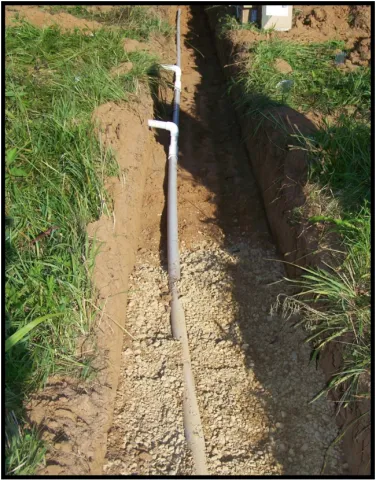
LPP systems must be designed by a Missouri Professional Engineer. The length and spacing of the dispersal trenches; trench design, and pressure network are more critical because the minimum soil treatment area required is often smaller than for a conventional gravity system. In addition to the list above, LPP and distribution:
- LPP dispersal trenches are narrow, typically 12 inches to as little as 8 inches wide.
- LPP trenches are shallow, generally 12” inches deep.
- LPP trenches are generally limited to 70’ feet in length.
- Distribution must be uniform, varying no more than 10 %.
Maintenance
Inspections
Inspection of the soil treatment area must be conducted at least annually and include assuring:
- When inspection ports are available, the observation of the presence and depth of ponding within each lateral; there is no evidence of damage to the lateral trenches; and there is no root intrusion or obstruction(s) to the system;
- There is no evidence of unequal WASTEWATER distribution in the soil treatment area;
- There is no evidence of ponding or saturation along the supply lines or distribution devices and the supply lines drain freely after each dose;
- There are no signs of surfacing EFFLUENT;
- No strong, foul odors are present near the soil treatment area;
- Vegetation is maintained on and around the soil treatment area;
- The surface of the soil treatment area has no areas of depression for surface water to collect;
- The soil treatment area is not subject to traffic, heavy equipment, or used as pasture for domesticated animals;
- The soil treatment area is not used for outbuildings and/or structures, such as patios and above-ground swimming pools;
- There is no visible damage to the dispersal trenches.
Service/Pumping
- Assure filters are in good condition and not clogged;
- Clean filters as recommended by the manufacturer;
- Assure the pump functions in accordance with Chapter 6 of these guidelines;
- Flush solids that accumulate at the ends of the distribution lines at least annually in a manner that does not result in surfacing EFFLUENT;
- Re-adjust pressure to ensure the operating pressure and flow rate are according to design specifications.
Warning Signs
While proper use, INSPECTIONS, and MAINTENANCE should prevent most ONSITE WASTEWATER TREATMENT SYSTEM problems, it is still important to be aware of changes in your onsite system and to act quickly if you suspect the system is MALFUNCTIONING. The most obvious onsite system failures are easy to spot.
- Odors, surfacing SEWAGE, or wet spots in the soil treatment area.
- Standing liquid over the soil treatment system, even during dry weather. This may indicate an excessive amount of WASTEWATER is moving up through the soil, instead of downward.
- Plumbing or sewage tank backups (often a black liquid with a disagreeable odor).
- Slow draining fixtures.
- Gurgling sounds in the plumbing system.
- An alarm that is activated.
- If you have a well and tests show the presence of coliform (bacteria) or nitrates, your soil treatment system may be MALFUNCTIONING.
Onsite systems fail when partially treated WASTEWATER comes into contact with groundwater. This type of failure is not easy to detect, but can result in the pollution of wells, nearby streams, or other bodies of water.
If you notice any of these signs or you suspect your system may be having problems, contact a qualified SERVICE PROVIDER or the LOCAL ONSITE WASTEWATER AUTHORITY for assistance.
Pressure Distribution Do’s and Don’ts
Proper OPERATION and MAINTENANCE of your onsite system can prevent costly repairs or replacement and can protect your property value. Observing the following recommendations will help to keep your system operating properly.
Do's
- Obtain the necessary permits from the appropriate ADMINISTRATIVE AUTHORITY before making any repairs.
- Use REGISTERED ONSITE WASTEWATER TREATMENT SYSTEM PROFESSIONALS and qualified SERVICE PROVIDERS.
- Conserve water to avoid overloading the onsite system; use high-efficiency fixtures and promptly repair any leaky faucets or toilets. Soil treatment systems do not have an unlimited capacity to disperse WASTEWATER.
- Divert other sources of water, like roof drains, house footing drains, and sump pumps away from the soil treatment area.
- Keep your sewage tank(s) accessible for INSPECTIONS and pumping, yet locked or otherwise secured to prevent accidental entry.
- Have your septic tank, ATU, or other pretreatment component inspected and pumped according to the guidelines for that component.
- Have your pump tank inspected at the same frequency as your septic tank or other pretreatment component and pumped if needed.
- If your pump tank alarm is activated, contact your SERVICE PROVIDER promptly to repair the system and minimize your water usage in the interim.
- Plan ahead—soil treatment systems do not last forever. If you have additional space, consider reserving some area from development so that it can be used for a replacement soil treatment system when needed.
- Know where the soil treatment system and replacement area are located. It is easier to protect the system when you know where the components are.
- Landscape the system properly. Plant and maintain grass over the soil treatment system to prevent soil erosion.
- Keep heavy equipment off the soil treatment area; cars and equipment must not be driven or parked over the soil treatment system.
- Contact a qualified SERVICE PROVIDER if you experience problems with your system, such as surfacing WASTEWATER in your yard or other warning signs the system may be MALFUNCTIONING.
- Keep detailed records regarding the system, its location, make/model, contract service agreement, service visits, and MAINTENANCE performed.
- Use commercial bathroom cleaners and laundry detergents in moderation and only according to manufacturer’s directions.
- Have your private water well tested periodically or if you experience any warning signs of the system MALFUNCTIONING (contact your local public health agency).
Don’ts
- Don’t enter a septic tank, pump tank, or any sewage tank. Poisonous gasses or a lack of oxygen can be fatal.
- Your septic tank system is not a trash can. Don’t put dental floss, feminine hygiene products, condoms, flushable wipes, diapers, cotton swabs, cigarette butts, coffee grounds, cat litter, paper towels, paint, pesticides, or other hazardous chemicals into your system.
- Don’t use caustic drain openers for a clogged drain. Instead, use boiling water or a drain snake to open clogs.
- Don’t drive or park vehicles on any part of your ONSITE WASTEWATER TREATMENT SYSTEM. Doing so can compact the soil in your soil treatment area or damage the pipes, tanks, or other system components.
- Don’t allow large animals and livestock to roam over the soil treatment system. Soil compaction prevents oxygen from getting into the soil and prevents water from flowing away from the soil treatment system.
- Don’t build over any part of your ONSITE WASTEWATER TREATMENT SYSTEM; this includes patios, carports, and other structures.
- Don’t pave or use landscaping plastic over the soil treatment system; bacteria in the soil need oxygen to properly treat WASTEWATER.
- Don’t dig in the soil treatment area, as damage to the pipes may occur.
- Don’t plant a garden over the soil treatment system. You risk the possibility of food contamination.
- Don’t plant more trees and shrubs in or near the soil treatment area.
- Don’t install an irrigation system in the soil treatment area or allow the irrigation water to run towards the soil treatment system.
- Don’t attempt to pump your own sewage tank; use the services of a qualified SERVICE PROVIDER.