
Chapter 3: Bio-filters - A Pretreatment Component
An Onsite Wastewater Treatment System Owner’s Manual
Chapter 3: Bio-filters - A Pretreatment Component
A septic tank followed by gravity dispersal trenches is the most common ONSITE WASTEWATER TREATMENT SYSTEM used in rural areas. However, there are many households for which the typical septic tank system is not the best wastewater treatment option. For example, septic tank systems are not suitable for lots with limited land area, poor soil conditions, or where the water table is too high to allow the soil adequate time to treat the WASTEWATER before it reaches groundwater. In these cases, a bio-filter treatment system may be a good option.
Bio-filters, or media filters, use ATTACHED GROWTH PROCESSES to treat WASTEWATER in an unsaturated environment. Attached growth is the process of flowing WASTEWATER through a natural or manufactured material for biological treatment. In contrast to the treatment processes where waste consuming bacteria grow suspended in sewage tanks, the
active treatment bacteria in ATTACHED GROWTH PROCESSES grow on a filter media, such as gravel, sand, peat, textile, or foam.
The bacteria are primarily AEROBIC, meaning they require oxygen to live and essentially recycle the organic material in the WASTEWATER into a film that develops on the media. To avoid plugging the bio-filter, WASTEWATER must first be treated to remove larger solids. This is accomplished by using a septic tank or an aeration treatment unit to treat the WASTEWATER prior to moving it through the attached growth bio-filter media.
Generally these processes are low MAINTENANCE, have low energy requirements, and are robust and stable; making them a good advanced wastewater treatment technology for individual homes, as well as, small communities.
How a Bio-filter Treatment System Works
Bio-filters make effective attached growth systems using natural filter media such as sand or peat, or manufactured media such as textile and foam. They can be designed as single-pass filters or recirculating filters. Recirculating filters cycle WASTEWATER through the media more than one time. Regardless of the media, the process is generally the same - WASTEWATER from a septic tank is applied to a bed of media, treatment occurs as WASTEWATER flow by bacteria growing on the media, the filtrate is collected in a drain underneath the media and may be recirculated or sent on to a soil treatment system for final treatment and dispersal.
A bio-filter treatment system provides a higher level of WASTEWATER treatment than septic tanks. However, proper OPERATION and MAINTENANCE is essential. The US Environmental Protection Agency has established five management models with progressively increasing management controls as sensitivity of the environment and/or treatment system complexity increases. MANAGEMENT MODEL II specifies program elements and activities where more complex designs are employed to enhance the capacity of conventional systems to accept and treat WASTEWATER. Because of treatment complexity, contracts with qualified SERVICE PROVIDERS are needed to ensure proper and timely MAINTENANCE.
The objective of this model is to ensure that:
- Advanced systems are designed and installed in accordance with appropriate state and local regulations;
- Homeowners are knowledgeable of their particular system and maintain a contractual agreement with a qualified SERVICE PROVIDER to provide routine MAINTENANCE (INSPECTIONS and pumping) necessary for the system to operate properly, and, if needed;
- Homeowners ensure a MALFUNCTIONING system is repaired in accordance with Missouri law.
This model is generally most appropriate for bio-filter treatment systems. However, in some sensitive environments, MANAGEMENT MODELS III or IV may be recommended.

Figure 1: Bio-filter, a single-pass sand filter. Small WASTEWATER doses trickle through the filter media where biological treatment takes place. Filtrate, the treated WASTEWATER, collects in the gravel and underdrain pipe and is dispersed into the soil. Bio-filters may use other media, such as glass, peat, textile, coconut coir, or foam rubber. Some bio-filters recirculate a portion of the filtrate for further treatment.
Sand Filters
A sand filter is a constructed bed of sand (other suitable granular material may be used) at least two feet deep that is contained in a liner made of concrete, plastic, or other impermeable material. The media must be clean and uniform in size to allow the WASTEWATER to flow through it properly. Partially treated WASTEWATER is applied evenly and intermittently across the filter surface utilizing a network of distribution pipes within the bed itself. By applying the WASTEWATER intermittently, the media is allowed to drain between doses ensuring it does not become SATURATED.
Treatment occurs by physical, biological, and chemical processes in combination as the WASTEWATER slowly trickles through the sand grains. Most treatment occurs in the first six to twelve inches of the filter surface. Some of the organic matter sticks to the surfaces or gets caught in the crevices between the sand grains. Chemical bonding takes place as certain particles come in contact with and react with the media. Biological pro- cesses occur when the bacteria consume
the organic particles in the WASTEWATER in a biomat layer near the surface of the filter. This area is where protozoa feed on the bacteria and help prevent the bacteria colony from becoming so dense that it clogs the filter. It is important that this balance between the various life forms is kept constant.
Sand filters are generally low-cost to operate and require minimal operator attention. Sand filters do require a certain amount of land area, which may limit their use.

Note the difference in the size of the sand. The smaller particle sized, light tan colored sand is used for a sand filter.
Peat Filters
Peat makes a good home for a number of different microorganisms, including bacteria, fungi, and tiny plants, making peat a reactive and effective filter. A peat filter is composed of three parts, the peat bed which is a two-foot thick layer of peat fiber; sphagnum moss; or coconut coir/coco peat, a distribution system for the WASTEWATER, and a drain. The distribution system applies the water evenly over the peat surface. The treated WASTEWATER is collected at the bottom of the filter and is sent to a soil treatment system for additional treatment and dispersal. Peat filters are usually single- pass treatment filters and may be purchased as pre-assembled modules or assembled from purchased materials. Due to the organic nature of the peat, the filter media must be replaced periodically. Normal life expectancy is between 8 and 15 years.

Textile Filters
Manmade textiles for WASTEWATER treatment are made of synthetic fiber that is durable and resistant to biodegradation. The engineered fabric is packed into a watertight fiberglass basin, providing a large surface area for biological treatment in a small space. The filter also includes a distribution network and drain. Textile filters are usually recirculating systems and are generally purchased as pre-assembled modules.

Foam Filters
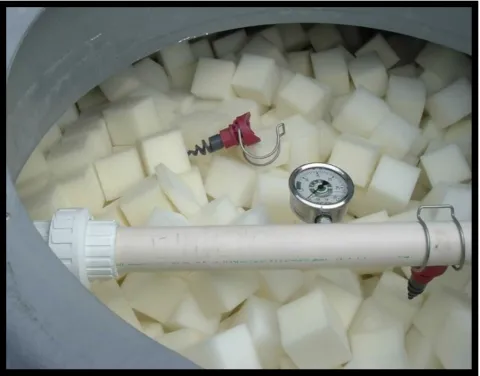
The physical properties of the plastic foam media provide large open pores and high surface area for effective treatment. Foam media systems may be single-pass or recirculating; recirculating systems may require a smaller amount of space for installation. These systems use a spray nozzle to distribute WASTEWATER over the media and a gravity drain or pump at the bottom of the filter to ensure the media does not become SATURATED. Foam filters may be purchased as pre-assembled modules or foam bundles may be purchased and installed in tanks purchased separately.
Design and Construction
A properly sized septic tank or ATU precedes the bio-filter; Bio-filters are contained in modules or a constructed watertight container;
Bio-filters must be located:
- In an area easily accessible for MAINTENANCE;
- To meet sewage tank set back distances specified in 19 CSR 20-3.060 Minimum Construction Standards for Onsite Systems; and
- To ensure drains and recirculation methods work properly.
Bio-filters are sized according to the standards specified in 19 CSR 20-3.060 Minimum Construction Standards for Onsite Systems or manufacturer’s requirements:
- Buried single-pass sand filters for single-family houses require at least 360 square feet of surface area. Buried filters are designed for low loading rates to prevent clogging of the sand and to provide OWNERS years of usage with minimal MAINTENANCE.
- Recirculating sand filters are open to the surface. For single-family houses, these sand filters require at least 48 square feet or at least 24 square feet per bedroom, whichever is greater. Multiple passes are used to accomplish treatment in a smaller area; however, filter clogging can be a problem if the filter is overloaded.
- Peat, textile and foam filter sizing is based on the number of bedrooms or the system design flow and on the manufacturer’s design guidance.
Maintenance - Service and Inspections
OPERATION and MAINTENANCE procedures for bio-filter treatment systems include regular INSPECTIONS, MAINTENANCE of the septic tank or other preceding treatment component, filter bed MAINTENANCE, and repairing or replacing failed components.
Inspections
Bio-filters must be inspected at least annually and as recommended by the manufacturer. The INSPECTION may be conducted by the homeowner, a REGISTERED ONSITE WASTEWATER TREATMENT SYSTEM PROFESSIONAL, or other qualified SERVICE PROVIDER. The INSPECTION should include assuring the following:
- No strong, foul odors are present near the bio-filter;
- There are no signs of leaking or surfacing of WASTEWATER;
- Buried sand filters have minimal surface water intrusion, allow oxygen transfer to the media surface, and have no trees or shrubs over its surface;
- Free access filters allow access through the cover material, to the distribution components, prevent surface water intrusion, and have no vegetation over its surface;
- Lids open freely to allow service and close and lock or are otherwise secured to prevent accidental entry;
- The air intake/ventilation, if any, is free of obstructions;
- The air supply system, if any, functions properly;
- If accessible, the media filter surface is not clogged;
- The distribution device or method functions properly and WASTEWATER is distributed uniformly over the media;
- If applicable, the operating pressure meets design specifications and/or manufacturer’s recommendations;
- Any additional MAINTENANCE recommended by the manufacturer is performed;
- If applicable, the septic tank or ATU is operating in accordance with Chapter 1 or 2 of these guidelines;
- Pump chambers/vaults are operating in accordance with Chapter 6 of these guidelines; and
- The soil treatment system is operating in accordance with Chapter 8, 9, or 10 of these guidelines
Service
System service should be conducted as needed and as recommended by the manufacturer and should include assuring:
- If applicable, air intake/ventilation screens are cleaned;
- Blocked vents and access ports are cleaned;
- If clogging is present, media is allowed to rest and dry, the media surface is raked and loosened, or the media is removed and replaced;
- If applicable, the recirculation device is cleaned and adjusted;
- If applicable, while the pump is running, the recirculation device or method is functional and has proper flow; and
- Pump MAINTENANCE in accordance with Chapter 6 of these guidelines.
Maintenance - Pumping
If applicable, it is the responsibility of the homeowner or user of the system to contract with a REGISTERED ONSITE WASTEWATER TREATMENT SYSTEM PROFESSIONAL or other qualified SERVICE PROVIDER for the removal and sanitary disposal of solids from the recirculation tank when any other tank or compartment is pumped or the SLUDGE level is no more than two thirds of the volume below the pump intake.
The REGISTERED ONSITE WASTEWATER TREATMENT SYSTEM PROFESSIONAL or other qualified SERVICE PROVIDER is responsible for the proper treatment and disposal of all hauled WASTEWATER by transporting to a municipal SEWAGE treatment plant capable of receiving the waste; transporting to a SLUDGE handling facility which possesses a current and valid permit issued for such activity; or land applying under a current and valid permit for such activity.
Final Treatment and Dispersal
Although properly operated and maintained bio-filters can produce a highly treated WASTEWATER, it must receive further treatment before it is ready to be returned to the environment. Final treatment and dispersal options include gravity or pressure distribution soil treatment systems.
Warning Signs of System Malfunctioning
While proper use, INSPECTIONS, and MAINTENANCE should prevent most onsite system problems, it is still important to be aware of changes in your sewage system and to act quickly if you suspect the system is MALFUNCTIONING. The most obvious onsite system failures are easy to spot.
- Alarms or lights activated;
- Any changes in the normal appearance of the WASTEWATER in the pump tank or chamber;
- Water pooling on the filter surface or near the filter;
- Plumbing backups;
- SEWAGE odors in the house, the filter area, or soil treatment area; and/or
- Tests show the presence of bacteria in well water.
Onsite systems fail when partially treated WASTEWATER comes into contact with groundwater. This type of failure is not easy to detect, but can result in the pollution of wells, nearby streams, or other bodies of water.
If you notice any of these signs, or you suspect your system may be having problems, contact a qualified SERVICE PROVIDER or local onsite WASTEWATER ADMINISTRATIVE AUTHORITY for assistance.
DID YOU KNOW?
Studies have shown that many biofilters are effective in reducing bacteria and nutrients in WASTEWATER by 90% or more when compared to septic tanks alone.
Bio-filter Do’s and Don’ts
Proper OPERATION and MAINTENANCE of your onsite system can prevent costly repairs or replacement and can protect your property value. Observing the following recommendations will help to keep your system operating properly.
Do's
- Obtain the necessary permits from the appropriate ADMINISTRATIVE AUTHORITY before making any repairs.
- Use a maintenance provider certified by the ATU manufacturer or other qualified SERVICE PROVIDERS for routine INSPECTIONS, MAINTENANCE, and pumping; and if you experience problems with the system, such as the alarm is activated or other warning signs the system may be MALFUNCTIONING.
- Maintain a service contract if available.
- Have the system maintained regularly in accordance with the manufacturer’s or system designer’s recommendations.
- Keep the system accessible for INSPECTIONS and pumping; yet locked or otherwise secured to prevent accidental entry.
- Keep detailed records regarding the system, its location; make/model; contract service agreement; service visits; and MAINTENANCE performed.
- Have your private water well tested periodically or if you experience any warning signs of the system MALFUNCTIONING (contact your local public health agency).
Don'ts
- Don’t enter a sewage tank or filter container. Poisonous gasses or a lack of oxygen can be fatal.
- Your onsite system is not a trash can. Don’t put dental floss, feminine hygiene products, flushable wipes, condoms, diapers, cotton swabs, cigarette butts, coffee grounds, cat litter, paper towels, paint, pesticides, or other hazardous chemicals into your system.
- Don’t use caustic drain openers for a clogged drain. Instead, use boiling water or a drain snake to open clogs.
- Don’t drive or park vehicles or allow livestock on any part of your onsite system. Doing so can compact the soil in your soil treatment area or damage the pipes, tank, or other onsite system components.
- Don’t build over any part of your system; this includes patios, carports, and other structures.