
Chapter 1: Septic Tanks - A Pretreatment Component
An Onsite Wastewater Treatment System Owner’s Manual
Chapter 1: Septic Tanks - A Pretreatment Component
Homes not served by public sewers rely on individual onsite or cluster wastewater treatment systems to treat and disperse household WASTEWATER. Household WASTEWATER includes both GRAYWATER and BLACKWATER. GRAYWATER is defined as water captured from nonfood preparation sinks, showers, baths, and clothes washing machines while BLACKWATER is that portion of WASTEWATER that originates from toilet fixtures, dishwashers, and food preparation sinks.
Household WASTEWATER contains human waste, dirt, food, toilet paper, soap, detergents, and cleaning products; which includes dissolved nutrients, microorganisms, and solid particles. Improperly maintained wastewater treatment systems can allow these substances to contaminate groundwater and/or surface water and pose a health hazard.
A typical ONSITE WASTEWATER TREATMENT SYSTEM has four main components: a sewer line from the house, a septic tank, a soil treatment system, and the soil under and around the treatment system. The septic tank is a buried, watertight tank designed and constructed to receive all household WASTEWATER and provide primary treatment. After receiving limited treatment in the septic tank, WASTEWATER is distributed and dispersed into the soil for final treatment. Then clean water, filtered by the soil, recharges streams, lakes, and groundwater in the area.
How a Septic Tank Works
Primary treatment means the septic tank provides short-term storage and time for the WASTEWATER to separate into layers. Tees, or baffles, provided at the septic tank’s inlet and outlet are essential to the function of the tank. When raw WASTEWATER enters the tank the inlet tee slows the incoming waste, reducing turbulence so that heavier solids can settle to the bottom of the tank and form a SLUDGE layer. Lighter solids, such as grease and paper, float to the surface and form a SCUM layer. The outlet tee keeps the SLUDGE and SCUM in the tank. During this storage period bacteria digest organic material in the WASTEWATER and reduce the volume of solids that are present.
As new WASTEWATER enters the tank through the inlet tee, an equal amount of clarified WASTEWATER is pushed out of the tank through the outlet tee. The WASTEWATER that leaves the tank has been partially treated but still contains disease causing bacteria and other pollutants and receives further treatment in the soil treatment area. The SCUM and SLUDGE layers retained and stored in the tank accumulate over time and eventually must be pumped out.
Septic tanks provide reliable, but limited treatment of WASTEWATER. The United States Environmental Protection Agency has established five management models with progressively increasing management controls as sensitivity of the environment and/or treatment system complexity increases. MANAGEMENT MODEL I specifies appropriate program elements and activities where treatment systems are owned and operated by individual PROPERTY OWNERS in areas of low environmental sensitivity.
The objective of this model is to ensure that-
- Conventional systems are designed and installed in accordance with appropriate state and local regulations;
- Homeowners are knowledgeable of their particular system and provide routine MAINTENANCE (INSPECTIONS and pumping) necessary for the system to operate properly, and, if needed;
- Homeowners ensure a MALFUNCTIONING system is repaired in accordance with Missouri law.
This model is generally appropriate for septic tank systems. In some sensitive environments, septic tanks can also be used as a component of a more advanced system for which MANAGEMENT MODELS II, III, or IV may be recommended.

Design and Construction
Septic tanks are typically made of concrete, fiberglass, or plastic. Installation of metal septic tanks is no longer allowed.
Septic tanks must be located:
- On firm bedding material capable of bearing the weight of the tank and its contents;
- In an area easily accessible for the removal of liquids and accumulated solids; and
- To meet the set back distances specified in 19 CSR 20-3.060 Minimum Construction Standards for Onsite Systems.
The size or liquid capacity of a septic tank is important for WASTEWATER separation and storage. For a single-family house, the liquid capacity is based upon the number of bedrooms with a minimum capacity of 1,000 gallons.

DID YOU KNOW?
Bacteria and other microorganisms, which are naturally present in all septic tanks, are responsible for the beginning phase of digesting and treating WASTEWATER generated in your house. Therefore, it is important to understand how detergents, chemicals and other substances can impact the health of your septic tank system.
SAFE - IN MODERATION
Most detergents are intended to be mixed with water and may remain suspended in the WASTEWATER until it reaches the soil treatment area. However, if used in accordance with manufacturer's label, detergents break down over time in a properly functioning ONSITE WASTEWATER TREATMENT SYSTEM and do not impact surface or groundwater.
Diluted, normal use amounts of hand soap, bar soap, dish detergent, shampoo, multi-surface cleaners and laundry detergent are examples that are safe for ONSITE WASTEWATER TREATMENT SYSTEMS.
Disinfectants and antimicrobials such as bleach, pine cleaners, quaternary ammonium-based products, and alcohol -based products are generally safe for ONSITE WASTEWATER TREATMENT SYSTEMS if used in moderation and in accordance with manufacturer’s label.
NOT-SAFE
In general, drain cleaners, concentrated cleaners/disinfectants, degreasers, and specialty cleaners such as oven cleaner are not safe to use with ONSITE WASTEWATER TREATMENT SYSTEMS. They can disrupt the bacteria and oth- er microorganisms in the system that break down nutrients and eliminate pathogens.
Maintenance - Inspections
DID YOU KNOW?
In order to ensure individuals are properly trained, the Missouri Department of Health and Senior Services registers several types of ONSITE WASTEWATER TREATMENT SYSTEM PROFESSIONALS. For more information about installers, onsite soil evaluators, onsite system inspectors/evaluators, and percolation testers please go to Wastewater Professionals.
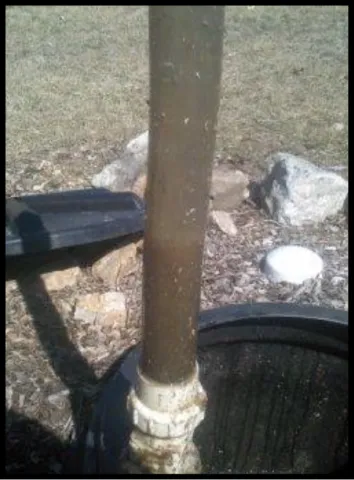
Regular MAINTENANCE is essential for getting the best performance from your septic tank system. If too much SLUDGE and SCUM are allowed to accumulate in the tank, the incoming WASTEWATER does not have adequate time to settle, causing solids to flow into the soil treatment system and clog dispersal trenches. If clogging occurs, WASTEWATER can overflow onto the ground surface or backup into the house, where it exposes people and animals to disease-causing organisms. To prevent this from happening, it is important to inspect your tank regularly and have it serviced when needed. Septic tanks should have INSPECTION access over the inlet and outlet tees/baffles. All tanks have manholes for inspecting and pumping; minor excavation work may be needed to uncover the manhole.
Inspections
Septic tanks must be inspected at least every two years. If the system has an EFFLUENT screen or the system serves a non-residential establishment, the tank should initially be inspected at least annually. The INSPECTION may be conducted by the homeowner, a REGISTERED ONSITE WASTEWATER TREATMENT SYSTEM PROFESSIONAL, or other qualified SERVICE PROVIDER. The INSPECTION should include assuring:
- The septic tank is structurally sound with no corrosion, cracking, or missing parts;
- There are no signs of water intrusion;
- The septic tank, risers, manhole, access ports, lids, and covers are watertight;
- Lids and covers are locked or otherwise secured to prevent accidental entry;
- The inlet and outlet tees or baffles are in good condition and functioning properly;
- If present, EFFLUENT screens are in good condition and not clogged; and
- The SCUM and SLUDGE layers are at an acceptable thickness.
Maintenance - Pumping

Correctly sized septic tanks are designed to accumulate solids for several years under normal conditions. As solids fill up the tank, WASTEWATER has less time to separate properly and solid particles could flow out of the tank in- to the dispersal trenches. If the tank is not peri- odically pumped out, these solids will enter the soil treatment system; clogging the system to a point that a new soil treatment area may be needed.
It is the responsibility of the homeowner or user of the septic tank system to contract with a REGISTERED ONSITE WASTEWATER TREATMENT SYSTEM PROFESSIONAL or other qualified SERVICE PROVIDER for the removal of the septic tank contents when needed. There are three main factors which determine the frequency at which a septic tank must be pumped:
- The liquid capacity of the tank;
- How much water flows through the system, usually related to the number of people in the household; and
- The volume of solids in the WASTEWATER, usually related to the use of a garbage disposal.
A septic tank must be pumped when the top of the SLUDGE layer is no closer than twelve inches below the bottom of the outlet tee or when the bottom of the SCUM layer is no closer than three inches above the bottom of the outlet tee. A typ- ical 1,000 gallon septic tank serving a three bed- room home may need to be pumped roughly eve- ry two to five years; if the home has a garbage disposal, the tank generally needs to be pumped twice as often.
A REGISTERED ONSITE WASTEWATER TREATMENT SYSTEM PROFESSIONAL or other qualified SERVICE PROVIDER is responsible for the proper treatment and disposal of all hauled WASTEWATER by transporting to a municipal sewage treatment plant capable of receiving the waste; transporting to a sludge handling facility which possesses a current and valid permit issued for such activity; or land applying under a current and valid permit for such activity.
Final Treatment and Dispersal
Although properly operated and maintained septic tanks are effective at providing primary treatment, the treatment is limited and WASTEWATER leaving the tank must receive further treatment before it is ready to be returned to the environment. Methods for final treatment and dispersal include discharge to a soil treatment system or a lagoon.
ADDITIVES
At some point, most system OWNERS consider the use of septic tank additives. However, sufficient bacteria for WASTEWATER treatment are naturally present in a septic tank and studies do not show a benefit to the use of additives. In fact, some additives may actually harm your system or pollute groundwater.
Warning Signs of System Malfunctioning
While proper use, INSPECTIONS, and MAINTENANCE should prevent most septic tank problems, it is still important to be aware of changes in your septic tank system and to act quickly if you suspect the system is MALFUNCTIONING. The most obvious onsite system failures are easy to spot.
- Surfacing SEWAGE, pooling water or muddy soil around your sewage tank, soil treatment system, or in your basement;
- Plumbing or septic tank backups;
- Slow draining fixtures;
- Gurgling sounds in the plumbing system;
- SEWAGE odors in the house or yard;
- Localized overgrowth of lush green grass in or near the soil treatment area; and/or
- Tests show the presence of bacteria in well water.

Onsite systems fail when partially treated WASTEWATER comes into contact with groundwater. This type of failure is not easy to detect, but can result in the pollution of wells, nearby streams, or other bodies of water.
If you notice any of these signs, or you suspect your septic tank system may be having problems, contact a qualified SERVICE PROVIDER or the local onsite WASTEWATER ADMINISTRATIVE AUTHORITY for assistance.
Septic Tank Do's and Don'ts
Proper OPERATION and MAINTENANCE of an onsite system can prevent costly repairs or replacement and can protect your property value. Observing the following recommendations will help to keep your system operating properly.
Do's
- Obtain the necessary permits from the appropriate ADMINISTRATIVE AUTHORITY before making any repairs.
- Use REGISTERED ONSITE WASTEWATER TREATMENT SYSTEM PROFESSIONALS and qualified SERVICE PROVIDERS.
- Conserve water to avoid overloading the onsite system, use high-efficiency fixtures and promptly repair any leaky faucets or toilets.
- Have your septic tank inspected annually if it has an EFFLUENT screen or every two years if it does not.
- Have your septic tank pumped routinely. Pumping your septic tank when needed may be the single most important thing you can do to protect your soil treatment system and your investment.
- Contact a qualified SERVICE PROVIDER if you experience problems with your system, such as surfacing WASTEWATER in your yard or other warning signs the system may be MALFUNCTIONING.
- Keep detailed records regarding the system, its location, make/model, contract service agreement, service visits, and MAINTENANCE performed.
- Use commercial bathroom cleaners and laundry detergents in moderation and only according to manufacturer’s directions.
- Keep your septic tank accessible for INSPECTIONS and pumping; yet locked or otherwise secured to prevent accidental entry.
- Have your private water well tested periodically or if you experience any warning signs of the system MALFUNCTIONING (contact your local public health agency).
Don'ts
- Don’t enter a septic tank. Poisonous gasses or a lack of oxygen can be fatal.
- Your septic tank system is not a trash can. Don’t put dental floss, feminine hygiene products, flushable wipes, condoms, diapers, cotton swabs, cigarette butts, coffee grounds, cat litter, paper towels, paint, pesticides, or other hazardous chemicals into your system.
- Don’t use caustic drain openers for a clogged drain. Instead, use boiling water or a drain snake to open clogs.
- Don’t drive or park vehicles or allow livestock on any part of your septic tank system. Doing so can compact the soil in your soil treatment area or damage the pipes, tank, or other onsite system components.
- Don’t build over any part of your septic tank system; this includes patios, carports, and other structures.
- Don’t attempt to pump your own septic tank; use the services of a qualified SERVICE PROVIDER.