
3.00 Available Home and Community Based Services
Home and Community Based Services Manual
3.00 Available Home and Community Based Services
Revised - June 2025
Home and Community Based Services (HCBS) are designed to assist in meeting the unmet needs of the participant and provide the necessary assistance to remain in the least restrictive environment. As part of the development of a Person Centered Care Plan (PCCP), services shall be authorized which appropriately relate to the unmet needs of the participant, in accordance with provider availability and program eligibility. Individuals are not eligible to receive HCBS while residing in hospitals, Intermediate Care Facilities (ICF), or Skilled Nursing Facilities (SNF). HCBS are authorized for reimbursement through Medicaid for participants who meet specific program eligibility requirements. Medicaid funded HCBS are available through either State Plan services or through a Home and Community Based Waiver. States can choose to include certain HCBS in the State Plan Medicaid program or through a Waiver with the United States Department of Health and Human Services (DHHS), Centers for Medicare and Medicaid Services (CMS).
- State Plan Services are administered under the authority of TXIX of the Social Security Act.
- Home and Community Based Waivers are authorized under the authority in §1915(c) of the Social Security Act. Waivers give states the flexibility to develop and implement alternatives for individuals at risk of being institutionalized. States can design each Waiver program and select the mix of services that best meets the needs of the population they wish to serve. HCBS, with oversight responsibility within the Department of Health and Senior Services (DHSS), Division of Senior and Disability Services (DSDS), are available through the Aged and Disabled Waiver, Adult Day Care Waiver, and the Independent Living Waiver. Medicaid participants can receive services through only one Medicaid Home and Community Based Waiver at a time, regardless of the state agency administering the Waiver.
- A complete listing of HCBS limits, units, and rates is located in the Services Units and Rates policy.
The Department of Social Services (DSS), MO HealthNet Division (MHD) is the single state Medicaid agency charged with the overall management and oversight of Medicaid programs in Missouri. MHD grants administrative program authority through cooperative agreements with other state agencies.
The following policies shall assist in determining the appropriate HCBS:
- 3.05 Basic Personal Care - State Plan (Agency Model)
- 3.10 Advanced Personal Care - State Plan (Agency Model)
- 3.15 Authorized Nurse Visit - State Plan (Agency Model)
- 3.20 Residential Care Facility/Assisted Living Facility (RCF/ALF) Personal Care - State Plan
- 3.25 Personal Care Assistance - State Plan (Consumer-Directed Model)
- 3.31 Adult Day Care Waiver
- Aged and Disabled Waiver
- 3.35 Chore
- 3.40 Home Delivered Meals
- 3.45 Homemaker
- 3.50 Respite (Basic and Advanced)
- 3.55 Adult Day Care
- 3.55 Independent Living Waiver
- Personal Care Assistance - Consumer Directed Model
- Financial Management Services
- Case Management
- Environmental Accessibility
- Specialized Medical Equipment
- Specialized Medical Supplies
- 3.60 Structured Family Caregiving Waiver
- 3.70 Social Services Grant General Revenue Protective Services Participants
- 3.00 Appendix 1 Home and Community Based Services Units and Rates
- 3.00 Appendix 2 Home and Community Based Services Cost Maximums
- 3.25 Appendix 1 Consumer Directed Services Tax Information
- 3.55 Appendix 2 Waiting List Notice for Independent Living Waiver Services
3.05 Basic Personal Care – State Plan (Agency Model)
Home and Community Based Services Manual
3.00 Available Home and Community Based Services
Revised - June 2025
Introduction
Agency Model Personal Care (PC) services are medically oriented tasks provided as an alternative to nursing facility care and designed to meet the maintenance needs of individuals with chronic health conditions. PC services must be reasonable according to the participant's condition and functional capacity. Home and Community Based Services (HCBS) providers enrolled as PC providers with the Department of Social Services (DSS), Missouri Medicaid Audit and Compliance Unit (MMAC) deliver the services.
Purpose
Agency Model PC services are funded through the Medicaid State Plan and are designed to assist with activities of daily living (ADL) and/or instrumental activities of daily living (IADL). They are provided as an alternative to nursing facility placement to persons for adults and individuals with disabilities. PC is also provided in a Residential Care Facility (RCF) or Assisted Living Facility (ALF).
Eligibility
All participants must meet the following eligibility criteria:
- At least 18 years of age
- In active Medicaid status (Medicaid Eligibility)
- Participants who are eligible for Medicaid on a spenddown basis may be authorized to receive PC during periods when they meet their spenddown liability.
- A participant is responsible for the cost of services received during periods of time when they have not met their spenddown liability.
- Participants who receive Medicaid due to eligibility for Blind Pension (BP) may be authorized for PC.
- Participants in a ‘Transfer of Property penalty’ may be authorized for PC.
- Authorization of PC does not meet the requirements for an individual to be eligible for Home and Community Based (HCB) Medicaid.
- Have an appropriate Medicaid Eligibility (ME) code.
- Meet nursing facility level of care.
Authorization
PC units shall be authorized as outlined below:
- Authorized in 15-minute units
- Consistent with the PC tasks to be completed on a regular basis
- Reasonable for the amount of PC units authorized
When developing a Person Centered Care Plan (PCCP) the following shall be taken into consideration:
- PC shall be included in the overall cost of care for the participant as referenced in the HCBS Cost Maximums policy
- PC services shall not exceed 60% of the cost maximum
- The combination of agency model PC and CDS shall not exceed 60% of the cost maximum.
The 60% cost maximum can be exceeded by the cost of APC and RN visits, but only up to the full monthly cost of 100%.
NOTE: When the PCCP includes an authorization for RN services, the cost of one RN visit shall be excluded from the calculation of a PCCP’s cost.
- When the combination of PC, other State Plan services, and an HCBS Waiver e.g., Aged and Disabled Waiver (ADW) or Independent Living Waiver (ILW) exceeds 100% of the monthly cost maximum, approval is required from the Bureau of Federal Programs (BFP).
- The appropriate supervisor for the Division of Senior and Disability Services (DSDS) staff shall review all PCCP requests over the 100% cost maximum to ensure the participant’s unmet needs require the amount of service requested.
- If documentation supports the request, the case shall be forwarded to BFP for consideration and approval prior to authorization over 100% of the cost cap.
- Pending the approval from BFP to exceed the cost maximum, PC services in combination with other State Plan or ADW or ILW services can be authorized up to 100% of the cost maximum.
When a PCCP includes Adult Day Care authorized through the ADW or the Adult Day Care Waiver (ADCW), the total cost of care cannot exceed 100% of the cost maximum.
NOTE: Pursuant to federal guidelines, a participant can only be enrolled in one HCBS waiver at a time, regardless of which department administers the waiver program.
Restrictions
The following outlines guidance to adhere to:
- The individual providing the service is an employee of the HCBS provider and cannot be a member of the immediate family of the participant. An immediate family member is defined as a parent, sibling, child by blood, adoption, or marriage (step-child), spouse, grandparent or grandchild.
- Participants authorized for certain services through the Department of Mental Health (DMH) may not be eligible for services as outlined in this policy. Staff shall refer to the DMH Service Coordination policy for guidance on coordination of services for participants authorized for DMH services.
Tasks
Suggested times and frequencies have been developed with the care needs of an average or typical participant in mind. In the development of the PCCP, consideration shall be given regarding the size of the home, geographic location, specific participant limitations, formal and informal supports, and other factors that might affect the amount of time necessary to complete required tasks.
PC services may include any of the following tasks:
Dietary
Assistance with meal preparation and cleanup and assistance with eating/feeding. Consideration shall also be given to the participant’s ability to prepare a light meal such as sandwiches, soups, and salads and/or the availability of home-delivered meals. (Suggested time 10-60 minutes – Suggested frequency 1-7 x/week)
Dressing/Grooming
Assistance with dressing and grooming including help with dressing and undressing, combing hair, nail care, oral hygiene and denture care, and shaving. (Suggested time 15 minutes – Suggested frequency 1-7 x/week)
Bathing
Assistance with bathing, including shampooing hair. (Suggested time 30-45 minutes – Suggested frequency 1-7 x/week)
Toileting/Continence
Assistance in going to the bathroom and changing bed linen. May also include the changing of bed linens for participants with medically related limitations that prohibit the completion of this task. Mobility and transfer to the bathroom should be included and delivered as needed. (Suggested time 5-10 minutes – Suggested frequency as needed)
Mobility/Transfer
Assistance with transfer and ambulation when the participant can at least partially bear their own weight. Actual lifting of the participant is not an appropriate task. (Suggested time 5-10 minutes – Suggested frequency as needed).
Self-Administration of Medications
Assistance with self-administration of medication and applying nonprescription topical ointments or lotions.
- Self-administration of medication is defined in 19 CSR 30-83.010 (46) as the act of actually taking or applying medication to oneself. For example, the time spent handing the medication container and water to the participant so the participant can self-administer their medications would be appropriately calculated in the time for this task. (Suggested time 1 unit/day for self-administration of medications taken up to 3 times daily; 2 units/day for medications taken 4 or more times daily)
- Refer to the RCF/ALF Personal Care – State Plan (Agency Model) policy for self-administration of medication in a RCF/ALF setting.
Medically Related Household Tasks
Includes the tasks outlined under Homemaker (ADW) services.
NOTE: Encouragement (prompting and cueing) and instruction of participants in self-care may be a component of the tasks described above; however, encouragement and instruction do not constitute a task in and of themselves.
3.10 Advanced Personal Care - State Plan (Agency Model)
Home and Community Based Services Manual
3.00 Available Home and Community Based Services
Revised - March 2025
Introduction
Advanced Personal Care (APC) (Agency Model) services are maintenance services provided in a participant’s home to assist with activities of daily living (ADL) when this assistance requires devices and procedures related to altered body functions.
Purpose
The authorization of APC services is funded through the Medicaid State Plan. These medically oriented services are designed to meet the physical and maintenance needs of participants with chronic and stable conditions. APC may also be provided in a Residential Care Facility (RCF) or Assisted Living Facility (ALF) through State Plan (Agency Model).
Eligibility
All APC participants must meet the following eligibility criteria:
- At least 18 years of age
- Meet nursing facility level of care (LOC)
- In active Medicaid status:
- Participants eligible for Medicaid on a spenddown basis may be authorized to receive APC when they meet their spenddown liability.
- A participant is responsible for the cost of services received during periods of time when they have not met their spenddown liability.
- Participants who receive Medicaid due to eligibility for Blind Pension (BP) may be authorized for APC.
- Participants in a ‘Transfer of Property penalty’ may be authorized for APC.
- Authorization of APC does not meet the eligibility requirements for an individual for Home and Community Based (HCB) Medicaid.
- Have an appropriate Medicaid Eligibility (ME) Code
Authorization of APC
When authorizing APC, the following shall apply:
- APC shall be authorized in increments of 15-minute units
- APC units shall be consistent with the APC tasks to be completed regularly
- The number of APC tasks identified shall be reasonable for authorized APC units
- APC shall be included in the overall monthly cost of care
- APC is provided by HCBS providers enrolled as a Personal Care-Agency Model provider.
- The APC staff is an employee of the HCBS provider and cannot be a member of the immediate family of the participant. An immediate family member is defined as a parent, sibling, child by blood, adoption, or marriage (stepchild), spouse, grandparent, or grandchild.
Cost Maximum
APC authorized together with other Medicaid State Plan Home and Community Based Services (HCBS) and Aged and Disabled Waiver (ADW), services shall not exceed 100% of the average statewide monthly cost for care in a nursing facility without prior approval of the Bureau of Federal Programs (BFP).
- If the documentation supports the request, the case shall be forwarded to BFP for consideration and approval before authorization over 100% of the cost cap
- Pending BFP approval to exceed the cost cap, APC services, combined with other State Plan or ADW services, can be authorized up to 100% of the cost cap
- When a PCCP includes Adult Day Care authorized through the ADW or the Adult Day Care Waiver (ADCW), the total cost of care cannot exceed 100% of the cost cap
NOTE: When the care plan includes RN services, the cost of one RN visit shall be excluded from calculating a care plan’s cost. When the combination of State Plan and ADW services exceeds the 100% cost maximum, the appropriate supervisor for the Division of Senior and Disability Services (DSDS) staff shall review all person-centered care plan (PCCP) requests over the 100% cost cap to address the participant’s unmet needs.
Restrictions
Participants authorized for certain services through the Department of Mental Health (DMH) may not be eligible for services as outlined in this policy. Staff shall refer to the Service Coordination Policy for guidance on coordinating services for participants authorized for DMH services.
Allowable Services
Participants who meet eligibility requirements may be authorized for any of the following services:
- Aseptic Dressings: (Suggested time 15 minutes per ordered instance)
- Application of dressings to superficial skin breaks or abrasions as directed by a licensed nurse
- Application of medicated (prescription) lotions and ointments to unbroken skin, including stage 1 decubitus
- Assistance with Transfer Device: (Suggested time 15 minutes per instance)
- Use of an assistive device for transfers
- Bowel/Bladder Program: (Suggested time 15 minutes per ordered instance)
- Administration of prescribed bowel programs, including suppositories and sphincter stimulation per protocol and prepackaged enemas for participants without contraindicating rectal or intestinal conditions
- Catheter Hygiene: (Suggested time 15 minutes per instance)
- Changing of bags, soap and water hygiene around the site of external, indwelling, and suprapubic catheters
- Removal of external catheters, skin inspection, and catheter reapplication
- Non-Injectable Medications: (Suggested time 15 minutes per ordered instance)
- Manual assistance with non-injectable medications may include opening a medicine lockbox, steadying the participant’s hand/arm for ear and eye drops, finger sticks for blood sugar monitoring and reading levels and when prompting is required to take medication
- Ostomy Hygiene: (Suggested time 15 minutes per instance)
- Changing of bags, soap and water hygiene around a well-healed ostomy site (including tracheostomies, gastrostomies, and colostomies)
- Passive Range of Motion: (Suggested time 15 minutes per ordered instance)
- Administration of movement of a joint through its full range of motion, delivered in accordance with the care plan
NOTE: Encouragement (prompting and cueing) and instruction of participants in self-care may be a component of the task; however, encouragement and instruction do not constitute a task in and of themselves.
3.15 Authorized Nurse Visits – State Plan (Agency Model)
Home and Community Based Services Manual
3.00 Available Home and Community Based Services
Revised - July 2026
Introduction
Nurse visits are provided by Home and Community Based Services (HCBS) providers participating in the Personal Care Agency Model for participants authorized for Personal Care (PC), Advanced Personal Care (APC), or Consumer Directed Services (CDS) services. During visits, the nurse may assess the participant’s health, review the care plan, supervise the personal care aide, or provide maintenance or preventive services. Concerns or changes in the participant’s condition are communicated to the participant, the aide, and DSDS staff. When needed, the nurse recommends updates to the care plan to support the participant’s safety and ability to remain at home. These visits offer ongoing monitoring for individuals with stable, chronic conditions and are not intended to replace services that should be provided through home health care.
Eligibility
To be eligible for nurse visits, all participants must meet the following criteria:
- At least 18 years of age
- Have an appropriate Medicaid Eligibility (ME) code
- Meet nursing facility level of care
- In active Medicaid status
- Participants who are eligible for Medicaid on a spenddown basis may be authorized to receive nurse visits during periods when they meet their spenddown liability.
- A participant is responsible for the cost of services received during periods of time when they have not met their spenddown liability.
- Participants who are eligible for Medicaid on a spenddown basis may be authorized to receive nurse visits during periods when they meet their spenddown liability.
In addition, participants who receive Medicaid due to eligibility for Blind Pension (BP) or are in a ‘Transfer of Property penalty’, may be authorized for nurse visits.
NOTE: The authorization of nurse visits does not meet the requirement for an individual to be eligible for Home and Community Based (HCB) Medicaid.
Authorization
The following criteria outlines the process for authorizing nurse visits:
- Nurse visits shall be authorized by the visit, not in 15-minute increments
- No minimum or maximum time is required to constitute a visit.
- Nurse visits are typically authorized by combining individual nursing tasks into the same nurse visit; however, they can be separated if there is a justified need
- The nurse is an employee of the HCBS provider and cannot be a member of the immediate family of the participant
- An immediate family member is defined as a parent, sibling, child by blood, adoption, or marriage (stepchild), spouse, grandparent or grandchild.
- A maximum of 26 nurse visits will only be provided in a six-month authorization period
- Authorized nurse visits reimbursed through the HCBS program shall not include nursing services that should be billed to another program (i.e., home health or skilled nursing services), or visits made to determine if a participant qualifies for HCBS services.
- When a service need is detected that requires skilled nursing care, the provider shall forward information to the participant's physician. The physician may then issue home health orders as appropriate.
- Participants authorized for certain services through the Department of Mental Health (DMH) may not be eligible for services as outlined in this policy
- DSDS staff shall refer to the DMH Service Coordination policy for guidance on coordinating services for participants authorized for DMH services.
NOTE: When a provider change occurs, the new provider shall only be authorized for the nurse visit(s) remaining within an existing authorization period.
Cost Maximum
Authorized nurse visits shall be included in the overall cost of care (HCBS Cost Maximums) with the following exceptions:
- The cost of authorized nurse visits is not included in the 60% monthly maximum cost for basic PC
- The cost of one (1) authorized nurse visit is not included in the 100% monthly cost for basic PC
- The cost of two nurse visits shall be excluded from the calculation of a PCCP cost when nurse visits are authorized for General Health Evaluations (GHE) only
NOTE: The electronic case record system will automatically exclude the nurse visit(s) from the calculation of the PCCP.
- Nurse visits authorized together with other Medicaid State Plan HCBS, i.e., Agency Model PC, CDS, Advanced Personal Care (APC), and Aged and Disabled Waiver Services (ADW) shall not exceed 100% of the monthly cost for care in a nursing facility without prior approval from the Bureau of Federal Programs (BFP)
- When the combination of State Plan and ADW services (excluding Adult Day Care) exceeds the 100% cost maximum:
- The appropriate supervisor for DSDS staff shall review all PCCP requests to ensure unmet needs require the amount of service requested.
- If documentation supports the request, it shall be forwarded to BFP for consideration and approval prior to authorizing over 100% of the cost maximum.
- Authorized nurse visits in combination with other state plan or ADW services can only be authorized up to 100% of the cost maximum until approval is given by BFP to exceed the 100% maximum.
- When the combination of State Plan and ADW services (excluding Adult Day Care) exceeds the 100% cost maximum:
NOTE: When a PCCP includes Adult Day Care, authorized through the ADW or the Adult Day Care Waiver (ADCW), the total cost cannot exceed 10cds0% of the cost maximum.
General Health Evaluations
All participants receiving Agency Model PC and APC shall be authorized a minimum of two (2) nurse visits annually to perform General Health Evaluations (GHE) as required by MO State Statute 192.2475.14 RSMo. The semi-annual nurse visits are necessary for the delivery and supervision of the individual providing services to ensure quality of care, assessment of the participant’s health, and adequacy of the participant’s PCCP.
Excluded from the requirement for semi-annual nurse visits are those participants authorized for:
- Personal Care Services (Agency Model) in a Residential Care Facility (RCF) or Assisted Living Facility (ALF)
- Aged and Disabled Waiver services only
- Personal Care Assistance (Consumer-Directed Model) only
- Independent Living Waiver only
- Adult Day Care Waiver only
- Structured Family Caregiving Waiver
Participants with a documented need for other nursing tasks shall not be authorized for separate semi-annual nurse visits. DSDS or its designee shall inform the provider that the General Health Evaluation (GHE) and Level of Care Recommendation form shall be completed during the regularly scheduled nurse visit in the 4th and 10th months following the (re)assessment, as outlined in the General Health Evaluation Chart below.
When authorizing the GHEs in the electronic case record, select only the first month of the GHE. The second month will automatically populate.
DSDS or its designee shall review the GHEs to help guide assessment and care planning processes. If the participant is identified as needing a change in their care plan, whether an increase or decrease in services, the nurse shall notify the Person Centered Care Planning team of the recommended changes.
General Health Evaluation Chart | ||
|---|---|---|
Month of Assessment | 4th Month | 10th Month |
| January | April | October |
| February | May | November |
| March | June | December |
| April | July | January |
| May | August | February |
| June | September | March |
| July | October | April |
| August | November | May |
| September | December | June |
| October | January | July |
| November | February | August |
| December | March | September |
Regular Nurse Visits
For authorized nurse visits other than the required semi-annual GHE visits, DSDS or its designee must verify and document that no other person is willing and able to provide the service. Such documentation may include, but is not limited to:
- Participant lives alone
- Lack of capable family support
- Unwillingness/incapability of other available individuals to provide the needed services
- Resident of RCF or ALF requires services beyond what is normally included in the monthly room and board reimbursement to the facility, RCF/ALF PC
In addition to increased supervision of the aide, and assessment of the participant’s health and adequacy of the care plan, authorized nurse visits may also include the following:
- Medications
- Filling insulin syringes weekly for diabetics who can self-inject the medication but cannot fill their own syringes.
- Documentation must be sufficient to establish that the participant has a diabetic condition impairment that prevents the participant from independently filling syringes.
- Oral medication set-ups in divided daily compartments for participants who self-administer prescribed medications but need assistance and monitoring due to confusion or disorientation.
- Documentation must be sufficient to establish the need for medication and that the participant is disoriented or confused. Although self-control of prescription and over-the-counter medications may be allowed in an RCF or ALF with written permission from the resident’s physician and allowed by facility policy, this task would not be applicable for RCF and ALF residents who are authorized for Personal Care in an RCF or ALF.
- Filling insulin syringes weekly for diabetics who can self-inject the medication but cannot fill their own syringes.
- Monitoring Skin Condition
- Check for possible skin breakdown due to immobility, incontinence, or other needs as described below.
- Unable to turn and position self
- Limited ability to ambulate, with long periods of time sitting or lying in one position, or is documented to be incontinent
- History of decubitus ulcers, poor circulation evidenced by edema or discolored extremities, and diabetes
- Documentation must be sufficient to establish the participant is at risk of skin breakdown.
- Check for possible skin breakdown due to immobility, incontinence, or other needs as described below.
- Nail Care
- Monthly visits to provide nail care for diabetic participants or participants with other medically contraindicating conditions, including but not limited to participants:
- Taking anticoagulant medication, such as Coumadin
- Diagnosed with peripheral vascular disease
- Diagnosed with a condition causing foot or nail deformities that need specialized treatment
- Diagnosed with a compromised immune system (e.g. HIV and chemotherapy patients)
- Documentation shall be sufficient to establish the participant has a medical condition AND is unable to perform this task.
- Monthly visits to provide nail care for diabetic participants or participants with other medically contraindicating conditions, including but not limited to participants:
Other Nursing Care
Participants may receive nurse visits for specific tasks when their needs cannot be met and are not reimbursable through the home health program. DSDS or its designee shall approve nurse visits for “other” non-routine nursing tasks after consultation with the participant, provider nurse, DSDS supervisor and, as necessary, the physician.
The “other” nursing tasks may include, but are not limited to:
- Administration of injectable medications (other than insulin)
- Venipunctures
- Catheter changes
- Enemas (only when not utilizing a prepackaged enema)
- Wound dressing changes
- Central line dressing/flush/blood draws
Providers with written documentation should upload it to the participant’s electronic case record and include documentation in case notes.
NOTE: It is not necessary for DSDS or its designee to obtain copies of a physician’s orders prior to the authorization of a nurse visit or adding a task to a nurse visit.
Advanced Personal Care
All APC participants shall be authorized for a monthly nurse visit to evaluate the adequacy of service delivery and ensure the participant's needs and conditions are met. All APC participants shall be authorized for a monthly nurse visit to evaluate the adequacy of service delivery and ensure the participant's needs and conditions are met. APC aides providing the services shall be trained in the APC tasks they deliver. During the monthly visit, the nurse assesses the APC aide’s ability to carry out the services.
If a participant is not authorized for weekly nurse visits, an additional nurse visit shall be authorized during the first full month of the APC aide's on-the-job training. DSDS staff or its designee shall select the Train APC task for the one-time visits.
Participants who receive weekly nurse visits shall not have the Train APC task selected. In these circumstances, the Train APC should be authorized as an RN visit for the one-month authorization period. The task should be performed by the nurse during the regular nurse visit as needed.
The Train APC task is to be completed as follows:
- Once during the first full month of an initial authorization of APC, or following the addition of an APC task to the care plan
- At the time of an APC provider change
- When requested by the provider (e.g., when aides change), to provide on-the-job training of the APC aide
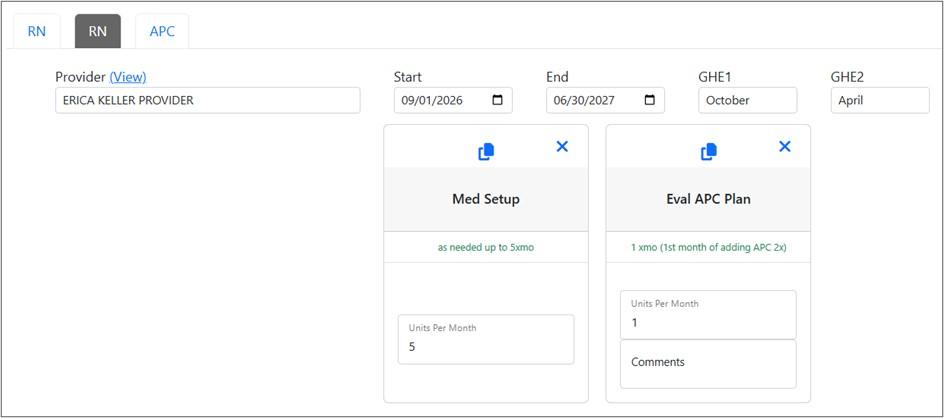
When developing the PCCP, two RN visits must be added as outlined:
- One unit is entered for Train APC and two units for Eval APC
- The Evaluate APC task must be authorized for two units during the first month to allow the provider to bill separately for both the training and the evaluation of the APC aide, as these will occur during two separate visits.
NOTE: To prevent duplicate prior authorizations, the start and end dates of each authorization must not overlap.
Example Of APC Authorization With A Monthly RN Visit
1st RN Authorization

2nd RN Authorization

Example Of APC Authorization With Weekly RN Visit
1st RN Authorization

2nd RN Authorization

Example Of APC Authorization With No Monthly Or Weekly Nurse Visits
1st RN Authorization

2nd RN Authorization
3.20 RCF/ALF Personal Care – State Plan (Agency Model)
Home and Community Based Services Manual
3.00 Available Home and Community Based Services
Revised - March 2026
Introduction
Personal Care (PC) services are maintenance services provided to residents of Residential Care Facilities (RCF) or Assisted Living Facilities (ALF) to assist with activities of daily living (ADL). Services are authorized to eligible residents when the resident's needs exceed the facility's minimum obligations as established in the licensure requirements.
RCFs or ALFs are responsible, at a minimum, for the basic human needs of its residents. The facilities are also responsible for assuring the resident's PC needs are met through the resident's resources or other available resources. The facilities are responsible for 24-hour protective oversight of residents and room and board. The reimbursement the facility receives from the resident (Supplemental Security Income (SSI), Social Security Administration (SSA), etc.) and a supplemental cash grant from the Department of Social Services (DSS) is intended to cover safe shelter needs (including housekeeping, basic linens, and the maintenance thereof) and nutritional needs (food and food preparation).
Purpose
RCF/ALF Personal Care services are designed to support residents' additional needs in this setting and are funded through Medicaid State Plan. Basic Personal Care, Advanced Personal Care and Authorized Nurse Visits are all allowable service types offered to residents with an identified need that goes above and beyond the facility's basic requirements.
Eligibility
All PC participants must meet the following eligibility criteria to receive services in an RCF/ALF:
- At least 18 years of age
- In active Medicaid status:
- Participants eligible for Medicaid on a spenddown basis may be authorized to receive services during periods they meet their spenddown liability.
- A participant is responsible for the cost of services received during periods of time when they have not met their spenddown liability.
- Participants who receive Medicaid due to eligibility for Blind Pension (BP) may be authorized for services in the RCF or ALF.
- Participants in a ‘Transfer of Property penalty’ may be authorized for services in the RCF or ALF.
- Have an appropriate Medicaid Eligibility (ME) Code.
- Meet nursing facility level of care (LOC)
Referrals
Referrals for PC services shall be made to the Department of Health and Senior Services (DHSS), Division of Senior and Disability Services (DSDS). DSDS shall screen and process the referral as appropriate, utilizing the same timeframes as all other HCBS.
HCBS participants requesting PC services may make a referral by contacting the HCBS Customer Service Center. Providers should initiate referrals by utilizing the Online HCBS Referral Form. In instances when referrals cannot be submitted online, referrals can be submitted by completing the Home and Community Based Services Referral Form. In addition to the referral forms, referrals may include a Physician’s Prescription for Personal Care.
Assessment
When arriving at an RCF/ALF and completing a (re)assessment, DSDS staff or its designee shall:
- Announce themselves to facility staff and indicate the intent of the visit before meeting with the current or potential participant
- Document the room condition where the current or potential participant resides in case notes
- DSDS or its designee must review the participant’s facility chart to verify information that will assist in determining the (LOC) and assistance needed. Items to verify include but are not limited to:
- Diagnosis and frequency of mental health physician visits
- Physician-ordered treatments, medications, or special diets the participant receives
- Make other collateral contacts, including, but not limited to, RCF or ALF staff (Administrator/manager, licensed nurse, PC aide who provides daily services), family, friends, legal representatives, or physicians to obtain information to complete the assessment process
- Make decisions regarding the authorization of PC services in consultation and agreement with the participant, the participant’s legal representative (if applicable), and the participant’s physician
- Ensure the services authorized shall reinforce and enhance the participant's current formal and informal support system
- Reimbursement for PC services cannot duplicate what is covered in other reimbursements to the facility (e.g., routine linen changes and meal preparation).
Authorization
RCF/ALF PC services are also governed by the average statewide monthly cost for care in a nursing facility. PC units shall be authorized as outlined below:
- PC services shall not exceed 60% of the cost maximum
- The 60% cost maximum can be exceeded by the cost of APC and RN visits, but only up to the full monthly cost of 100%
- All combined PC services shall not exceed 100% of the average statewide monthly cost for care in a nursing facility
NOTE: When the care plan includes authorization for RN services, the cost of one RN visit shall be excluded from the calculation of a care plan’s cost.
Tasks
Residents who meet the necessary Medicaid eligibility requirements may be authorized for any of the following combinations of services provided.
Basic Personal Care
Basic Personal Care (PC) services in RCF/ALF shall be authorized in 15-minute units and are generally medically oriented tasks designed to meet the physical and maintenance needs of participants with chronic, stable conditions. PC may include the following tasks:
- Bathing
- Direct assistance with bathing and shampooing hair that requires active participation by the aide. (e.g., hands-on washing assistance, assistance in or out of the bath, gathering supplies/clean clothing, etc.) (Suggested time 15-45 minutes per bath)
- Dietary
- Direct assistance with meal preparation, feeding and clean up. Dietary shall be authorized when the participant has a physician-ordered specialized diet. Dietary may also be authorized if the participant needs assistance with feeding, cutting up food, carrying a tray to the table, opening containers, etc. Authorization of service units must be based on the participant’s specific needs. (Suggested time 15 minutes per meal)
- DSDS or its designee shall review any physician-ordered diet before authorizing units for dietary needs. No units shall be authorized for meal preparation and clean-up unless facility staff exceeds licensure requirements.
- Dressing/Grooming
- Direct assistance with dressing and undressing, combing hair, nail care, oral hygiene, shaving, and assisting with prosthetics. (Suggested time 15 minutes per dressing instance)
- Essential Correspondence
- Direct assistance with reading, writing, or managing necessary paperwork/communications for a participant who is unable to do so independently. (Suggested time 15 minutes – Suggested frequency 1 x/week)
- Examples include:
- Reading and responding to mail: Assisting with official mail, such as letters from Social Security, Medicare, Medicaid, or bank statements.
- Bill paying: Assisting with organizing, writing checks, or facilitating online payments.
- Managing medical correspondence: Reading and responding to letters from physicians or health care providers regarding appointments, lab results, or care plans. Assisting with the setup of virtual appointments.
- Completing forms: Assisting with filling out applications for benefits or other necessary documents.
- Medically Related Household Tasks
- Assistance with required cleaning that goes above and beyond the minimum housekeeping requirements of the facility. Time may be authorized if the participant has a medically related need that requires the facility staff to clean a resident’s living area more often than usual (e.g. profuse bodily secretions, excess bodily fluids from incontinence, destructive tendencies, hoarding, etc.). DSDS or its designee can authorize services to clean the resident’s living area and launder the resident’s clothes and linens. (Suggested time 15-minutes per instance)
- Mobility and Transfer
- Direct assistance with mobility, transfer, and ambulation when the participant can at least partially bear their weight. (Suggested time 5-10 minutes per instance)
- Self-Administration of Medications
- Direct assistance with medications and applying nonprescription topical ointments or lotions (e.g. the time spent handling the medication container, including inhalers, medicines for nebulizers, ointments/lotions, steadying the participant’s hand/arm to get oral medication and inhalants to mouth, and water to the participant. (Suggested time 1 unit/day for self-administration of medications taken up to 3 times daily; 2 units/day for medications taken 4 or more times daily)
- Medication administration is not a covered task within the PC program. The self-administration of medication task does not include the time required by facility staff to administer the medication. Administration of medication is defined in 19 CSR 30-86.042(51) as delivered to a resident their prescription medication either in the original pharmacy container or for internal medication, removing an individual dose from the pharmacy container and placing it in a small container or liquid medium for the resident to remove from the container and self-administer.
- Direct assistance with medications and applying nonprescription topical ointments or lotions (e.g. the time spent handling the medication container, including inhalers, medicines for nebulizers, ointments/lotions, steadying the participant’s hand/arm to get oral medication and inhalants to mouth, and water to the participant. (Suggested time 1 unit/day for self-administration of medications taken up to 3 times daily; 2 units/day for medications taken 4 or more times daily)
- Toileting
- Direct assistance with toileting tasks. This may include assistance using or transferring to/from the toilet, commode, bedpan, urinal, cleansing after use and assistance with incontinence episode(s) (The suggested time is 5 minutes multiplied by times per day based upon the suggested frequency needed).
- Encouragement (prompting and cueing) and instruction of participants in self-care may be a component of the services; however, encouragement and instruction do not constitute a task in and of themselves.
- Direct assistance with toileting tasks. This may include assistance using or transferring to/from the toilet, commode, bedpan, urinal, cleansing after use and assistance with incontinence episode(s) (The suggested time is 5 minutes multiplied by times per day based upon the suggested frequency needed).
Advanced Personal Care
Advanced Personal Care (APC) services shall be authorized in 15-minute units and are medically oriented tasks designed to meet the physical and maintenance needs of participants with a chronic, stable condition when such assistance requires devices and procedures related to altered body functions. APC may include the following tasks:
- Aseptic Dressings
- Application of dressings to superficial skin breaks or abrasions as directed by a licensed nurse. (Suggested time 15 minutes per ordered instance)
- Application of medicated (prescription) lotions and ointments to unbroken skin, including stage 1 decubitus. (Suggested time 15 minutes per ordered instance)
- Bowel Program
- Administration of prescribed bowel programs, including suppositories and sphincter stimulation per protocol and prepackaged enemas for participants without contraindicating rectal or intestinal conditions. (Suggested time 15 minutes per ordered instance)
- Catheter Hygiene
- Changing of bags, soap and water hygiene around the site of external, indwelling, and suprapubic catheters. (Suggested time 15- minutes per instance)
- Removal of external catheters, skin inspection, and catheter reapplication. (Suggested time 15- minutes per instance)
- Non-Injectable Medications
- Manual assistance with non-injectable medications, as set up by a licensed nurse, may include opening a medicine lockbox, steadying the participant’s hand/arm for ear and eye drops, finger sticks for blood sugar monitoring and reading levels and when prompting is required to take medication. (Suggested time 15 minutes per ordered instance)
- Ostomy Hygiene
- Changing of bags, soap and water hygiene around a well healed ostomy site (including tracheostomies, gastrostomies, and colostomies). (Suggested time 15- minutes per instance)
- Passive Range of Motion
- Administration of movement of a joint through its full range of motion, delivered in accordance with the care plan. (Suggested time 15 minutes per ordered instance)
Authorized Nurse Visits
Authorized Nurse Visits (RN) are authorized by the visit. No minimum or maximum time is required to constitute a visit. RN services are maintenance or preventative services provided by a Registered Nurse (RN) or a Licensed Practical Nurse (LPN) under an RN's or physician's direction.
Authorized Nurse Visit tasks may include:
- Evaluate APC Care Plan
- All APC participants shall be authorized for an RN visit monthly to evaluate the adequacy of the authorized services to meet the participant’s needs and assess the APC aide’s ability to carry out the authorized services.
- Other RN Care
- Monitor skin condition(s)
- Nail care: Monthly visits to provide nail care for diabetic participants or participants with other medically contraindicating conditions, including but not limited to participants:
- Taking anticoagulant medication
- Diagnosed with peripheral vascular disease
- Diagnosed with a compromised immune system
- Administration of injectable medications (other than insulin)
- Venipunctures
- Catheter changes
- Enemas (only when not utilizing a prepackaged enema)
- Central line dressing/flush/blood draws
3.25 Personal Care Assistance – State Plan (Consumer-Directed Service Model)
Home and Community Based Services Manual
3.00 Available Home and Community Based Services
Revised - January 2026
Introduction
Personal Care Assistance Consumer Directed Services (CDS) is a Home and Community Based Services (HCBS) program offered through the Division of Senior and Disability Services (DSDS). CDS is available to participants who can direct their own care and can live independently. CDS participants select an HCBS provider that is enrolled as a CDS provider with the Department of Social Services (DSS), Missouri Medicaid Audit and Compliance (MMAC) Unit. Payment is made to the HCBS provider on behalf of the participant. The HCBS provider processes payroll, on behalf of the participant, to the individual providing the services.
Authorization of Personal Care Assistance is funded through both the Consumer-Directed Model Medicaid State Plan and the Independent Living Waiver (ILW). This policy addresses State Plan services only. Refer to the ILW Policy for additional information regarding services through the ILW.
Purpose
CDS provides assistance with activities of daily living (ADL) and/or instrumental activities of daily living (IADL) provided as an alternative to nursing facility placement to persons with a physical disability.
Eligibility
All CDS participants must meet the following eligibility criteria:
- Be at least eighteen (18) years of age
- Be physically disabled, as defined by 19 CSR 15-8.100
- Loss of, or loss of use of, all or part of the body's neurological, muscular, or skeletal functions to the extent the person requires the assistance of another person to accomplish routine tasks.
- Be able to self-direct their CDS
- In active Medicaid status
- Participants eligible for Medicaid on a spenddown basis may be authorized to receive CDS during periods when they meet their spenddown liability.
- During periods when the participant has not met their monthly spenddown liability amount, the participant and provider may make a private arrangement for the continued delivery of services. In these instances, the participant is responsible for the cost of services received.
- Participants who receive Medicaid due to eligibility for Blind Pension (BP) may be authorized for CDS.
- Participants in a ‘Transfer of Property penalty’ may be authorized for CDS.
- Authorization of CDS does not meet the requirements for an individual to be eligible for Home and Community Based (HCB) Medicaid.
- Participants eligible for Medicaid on a spenddown basis may be authorized to receive CDS during periods when they meet their spenddown liability.
- Have an appropriate Medicaid Eligibility (ME) Code
- Meet nursing facility level of care (LOC)
- Have not been previously involved in Medicaid fraud
Self-Directed Determination
A current or potential CDS participant is required to have the ability to direct their care per 208.903.1.(4), RS Mo. Consumer directed is defined as the hiring, training, supervising, and directing of the personal care attendant. Section 208.909.1, RSMo states that current or potential participants must be able to fulfill the following responsibilities:
- Supervise the personal care attendant
- Verify the wages to be paid to the personal care attendant
- Monitor proper Electronic Visit Verification (EVV) usage
- Notify DSDS staff or its designee of any changes affecting the CDS Person-Centered Care Plan (PCCP) or the participant’s place of residence
- Report any problems resulting from the quality of services rendered by the personal care attendant to the participant’s provider
- It shall be reported to DSDS staff or its designee if the problem cannot be resolved through the provider.
- Report to DSDS significant changes in participant’s health and/or ability to self-direct their care
Documentation shall be provided in the participant’s electronic case record if it is determined that a current or potential participant requesting CDS cannot direct their care or fulfill the responsibilities of a CDS participant. Examples of documentation may include, but are not limited to:
- Responses to questions from the current or potential participant during the assessment process that need further clarification. Questions are to be posed to the current or potential participant.
- If another individual responds on behalf of the current or potential participant, this must be documented in the case notes.
- Completion of the Self Direction Assessment questions
- If the Self Direction Assessment Questions are utilized, answers to the questions shall be provided as an exhibit if the current or potential participant appeals the decision that they cannot self-direct services.
- Completion of the St. Louis University Mental Status (SLUMS) exam. This may be utilized when there is a concern regarding an individual’s ability to self-direct.
- The instructions to the SLUMS provide background information on the exam, clarifies when the exam shall be utilized, and defines further evaluation which must be pursued.
- Statements or medical records from the current or potential participant’s healthcare professional documenting any functional limitations preventing the individual from self-directing
- The Healthcare Professional Inquiry may be utilized when there are concerns regarding the current or potential participant’s ability to self-direct. The response received from the Healthcare Professional Inquiry shall be documented and uploaded to the electronic case record along with other self-direction determination documents if utilized.
If a thorough review of all available information has taken place and the current or potential participant cannot self-direct, Adverse Action procedures shall be followed, and DSDS staff or its designee shall advise that individual and/or the authorized representative of other available options. The Collateral Contacts Policy outlines the various services available through alternative HCBS. Current or potential participants shall be advised that Personal Care (PC) and Advanced Personal Care (APC) services are comparable to services available through the CDS program.
- DSDS staff or its designee shall document the discussions held regarding the availability of other services.
Restrictions and Limitations
CDS shall not be authorized to pay for services when:
- The primary benefit is to a household unit.
- The task is one that household members may reasonably be expected to share or do for one another unless the task is above and beyond typical activities provided for a household member without a disability.
- CDS does not include any task that must be performed/ trained by a licensed professional (i.e., skilled nursing, therapies ordered by a physician, etc.).
- A physically disabled person who can direct their care but has a cognitive impairment that requires a designated person to assist with the administration of the program can only be authorized through the ILW.
- Participants authorized for self-directed services through the Department of Mental Health (DMH) are not eligible for services as outlined in this policy. Staff shall refer to the Service Coordination Policy for guidance on coordinating services for participants authorized for DMH services.
- Individuals who reside in a nursing facility, Residential Care Facility (RCF) or Assisted Living Facility (ALF) licensed by DHSS, Division of Regulation and Licensure (DRL) are not eligible for CDS.
- The ‘CDS Restricted’ checkbox in the participant’s electronic case record has been checked. This box can be checked when:
- DSDS staff followed the procedures outlined in the Adverse Action policy and Appeal and Hearing Process. Services shall not be closed until the 10-day appeal time frame has passed, and the participant has not appealed, or until the Department of Social Services (DSS), Division of Legal Services (DLS) has made its final decision for the appeal hearing affirming the adverse action.
- As appropriate, all current authorization(s) for CDS shall be closed, and other HCBS that may meet the participant's needs have been offered to the participant, e.g., Agency Model.
- The attendant shall not:
- Have been involved in Medicaid fraud previously
- Be a current CDS participant
- Participants can exercise individual choice in deciding who provides their CDS. The CDS participant is the attendant’s employer-of-record.
- The attendant may be a family member. However, the attendant cannot be the participant’s spouse or legal guardian.
NOTE: An individual with a guardian or conservator cannot be rejected for CDS solely for that reason. Explanation for the need of a guardian or conservatorship can justify the reason to reject CDS due to cognitive inabilities to self-direct. DSDS staff or its designee shall obtain a copy of the appointment order.
Authorization
The following is an overview of CDS authorizations and tasks:
- CDS shall be authorized in 15-minute units
- CDS shall be included in the overall cost of care for the participant as referenced in the HCBS Cost Maximums policy
- CDS shall not exceed 60% of the cost maximum
- The combination of CDS and agency model PC shall not exceed 60% of the cost maximum.
- The 60% cost maximum can be exceeded by the cost of APC and RN visits, but only up to the full monthly cost of 100%.
NOTE: When the care plan includes RN services, the cost of one RN visit shall be excluded from the overall care plan cost.
- When the combination of CDS, other State Plan services, and an HCBS Waiver (e.g., Aged and Disabled Waiver (ADW) or ILW) services exceed the cost maximum by the cost of the waiver services:
- The appropriate supervisor for the DSDS staff shall review all PCCP requests over the 100% cost maximum to ensure the participant’s unmet needs require the amount of service requested.
- If documentation supports the request, the case shall be forwarded to the Bureau of Federal Programs (BFP) for consideration and approval prior to authorization over 100% of the cost maximum.
- Pending the approval from BFP to exceed the cost maximum, CDS in combination with other State Plan or ADW services can be authorized up to 100% of the cost maximum, excluding PC and/or CDS, which may never exceed 60% of the cost maximum.
NOTE: When a PCCP includes Adult Day Care authorized through the ADW or the Adult Day Care Waiver (ADCW), the total cost of care cannot exceed 100% of the cost maximum.
Under federal guidelines, a participant can only enroll in one (1) HCBS Waiver at a time, regardless of what agency administers the waiver program.
Tasks
CDS provides “hands-on” assistance with physical tasks that benefit the participant and are based on the participant's physical limitations. No time can be authorized for the following:
- Stand-by assistance, prompting, or cueing
- Respite care or for time spent waiting for a participant at any appointment
CDS may include any of the following tasks:
- Assistance with Transfer Device
- Use an assistive device for transfers
- Bathing
- Direct assistance with bathing and shampooing hair that requires active participation by the aide (e.g., hands-on washing assistance, assistance in or out of the bath, gathering supplies/clean clothing, etc.)
- Bowel/bladder
- o Administration of prescribed bowel programs, including the use of suppositories and sphincter stimulation per protocol and pre-packaged enemas for participants without contraindicating rectal or intestinal conditions
- Catheter hygiene:
- Changing bags and soap and water hygiene around the site of external, indwelling, and suprapubic catheters.
- Removal of external catheters, inspect skin, and reapply catheter
- Change linens
- Clean bath
- Clean floors
- Clean kitchen
- Cleaning/maintaining equipment
- Wheelchairs, bedside commodes, shower chairs and nebulizer machines, etc
- Dressing/grooming:
- Direct assistance with dressing and undressing, combing hair, nail care, oral hygiene, shaving, and assisting with prosthetics
- Essential correspondence
- Essential transportation, including all essential shopping/errands (regardless if the participant is with the CDS attendant), medical appointments, school, or employment, etc.
- For the participant to be eligible for transportation assistance, there must also be an identified need for personal care assistance, even if that need is met by supports other than CDS.
- CDS Transportation does not include transporting to medical appointments when that appointment is covered under the Non-Emergency Medical Transportation (NEMT) program. To determine if NEMT covers the medical appointment, contact the NEMT provider at 1-866-269-5927.
- Laundry (home)
- Laundry (off-site)
- Make bed
- Meal prep/eating
- Direct assistance with meal preparation, feeding and clean up.
- Medications
- Direct assistance with medications (e.g., the time spent handling the medication container, including inhalers, medication for nebulizers, ointments/lotions, steadying the participant’s hand/arm to get oral medication and inhalants to mouth, and water to the participant)
- Mobility/transfer
- Direct assistance with mobility, transfer, and ambulation when the participant can at least partially bear their weight
- Ostomy hygiene
- Changing bags and soap and water hygiene around an ostomy site (including tracheostomies, gastrostomies, and colostomies, all with a well-healed stoma)
- Passive Range of Motion
- Passive range of motion (non-resistive flexion of joint within normal range) delivered in accordance with the care plan
- Tidy and Dust
- Toileting
- Direct assistance with toileting tasks. This may include assistance using or transferring to/from the toilet, commode, bedpan, urinal, cleansing after use and assistance with incontinence episode(s). (The suggested time is 5 minutes multiplied by the number of times assistance is given per day based upon the suggested frequency needed)
- Trash
- Treatments
- Eye drops, rubbing creams or lotions that are prescribed or non-prescribed
- Turning/positioning
- Wash dishes
Calculating Essential Transportation
Essential transportation is entered on the care plan as minutes per month. To calculate essential transportation, the total number of minutes needed per day is multiplied by the number of days per month. Utilize the chart below to determine the number of days per month based on the frequency per week.
| # of Days/Week | 1 | 2 | 3 | 4 | 5 | 6 | 7 |
| # Days/Month | *5 | 10 | 15 | 19 | 23 | 27 | 31 |
Calculation Formula: number of minutes per day x number of days per month = number of minutes per month
NOTE: To account for months with 5 weeks, the formula always calculates based on a five-week month.
The total number of minutes should be entered on the care plan.
Example: 90 minutes, once a week: 90 x 5 = 450 minutes
Example: 60 minutes, twice a week: 60 x 10 = 600 minutes
Example: 60 minutes, three times a week: 60 x 15 = 900 minutes
Example: If there is an unexpected outing, such as a medical appointment not covered by NEMT, the additional time for the appointment should be calculated and added to the current authorization for essential transportation.
Personal Care Assistance - State Plan (Consumer-Directed Services Model)
Home and Community Based Services Manual
3.00 Available Home and Community Based Services
CDS shall not be authorized to pay for services when:
- The primary benefit is to a household unit.
- The task is one that household members may reasonably be expected to share or do for one another unless the task is above and beyond typical activities provided for a household member without a disability.
- CDS does not include any task that must be performed/ trained by a licensed professional (i.e., skilled nursing, therapies ordered by a physician, etc.).
- A physically disabled person who can direct their care but has a cognitive impairment that requires a designated person to assist with the administration of the program can only be authorized through the ILW.
- Participants authorized for self-directed services through the Department of Mental Health (DMH) are not eligible for services as outlined in this policy. Staff shall refer to the Service Coordination Policy for guidance on coordinating services for participants authorized for DMH services.
- Individuals who reside in a nursing facility, Residential Care Facility (RCF) or Assisted Living Facility (ALF) licensed by DHSS, Division of Regulation and Licensure (DRL) are not eligible for CDS.
- The ‘CDS Restricted’ checkbox in the participant’s electronic case record has been checked. This box can be checked when:
- DSDS staff followed the procedures outlined in the Adverse Action policy and Appeal and Hearing Process. Services shall not be closed until the 10-day appeal time frame has passed, and the participant has not appealed, or until the Department of Social Services (DSS), Division of Legal Services (DLS) has made its final decision for the appeal hearing affirming the adverse action.
- As appropriate, all current authorization(s) for CDS shall be closed, and other HCBS that may meet the participant's needs have been offered to the participant, e.g., Agency Model.
- The attendant shall not:
- Have been involved in Medicaid fraud previously
- Be a current CDS participant
- Participants can exercise individual choice in deciding who provides their CDS. The CDS participant is the attendant’s employer-of-record.
- The attendant may be a family member. However, the attendant cannot be the participant’s spouse or legal guardian.
NOTE: An individual with a guardian or conservator cannot be rejected for CDS solely for that reason. Explanation for the need of a guardian or conservatorship can justify the reason to reject CDS due to cognitive inabilities to self-direct. DSDS staff or its designee shall obtain a copy of the appointment order.
3.31 Adult Day Care Waiver
Home and Community Based Services Manual
3.00 Available Home and Community Based Services
Revised - January 2018
Adult Day Care Waiver (ADCW) is the continuous care and supervision of a disabled adult in a licensed adult day care setting. Services include but are not limited to assistance with activities of daily living, planned group activities, food services, client observation, skilled nursing services as specified in the plan of care, and transportation. Planned group activities include socialization, recreation and cultural activities that stimulate the individual and help the participant maintain optimal functioning. The provider must arrange or provide transportation to the adult day care facility at no cost to the participant. Reimbursement will be made for up to 120 minutes per day of transportation related to transporting an individual to and from the Adult Day Care (ADC) setting. Meals provided as part of ADC shall not constitute a "full nutritional regimen" (3 meals per day).
- Authorization of the ADC is funded through the Adult Day Care Waiver (ADCW).
- All ADCW participants must meet the following eligibility criteria:
- Between the ages of eighteen (18) to sixty-three (63) years of age;
- Initial authorizations are restricted to those participants between the ages of eighteen (18) to sixty-two (62). Those participants age sixty-three shall be authorized for ADC services through the Aged and Disabled Waiver (ADW).
- In active Medicaid status (Medicaid Eligibility).
- Participants who are eligible for Medicaid on a spenddown basis may be authorized to receive the ADCW during periods when they meet their spenddown liability.
- A participant is responsible for the cost of services received during periods of time when they have not met their spenddown liability.
- Participants who receive Medicaid due to eligibility for Blind Pension (BP) may not be authorized for the ADCW.
- Participants in a ‘Transfer of Property penalty’ may be authorized for the ADCW.
- Authorization of the ADCW does not meet the requirements for an individual to be eligible for Home and Community Based (HCB) Medicaid.
- Have an appropriate Medicaid Eligibility (ME) code; and
- Meet nursing facility level of care.
- Between the ages of eighteen (18) to sixty-three (63) years of age;
- ADCW services shall be authorized for:
- Up to 10 hours per day for a maximum of 5 days per week of which no more than 120 minutes, or eight (8), 15 minute units per day may be related to transporting an individual to and from the ADC setting.
ADCW shall be included in the overall cost of care, HCBS Cost Maximums, for the participant.
ADCW authorized together with other Medicaid State Plan HCBS [i.e., Basic Personal Care (PC), Advanced Personal Care (APC), Authorized Nurse Visits (RN), and Consumer-Directed Model Personal Care (CDS)] shall not exceed 100% of the average statewide monthly cost for care in a nursing facility.
NOTE: When the care plan includes an authorization for RN services, the cost of one RN visit shall be excluded from the calculation of a care plan’s cost.
- ADCW is provided by ADC settings licensed by DHSS, Division of Regulation and Licensure (DRL) with a Medicaid provider agreement with the Department of Social Services (DSS), Missouri Medicaid Audit and Compliance Unit (MMAC). Payment is made to the ADCW provider on behalf of the participant.
Restrictions
- Individuals who reside in a nursing facility, Residential Care Facility (RCF) or Assisted Living Facility (ALF) licensed by DHSS DRL, are not eligible for ADCW.
- Participants authorized for certain services through the Department of Mental Health (DMH) may not be eligible for services as outlined in this policy. Staff shall refer to the DMH Service Coordination Policy for guidance on coordination of services for participants authorized for DMH services.
Services
- Services received from the ADC are determined by the individual plan of care developed by the participant, ADC personnel, and the participant’s physician. The individual plan of care is developed every six (6) months by the ADC and includes the amount, duration, and scope of treatment and services to be provided. The individual plan of care shall be available to Division of Senior and Disability Services (DSDS) staff or its designee upon request. Depending on the individual plan of care, the participant may receive the following organized services as a component of receiving the ADCW:
- Leisure-time and exercise activities - planned recreational and social activities;
- Counseling services - assistance to participants and families with personal, social, family or adjustment problems;
- Rehabilitative services - occupational, physical, and speech therapy;
- Activities of daily living - such as assistance with walking, toileting, or feeding;
- Medication management and nursing services - by a licensed nurse;
- Meals - to include physician ordered special or modified diets and snacks; and
- Up to 10 hours per day for a maximum of 5 days per week of which no more than eight (8), 15 minute units per day may be related to transporting an individual to and from the adult day care setting.
3.35 Chore (Aged and Disabled Waiver)
Home and Community Based Services Manual
3.00 Available Home and Community Based Services
Revised - April 2011
Chore services are short-term, intermittent tasks necessary to maintain a clean, sanitary and safe home environment as determined by the Assessor to be critical in maintaining the participant’s health and safety. Chore services must be reasonable and necessary according to the condition of the functional capacity of the participant. Limited ability of the participant to perform necessary tasks shall be thoroughly documented. Chore services are mutually identified as necessary by the participant and the Assessor and based on information obtained during the assessment process.
- Authorization for Chore is funded through the Aged and Disabled Waiver (ADW) only.
- All Chore participants must meet the following eligibility criteria:
- At least 63 years of age;
- In active Medicaid status (Medicaid Eligibility)
- Participants who are eligible for Medicaid on a spenddown basis may be authorized to receive Chore services during periods when they meet their spenddown liability.
- A participant is responsible for the cost of services received during periods of time when they have not met their spenddown liability.
- Authorization of Chore does meet the requirement for an individual to be eligible for Home and Community Based (HCB) Medicaid.
- Have an appropriate Medicaid Eligibility (ME) Codes; and
- Meet nursing facility level of care.
- Chore Services shall be provided only when the participant and other household members are incapable of performing and when no other relative, caregiver, landlord, community or volunteer agency, or third party payor is capable of or responsible for providing such tasks.
- In the case of rental property, the responsibility of the landlord shall be explored prior to any authorization of services.
Chore services shall be authorized in 15-minute units.
- Chore units authorized shall be consistent with the identified Chore tasks to be completed for the short term or intermittent authorization period to ensure the participant’s health and safety.
- Chore services shall be included in the overall cost of care (HCBS Cost Maximums) for the participant.
- Chore services authorized together with other Home and Community Based Services (HCBS) shall not exceed 100% of the average statewide monthly cost for care in a nursing facility, without prior approval of the state agency.
NOTE: The cost of one RN, when RN is authorized on a monthly basis, shall be excluded from the calculation of a care plan's cost.
- When the combination of State Plan and Aged and Disabled Waiver services exceed the 100% cost maximum:
- The Assessor’s nurse shall review all person-centered care plan requests over the 100% cost cap to ensure the participant’s unmet needs require the amount of service requested.
- If documentation supports the request, the case shall be forwarded to the state agency for approval prior to authorization over the 100% of the cost cap.
- Pending the approval from the state agency, to exceed the cost cap, HCBS can be authorized up to the 100% of the cost cap.
- Chores services are provided by HCBS providers that are enrolled as an ADW provider with the Department of Social Services (DSS), Missouri Medicaid Audit and Compliance Unit (MMAC). Payment is made to the HCBS provider on behalf of the participant.
- The individual providing the service is an employee of the HCBS provider and cannot be a member of the immediate family of the participant. An immediate family member is defined as a parent; sibling; child by blood, adoption, or marriage (step-child); spouse; grandparent or grandchild.
- Restrictions:
- Individuals who reside in a nursing facility, Residential Care Facility (RCF) or Assisted Living Facility (ALF) licensed by DHSS, Division of Regulation and Licensure, or any group home or residential type facility, licensed by the Department of Mental Health (DMH), are not eligible for Chore services.
- Participants who receive Medicaid due to eligibility for Blind Pension (BP) are not eligible for Chore services.
- Participants in a ‘Transfer of Property penalty’ are not eligible for Chore services.
- Participants receiving services through any other HCBS waiver are not eligible for Chore services funded through the Aged and Disabled Waiver.
- Chore services may include and of the following activities:
- Wash walls and woodwork;
- Clean closets, basement and attics;
- Shampoo rugs;
- Air mattresses and bedding;
- Spray for insects within the home, using over-the-counter supplies; and
- Provide rodent control within the home (setting traps or using over-the-counter supplies).
3.40 Home Delivered Meals (Aged and Disabled Waiver)
Home and Community Based Services Manual
3.00 Available Home and Community Based Services
Revised - January 2018
Home Delivered Meals (HDM) can be an authorized service when determined necessary by the Department of Health and Senior Services (DHSS), Division of Senior and Disability Services (DSDS) to assist in meeting the nutritional needs of the participant. HDM can be authorized to individuals who are unable to prepare a balanced meal, or who otherwise need HDM to meet their individual care needs. HDM are authorized to provide participants with one or two meals per day, each of which shall contain at least 1/3 of the recommended daily nutritional requirements.
- Authorization for HDM is funded through the Aged and Disabled Waiver (ADW) only.
- All HDM participants must meet the following eligibility criteria:
- At least 63 years of age;
- In active Medicaid status (Medicaid Eligibility);
- Participants who are eligible for Medicaid on a spenddown basis may be authorized to receive HDM during periods when they meet their spenddown liability.
- A participant may be asked for a donation for the cost of HDM received during periods of time when they have not met their spenddown liability.
- Authorization of HDM does meet the requirements for an individual to be eligible for Home and Community Based (HCB) Medicaid.
- Have an appropriate Medicaid Eligibility (ME) code; and
- Meet nursing facility level of care.
- A unit of HDM is considered one meal. A maximum of two meals (units) per day may be authorized. The number of HDM shall be appropriate to the participant’s individual situation. The participant’s need for HDM must be assessed and prior authorized considering the frequency, time, and variety of other services and assistance available within the home.
- It may be necessary to authorize an HDM in conjunction with other Home and Community Based Services (HCBS) in order to meet the dietary needs of the participant.
- HDM shall be included in the overall HCBS Cost Maximums of care for the participant.
- HDM authorized together with other HCBS shall not exceed 100% of the average statewide monthly cost for care in a nursing facility, without prior approval of the Bureau of Long Term Services and Supports (BLTSS).
NOTE: When the care plan includes an authorization for RN services, the cost of one RN visit shall be excluded from the calculation of a care plan’s cost - When the combination of State Plan and ADW services exceed the 100% cost maximum:
- The appropriate supervisor for the Division of Senior and Disability Services (DSDS) review all person centered care plan requests over the 100% cost cap to ensure the participant’s unmet needs require the amount of service requested.
- If documentation supports the request, the case shall be forwarded to the BLTSS for consideration and approval, prior to authorization over 100% of the cost cap.
- Pending the approval from BLTSS to exceed the cost cap, HDM services in combination with other State Plan or ADW services can be authorized up to 100% of the cost cap.
- HDM authorized together with other HCBS shall not exceed 100% of the average statewide monthly cost for care in a nursing facility, without prior approval of the Bureau of Long Term Services and Supports (BLTSS).
- HDM are provided by the Area Agencies on Aging (AAA) enrolled as an ADW provider with the Department of Social Services (DSS), Missouri Medicaid Audit and Compliance Unit (MMAC). The AAA may sub-contract with Senior Centers throughout the state. Payment is made to the AAA on behalf of the participant.
- Restrictions:
- Individuals who reside in a nursing facility, Residential Care Facility (RCF) or Assisted Living Facility (ALF) licensed by DHSS, Division of Regulation and Licensure are not eligible for HDM.
- Participants authorized for certain services through the Department of Mental Health (DMH) may not be eligible for services as outlined in this policy. Staff shall refer to the DMH Service Coordination Policy for guidance on coordination of services for participants authorized for DMH services.
- Participants who receive Medicaid due to eligibility for Blind Pension (BP) are not eligible for Medicaid funded HDM.
- Participants in a ‘Transfer of Property penalty’ are not eligible for Medicaid funded HDM.
- Participants receiving services through any other HCBS waiver are not eligible for HDM funded through the ADW.
3.45 Homemaker (Aged and Disabled Waiver)
Home and Community Based Services Manual
3.00 Available Home and Community Based Services
Revised - November 2021
Homemaker (HC) services are general household tasks for the participant as an alternative to nursing facility care. Homemaker services must be reasonable and necessary according to the condition and functional capacity of the participant.
- Authorization of HC is funded through the Medicaid Aged and Disabled Waiver (ADW) only. As it is a federal requirement that State Plan services be utilized before authorizing comparable services in a Home and Community Based Waiver, all appropriate State Plan Personal Care (PC), Medically Related Household Tasks must be utilized before the authorization of Homemaker (HC) services to the Person Centered Care Plan (PCCP). An exception to this requirement is for the provision of Home and Community Based (HCB) Medicaid (Medicaid Eligibility). ADW services can be authorized before utilizing comparable State Plan services if the ADW services are being authorized in order for the participant to qualify for HCB Medicaid or a Miller Trust.
- All HC participants must meet the following eligibility criteria:
- At least 63 years of age;
- In active Medicaid status (Medicaid Eligibility);
- Participants who are eligible for Medicaid on a spenddown basis may be authorized to receive HC services during periods when they meet their spenddown liability.
- A participant is responsible for the cost of services received during periods of time when they have not met their spenddown liability.
- Authorization of HC does meet the requirement for an individual to be eligible for HCB Medicaid.
- Have an appropriate Medicaid Eligibility (ME) code; and
- Meet nursing facility level of care.
- HC services shall not be authorized when the participant lives with other persons who are able to perform these tasks. If necessary, HC may be authorized to perform only those tasksessential for the participant, such as cleaning the participant’s room, changing the participant’s bed linens or cleaning the bathroom after bathing the participant. Any HC services authorized in this type of living arrangement shall not include cleaning common areas used by all members of the household.
- HC services shall be authorized in 15-minute units.
- HC units authorized shall be consistent with the HC tasks to be completed on a regular basis.
- The amount of HC tasks identified shall be reasonable for the amount of HC units authorized.
- HC shall be included in the overall HCBS Cost Maximums of care for the participant.
- HC authorized together with other Home and Community Based Services (HCBS) shall not exceed 100% of the average statewide monthly cost for care in a nursing facility, without prior approval of the Bureau of Long Term Services and Supports (BLTSS).
NOTE: When the care plan includes an authorization for RN services, the cost of one RNvisitshall be excluded from the calculation of a care plan’s cost.- When the combination of State Plan and ADW services exceed the 100% cost maximum:
- The appropriate supervisor for the Division of Senior and Disability Services(DSDS) staff shall review all person centered care plan requests over the 100% cost cap to ensure the participant’s unmet needs require the amount of service requested.
- If documentation supports the request, the case shall be forwarded to BLTSS for consideration and approval prior to authorization over the 100% of the cost cap.
- Pending the approval from BLTSS to exceed the cost cap, HC services in combination with other State Plan or ADW services shall be authorized up to the 100% of the cost cap.
- When the combination of State Plan and ADW services exceed the 100% cost maximum:
- HC is provided by HCBS providers enrolled as an ADW provider with the Department of Social Services (DSS), Missouri Medicaid Audit and Compliance Unit (MMAC). Payment is made to the HCBS provider on behalf of the participant.
- The individual providing the homemaker service is an employee of the HCBS provider and cannot be a member of the immediate family of the participant. An immediate family member is defined as a parent; sibling; child by blood, adoption, or marriage (step-child); spouse; grandparent or grandchild.
- Restrictions:
- Individuals who reside in a nursing facility, Residential Care Facility (RCF) or Assisted Living Facility (ALF) licensed by DHSS, Division of Regulation and Licensure are not eligible for HC.
- Participants authorized for certain services though the Department of Mental Health Services (DMH) may not be eligible for services as outlined in this policy. Staff shall refer to the DMH Service Coordination Policy for guidance on coordination of services for participants authorized for DMH services.
- Participants who receive Medicaid due to eligibility for Blind Pension (BP) are not eligible for HC services. o Participants in a ‘Transfer of Property penalty’ are not eligible for HC services.
- Participants receiving services through any other HCBS waiver are not eligible for HC services funded through the ADW.
- Homemaker services may include any of the following tasks:
NOTE: Suggested times and frequencies have been developed with the care needs of an average or typical participant in mind. In the development of the (PCCP), consideration shall be given regarding the size of the home, geographic location, specific participant limitations, formal and informal supports, and other factors that might affect the amount of time necessary to complete required tasks.- Meals/Dishes: Consideration shall be given the participant’s ability to prepare a light meal such as sandwiches, soups, and salads and/or the availability of home-delivered meals. Many participants will not need meal preparation on a daily basis, regardless of the type of meal. Includes washing, drying and putting away participant’s dishes. (Suggested time 10 - 60 minutes – Suggested frequency 1-7 x/week)
- Clean Kitchen: Includes cleaning counter tops, tabletop, and sweeping and mopping floors. (Suggested time 30 - 45 minutes – Suggested frequency 1x/week)
- Clean Bath: Includes sweeping and mopping the floor and cleaning the tub, toilet, and sink. (Suggested time 30 - 45 minutes – Suggested frequency 1 x/week)
- Clean Living Area: Includes sweeping/vacuuming/mopping all floors as necessary and tidying and dusting. (Suggested time 10 - 45 minutes – Suggested frequency 1 x/week)
- Make Bed/Change Linens: Linens are generally changed once a week and the bed made on days the employee is there. (Suggested time 10 minutes – Suggested frequency as needed)
- Laundry (Home/Off Site): Includes washing, folding, and putting away clothing. An off- site facility will require additional time for completion. (Suggested time 30 – 150 minutes – Suggested frequency 1 x/week)
- Iron/Mend: Includes ironing and mending clothing as directed by participant. (Suggestedtime 10 - 15 minutes – Suggested frequency 1 x/week)
- Wash Windows/Blinds: Includes washing inside windows and cleaning blinds that are within reach without climbing. (Suggested time 10 - 15 minutes – Suggested frequency 1 x/week)
- Trash: Includes bagging and carrying trash out to receptacle. (Suggested time 5 minutes – Suggested frequency 1 x/week)
- Shopping/Errands: Includes travel time to and from the store and putting items away upon return to participant’s home. If shopping is required more than once a week, the amount of time should generally be decreased. Shopping does not include going to multiple stores, unless necessary. The store should be a reasonable distance from participant’s home. Essential errands include banking, post office, bill paying, etc. (Suggested time 60 - 120 minutes – Suggested frequency 1-2 x/week)
- Essential Correspondence: Includes reading/writing essential correspondence for blind, someone who is unable to read or write, or physically impaired participants. (Suggested time 30 minutes – Suggested frequency 1 x/week)
3.50 Respite Care (Aged and Disabled Waiver)
Home and Community Based Services Manual
3.00 Available Home and Community Based Services
Revised - July 2026
Introduction
Respite Care services provide maintenance and supervision to a participant in their home, offering relief to caregivers who typically provide or coordinate daily care. This relief ensures participants continue to receive safe, appropriate supervision and assistance when caregivers are temporarily unable to provide care. By supporting caregiver well-being, Respite helps reduce stress, maintains participant stability, and strengthens the overall caregiving arrangement.
Respite Care is funded through the Aged and Disabled Waiver (ADW) and may be authorized as either Basic or Advanced Respite, depending on the level of support the participant requires.
Eligibility
- To qualify for Respite, a participant must meet all the following requirements:
- At least 63 years of age
- Meet nursing facility level of care
- Have an appropriate Medicaid Eligibility (ME) Code and be in active Medicaid status
- Spenddown participants may receive Respite only when their spenddown liability is met.
- Participants are responsible for costs during unmet spenddown periods.
- Respite authorization satisfies the requirement for HCB Medicaid eligibility.
- Spenddown participants may receive Respite only when their spenddown liability is met.
- Participants are eligible for Medicaid through Blind Pension
- Have a designated caregiver(s) who regularly provides or arranges care
- Caregivers may include family, friends, or neighbors who provide unpaid support.
- The Respite aide must be an employee of the HCBS provider and cannot be an immediate family member, defined as a parent, sibling, child or stepchild, spouse, grandparent, or grandchild.
Restrictions
The following are restrictions of Respite, and the participant shall not:
- Reside in a Nursing Facility, RCF or ALF
- Receive certain DMH services
- Be in a Transfer of Property penalty period
- Participant is receiving services through another HCBS waiver
- Be a paid caregiver (aide, attendant, home health staff, private pay staff)
Limitations
Respite services are limited to a maximum of 49 hours per week, whether the participant receives Basic Respite, Advanced Respite, or a combination of both.
- When both types are authorized, the total combined hours still cannot exceed 49 hours in any week.
- Respite is authorized in 15‑minute units, with a monthly maximum of 868 units.
Process
The Division of Senior and Disability (DSDS) staff determine eligibility, assess the participant’s needs, and create the Person-Centered Care Plan (PCCP). Respite must be provided in the participant’s home and cannot take the place of other services that better meet their needs. Only providers enrolled with Missouri Medicaid Audit and Compliance (MMAC) as ADW providers may deliver Respite, and they must keep their enrollment active.
Respite Care Services
Basic Respite is Intended for participants with non-skilled needs who are unable to perform activities of daily living (ADLs). It is not used when Personal Care or Homemaker services would better address the participant’s ongoing needs.
Advanced Respite is for participants with special care needs requiring a higher level of personal oversight. Participants appropriate for Advanced Respite care include, but are not limited to:
- Participants who are bedbound and need assistance with positioning, transfer equipment, or elimination
- Participants who require manual help with non-injectable medication tasks
- Participants with dementia-related behavior disorders who need close monitoring
- Examples of such behaviors include appliance misuse, sundowning, wandering or elopement, and delusions or hallucinations.
Respite consists of supportive activities that ensure the participant’s safety, comfort, and essential care needs. Additional HCBS services may be authorized on the same day, but they cannot overlap when Respite is being provided. The following activities include:
- Supervision
- Personal oversight of the participant, including making a reasonable effort to assure the safety of the participant and to assist the participant in meeting his/her own essential human needs.
- Sleeping is permitted when the participant is asleep, provided there is no indication that the participant's condition would pose a risk if the participant awoke while the Respite aide was sleeping.
- The Respite aide must be near the participant while the participant sleeps.
- Companionship
- Provided during the participant's waking hours to make the participant as comfortable as possible.
- Direct participant assistance
- Provided to meet needs usually provided by the regular caregiver.
Cost Maximum
Respite shall be included in the overall cost of care and shall remain within the cost maximum for HCBS unless approval from the Bureau of Federal Programs (BFP) is obtained. When State Plan and ADW services combined exceed the 100% cost maximum, the following steps are required:
- The appropriate supervisor for DSDS staff shall review all Person-Centered Care Plan (PCCP) requests over the 100% cost cap to ensure the participant’s unmet needs require the amount of service requested
- If documentation supports the request, the case shall be forwarded to BFP for consideration and approval prior to authorizing
- Pending the approval from BFP, Respite in combination with other State Plan or ADW services can be authorized up to the 100% of the cost cap.
- Once approval from BFP is given, the ADW portion of the care plan may be authorized to exceed 100% of the cost cap, while all other State Plan services must remain within their required cost and unit maximums.
- The cost of one RN visit is excluded from the total cost calculation when RN services are included in the care plan
NOTE: Future increases to ADW services may be approved at the supervisor's discretion without additional BFP review.
3.51 Adult Day Care (Aged and Disabled Waiver)
Home and Community Based Services Manual
3.00 Available Home and Community Based Services
Revised - January 2018
Adult Day Care (ADC) is the continuous care and supervision of a disabled adult in a licensed adult day care setting. Services include but are not limited to assistance with activities of daily living, planned group activities, food services, client observation, skilled nursing services as specified in the plan of care, and transportation. Planned group activities include socialization, recreation and cultural activities that stimulate the individual and help the participant maintain optimal functioning. The provider must arrange or provide transportation to the adult day care facility at no cost to the participant. Reimbursement will be made for up to 120 minutes per day of transportation related to transporting an individual to and from the Adult Day Care setting. Meals provided as part of ADC shall not constitute a "full nutritional regimen" (3 meals per day).
- Authorization of ADC is funded through the Aged and Disabled Waiver.
- All ADC participants must meet the following eligibility criteria:
- At least sixty-three (63) years of age;
- In active Medicaid status (Medicaid Eligibility).
- Participants who are eligible for Medicaid on a spenddown basis may be authorized to receive the ADC during periods when they meet their spenddown liability.
- A participant is responsible for the cost of services received during periods of time when they have not met their spenddown liability.
- Participants who receive Medicaid due to eligibility for Blind Pension (BP) may not be authorized for the ADC.
- Participants in a ‘Transfer of Property penalty’ may not be authorized for the ADC.
- Authorization of the ADC does meet the requirements for an individual to be eligible for Home and Community Based (HCB) Medicaid.
- Have an appropriate Medicaid Eligibility (ME) Codes; and
- Meet nursing facility level of care.
- ADC services shall be authorized for:
- Up to 10 hours per day for a maximum of 5 days per week of which no more than 120 minutes, or eight (8), 15 minute units per day may be related to transporting an individual to and from the adult day care setting.
- ADC shall be included in the overall HCBS Cost Maximums cost of care for the participant.
- ADC authorized together with other Aged and Disabled Services and Medicaid State Plan HCBS [i.e., Basic Personal Care (PC), Advanced Personal Care (APC), Authorized Nurse Visits (RN), and Consumer-Directed Model Personal Care (CDS)] shall not exceed 100% of the average statewide monthly cost for care in a nursing facility.
NOTE: When the care plan includes an authorization for RN services, the cost of one RN visit shall be excluded from the calculation of a care plan’s cost.
- ADC is provided by Adult Day Care facilities licensed by DHSS, Division of Regulation and Licensure (DRL) with a Medicaid provider agreement with the Department of Social Services (DSS), Missouri Medicaid Audit and Compliance Unit (MMAC). Payment is made to the ADC provider on behalf of the participant.
- Restrictions:
- Individuals who reside in a nursing facility, Residential Care Facility (RCF) or Assisted Living Facility (ALF) licensed by DHSS, DRL are not eligible for ADC.
- Participants authorized for certain services through the Department of Mental Health (DMH) may not be eligible for services as outlined in this policy. Staff shall refer to the DMH Service Coordination Policyfor guidance on coordination of services for participants authorized for DMH services.
- Services received from the ADC are determined by the individual plan of care developed by the participant, ADC personnel, and the participant’s physician. The individual plan of care is developed every six (6) months by the ADC and includes the amount, duration and scope of treatment and services to be provided. The individual plan of care shall be available to Division of Senior and Disability Services (DSDS) staff or its designee upon request. Depending on the individual plan of care, the participant may receive the following organized services as a component of receiving the ADC:
- Leisure-time and exercise activities - planned recreational and social activities;
- Counseling services - assistance to participants and families with personal, social, family or adjustment problems;
- Rehabilitative services - occupational, physical, and speech therapy;
- Activities of daily living - such as assistance with walking, toileting, or feeding;
- Medication management and nursing services - by a licensed nurse;
- Meals - to include physician ordered special or modified diets and snacks; and
- Up to 10 hours per day for a maximum of 5 days per week of which no more than eight (8), 15 minute units per day may be related to transporting an individual to and from the adult day care setting.
3.55 Independent Living Waiver
Home and Community Based Services Manual
3.00 Available Home and Community Based Services
Revised - July 2026
Introduction
The Independent Living Waiver (ILW) program offers a self-directed option that supports adults with disabilities to remain living independently in their homes. The waiver offers additional Personal Care services along with other supportive options for participants who have higher or specialized care needs.
Available ILW services include:
- CDS Personal Care hours
- Case Management (CM)
- Environmental Accessibility Adaptations (EAA)
- Specialized Medical Supplies (SMS)
- Financial Management Services (FMS)
Eligibility
The ILW aims to establish and maintain a community-based system of care for individuals 18 years of age and older with disabilities. These individuals live in and wish to continue living independently in their homes and/or communities and self-direct their services.
To qualify for the ILW, a participant must:
- Be 18-64 years old when they first enroll
- Participants who turn sixty-five (65) while enrolled may stay in the program if they can still self-direct their care.
- Have a physical disability as defined in 19 CSR 15-8 that makes it necessary for someone else to help with daily tasks.
- When applicable, have a cognitive impairment with an onset on or after age twenty-two (22).
- Be able to self-direct their own CDS care.
- Meet Nursing Facility Level of Care (LOC).
- Have an appropriate Medicaid Eligibility (ME) code and be in an active Medicaid status.
- Participants on Medicaid spenddown may receive ILW when their spenddown is met.
- When the participant has not met their monthly spenddown liability, the participant and provider may arrange privately for the continued delivery of services. In these instances, the participant is responsible for the cost of services received.
- Authorization of the ILW does not meet the eligibility requirements for Home and Community Based (HCB) Medicaid.
- Participants in a ‘Transfer of Property’ penalty can receive the ILW.
- Participants who receive Blind Pension (BP) are not eligible for the ILW.
- Participants on Medicaid spenddown may receive ILW when their spenddown is met.
Eligibility
To qualify for the ILW, a participant must:
- Be 18-64 years old when they first enroll
- Participants who turn sixty-five (65) while enrolled may stay in the program if they can still self-direct their care.
- Have a physical disability as defined in 19 CSR 15-8 that makes it necessary for someone else to help with daily tasks.
- When applicable, have a cognitive impairment with an onset on or after age twenty-two (22).
- Be able to self-direct their own CDS care.
- Meet Nursing Facility Level of Care (LOC).
- Have an appropriate Medicaid Eligibility (ME) code and be in an active Medicaid status.
- Participants on Medicaid spenddown may receive ILW when their spenddown is met.
- When the participant has not met their monthly spenddown liability, the participant and provider may arrange privately for the continued delivery of services. In these instances, the participant is responsible for the cost of services received.
- Authorization of the ILW does not meet the eligibility requirements for Home and Community Based (HCB) Medicaid.
- Participants in a ‘Transfer of Property’ penalty can receive the ILW.
- Participants who receive Blind Pension (BP) are not eligible for the ILW.
- Participants on Medicaid spenddown may receive ILW when their spenddown is met.
Restrictions
Participants in the ILW program are subject to the following restrictions and shall not:
- Be enrolled in any other waiver program, regardless of which state agency administers the waiver;
- Live in any type of facility, group home, or boarding home;
- Be marked as 'CDS Restricted' in their case record.
Limitations
The following are limitations to the ILW:
- Waiver Slots: Each waiver year (July 1 - June 30) has a limited number of participant slots. If a participant leaves the waiver during a waiver year, for any reason, the slot remains occupied for the duration of the waiver year. When slots are filled, eligible participants will be places on the waitlist.
- The waitlist is prioritized based on participants’ level of care scores.
- At the start of each waiver year, participants will be moved from the waitlist into the newly available slots. Bureau of Federal Programs (BFP) manages the waitlist and will redirect the allocation of slots as they become available.
- Maximum Authorization: ILW Personal Care services are limited to a monthly maximum of 868 units.
- ILW is authorized in units of fifteen (15) minutes.
Process
When a potential need for an ILW service is identified, DSDS staff must first verify that the participant meets basic eligibility requirements, including age, appropriate ME code, and ability to self-direct.
Once basic eligibility is confirmed, DSDS will begin the planning process as follows:
- DSDS staff shall complete and upload a CDS worksheet, outlining all CDS and ILW services requested.
- If additional agency model services are or will be authorized, an In-Home Services (IHS) Worksheet outlining the specific services and tasks must also be completed. Both worksheets shall include clear explanations for each requested task, daily service frequency, and justification for the amount of time allocated.
- When all required documentation is completed, DSDS staff shall submit the ILW request to their supervisor for review.
- The supervisor shall confirm all steps have been completed correctly and that the participant’s unmet needs justify the request.
- If documentation supports the request, the supervisor will forward the request to Bureau of Federal Programs (BFP) for final review and approval before authorization.
- Pending approval from BFP, the participant may be authorized for services up to the state plan limits.
Service Description
CDS Personal Care
The ILW Personal Care services offer the same tasks as the CDS State Plan Personal Care. The waiver provides an opportunity for participants with identified needs to receive additional self-directed Personal Care services once State Plan Personal Care service limits have been reached.
The ILW further provides an option for participants who have an impairment that does not interfere with their ability to self‑direct to delegate their self‑direction responsibilities to another person. Participants who choose to delegate self‑direction cannot receive authorization through State Plan CDS.
Financial Management Services (FMS)
FMS is provided to participants receiving Personal Care through the ILW to help them employ Personal Care attendants and access to other ILW services. FMS is authorized as one (1) unit per month.
FMS providers are responsible for the following:
- Assisting participants in verifying the attendant’s citizenship status.
- Collecting and processing Electronic Visit Verification (EVV) records.
- Processing payroll, including withholding, filing and payment of all applicable federal, state, and local employment-related taxes and insurance.
- Ensuring that all funds designated for attendants are used solely for wages and required employment taxes and insurance.
- Confirming that attendants are registered with the Family Care Safety Registry (FCSR).
- Providing information and assistance to the participant or their designee in arranging, directing, and managing services.
- Helping identify immediate and long-term needs, developing options to meet those needs, and accessing needed supports and services.
- Offering practical skills training to help participants or their designee independently direct and manage waiver services, including:
- Guidance on recruiting, hiring, and managing attendants.
- Information on communication and problem-solving skills.
- Support to ensure that participants understand their responsibilities in directing services.
- Assistance with obtaining assistive technology services or devices.
- Advocating for the participant by coordinating with individuals, businesses, or agencies to secure the best available service within existing resources.
- Helping participants obtain three (3) cost statements when authorizing SME, SMS, and EAA services.
- Ensuring the purchase price includes training on the operation and maintenance of equipment, along with ongoing upkeep.
- Verifying that equipment and supply providers are enrolled as a State Plan Durable Medical Equipment (DME) provider or registered and in good standing with the Missouri Secretary of State’s Office.
- Ensuring EAA providers meet all state and local licensing or certification requirements, including having any required business licenses and meeting all applicable building codes.
Case Management (CM)
CM helps participants access the waiver services, State Plan services, and other medical, social, educational, or community resources they need, regardless of the funding source.
All ILW participants must be authorized for CM. Case managers employed by the HCBS provider are required to deliver and document at least 12 hours of CM services per year, which must include monthly contact with the participant. CM is authorized as one (1) unit per month.
CM activities may include:
- Identifying potential abuse, neglect, or exploitation.
- Monitoring the delivery of services outlined in the participant’s care plan.
- Reviewing the care plan and evaluating the participant’s needs, including monthly contacts and face-to-face visits with the participant when appropriate.
- Supporting participants in accessing a full range of services and providers to meet their individual needs, regardless of funding source.
Environmental Accessibility Adaptations (EAA)
EAA are physical modifications to a participant’s home to protect their health and safety and/or help the participant live more independently in their home and community. EAA is limited to a maximum of $5,000 dollars within a five-year period. Units are based on the actual cost of the work performed (Services Units and Rates).
The following are examples of allowable EAA modifications:
- Installing ramps and grab-bars, widening doorways, and modifying bathroom facilities.
- Installing specialized electrical or plumbing systems required for the participant’s safety.
- Other home modifications that have a direct impact on the participant’s health and safety.
The following are examples of requests that are not allowed EAA:
- General home improvements that do not provide a direct medical or remedial benefit, such as carpeting, roof repair, or central air conditioning.
- Participants living in rental property must first request that the landlord complete the needed modifications and/or give permission for the work to be done.
NOTE: EAA may only be authorized after the FMS provider verifies and documents that no other resources are available to meet the need.
Specialized Medical Equipment (SME)
SME includes devices, controls, or appliances that enable participants to increase their ability to perform activities of daily living. Authorization of SME is limited to $5,000 in a five-year period. A unit is based on the actual cost of the device (Service Rates and Units). Examples include:
- Lift chairs, commode chairs, patient lifts, trapeze equipment, oxygen, respiratory equipment, shower benches, augmentative communication devices, canes, walkers, or wheelchairs
Specialized Medical Supplies (SMS)
SME include items that will enable a participant to increase their ability to perform activities of daily living. A unit is based on the actual cost of supplies (Services Units and Rates). Examples include:
- Incontinence supplies, such as adult diapers and disposable bed pads
- When a participant currently receives incontinence supplies through the Medicaid exception process, and the participant is being enrolled in the ILW, staff shall request authorization of SMS through the ILW.
NOTE: EAA, SME, and SMS shall only be authorized when it can be documented that such authorization will decrease the current authorization of or future need for personal care assistance services, either through the State Plan or the ILW.
SME and SMS shall be authorized only when it can be documented that these services cannot be covered by another source, such as Medicaid or Medicare covered Durable Medical Equipment.
Provider Choice
Providers must be enrolled as CDS providers with the Department of Social Services (DSS), Missouri Medicaid Audit and Compliance (MMAC) Unit. In addition, providers must have an ILW addendum on file with MMAC.
Payment is made directly to the HCBS provider, as Medicaid reimburses only contracted providers. However, the participant remains the employer of the attendant.
Provider Service Delivery
Providers should deliver all tasks authorized under both State Plan and ILW as State Plan services until the 60% cost maximum has been reached. After the 60% threshold is exhausted, providers must transition to delivering all tasks under ILW for the remainder of the month. This approach must be applied consistently in both the electronic visit verification and billing claims.
Authorization
The following will guide prior authorization in the electronic case management system for both State Plan CDS and ILW services upon approval from BFP.
CDS State Plan Personal Care
- On the Care Plan Builder Page, select ‘Add Service’
- From the ‘Service Type’ drop down select ‘Personal Care Assistance – CDS’
- Select ‘Add Task’
- Add tasks up to the 60% cost maximum; tasks beyond the 60% cost maximum will be authorized under the ILW.
- Select the Provider
- Adjust the start date, as needed
ILW Personal Care
- On the Care Plan Builder Page, select ‘Add Service’
- From the ‘Service Type’ drop-down select ‘Personal Care Assistance – ILW’
- Select ‘Add Task’
- Choose all tasks to be authorized as Personal Care – ILW.
- Be careful not to duplicate tasks already authorized under Personal Care Assistance – CDS.
- Select the Provider
- Adjust the start date, as needed
Case Management
- CM will populate automatically when ‘Personal Care – Independent Living Waiver’ is selected on the Care Plan Builder.
- Case Management will auto-populate 1 unit per month with the same date range as Personal Care -Independent Living Waiver.
- If Personal Care Assistance – Independent Living Waiver is deleted, CM will be deleted.
- Select the Provider.
- Adjust the start date, as needed.
- In rare instances, a participant can be authorized for Case Management without the need for Personal Care above the 60% cost maximum. In these instances, CM can be added to the care plan manually
- On the Care Plan Builder Page, select ‘Add Service’.
- From the ‘Service Type’ drop-down, select ‘Case Management’.
Financial Management Services
- FMS will populate automatically when ‘Personal Care – Independent Living Waiver’ is selected on the Care Plan Builder.
- FMS will auto-populate 1 unit with the same date range as Personal Care -Independent Living Waiver.
- If Personal Care Assistance – Independent Living Waiver is deleted, FMS will be deleted.
- Select the Provider.
- Adjust the start date as needed.
- When CM is added to the care plan without the need for additional Personal Care, Financial Management will also be required.
- On the Care Plan Builder Page, select ‘Add Service’.
- From the ‘Service Type’ drop-down select ‘Financial Management’.
3.60 Structured Family Caregiving Waiver
Home and Community Based Services Manual
3.00 Available Home and Community Based Services
Revised - March 2025
Introduction
The Structured Family Caregiving Waiver (SFCW) is a Home and Community Based Services (HCBS) waiver service offered through the Division of Senior and Disability Services (DSDS) available to participants with a diagnosis of Alzheimer’s disease or related dementia disorders. The goal of the SFCW is to provide necessary care to participants in a home environment by fostering the participant’s independence while preserving dignity, self-respect, and privacy in a non-institutional setting.
Purpose
SFCW is designed to provide long-term care to those whose needs can be met within the SFCW. Participant needs shall be addressed in a manner that support and enable the individual to maximize their ability to function at the highest level of independence possible. The participant’s needs are met by a cooperative relationship between the participant and/or legal guardian, the primary and substitute caregivers, and the SFCW provider.
The participant’s right of self-determination shall be sought and respected throughout the Person-Centered Care Planning (PCCP) process and delivery of the SFCW. The participant shall participate and approve of the services being delivered or when appropriate, the legal guardian may communicate this approval.
- The SFCW service shall be administered and received in the participants' or primary caregivers' home and community. The primary caregiver must be the live-in caregiver already providing care to the participant prior to authorization of SFCW.
- The primary and substitute caregivers may be a non-family member, family member, or legal guardian.
Eligibility
All SFCW participants must meet the following eligibility criteria:
- Be 21 years of age and over at initial entry
- Diagnosed with Alzheimer's or related dementia disorders as defined by state statute 172.800 RSMo by a physician licensed in the State of Missouri
- Reside full time in the same household as the primary caregiver
- Have an established backup plan
- A qualified substitute caregiver familiar with the participant’s needs, chosen by the participant or legal guardian and employed by the provider, must be identified and available to provide services at times when the primary caregiver is not available.
- Meet Nursing Facility Level of Care (LOC)
- Have an appropriate Medicaid Eligibility (ME) code
- Be in active Medicaid status
- Participants eligible for Medicaid on a spenddown basis may be authorized to receive SFCW during periods when spenddown liability is met.
- When the participant has not met their monthly spenddown liability amount, the participant and provider may make a private arrangement for the continued delivery of services. In these instances, the participant is responsible for the cost of services received.
- Authorization of the SFCW does not meet the requirements for an individual to be eligible for Home and Community Based (HCB) Medicaid.
- Participants in a ‘Transfer of Property penalty’ are eligible for Medicaid funded SFCW
- Participants who receive Medicaid due to eligibility for Blind Pension (BP) are not eligible for the SFCW.
Restrictions
The SFCW has the following restrictions:
- The participant must not be enrolled in any other HCBS state plan or waiver service, regardless of which state agency administers the waiver
- Individuals who reside in a facility of any kind, group home, or boarding home are not eligible for the SFCW.
- The hiring of more than one primary caregiver is not allowed.
Service Descriptions
The SFCW provider is required to develop, implement, and provide a Person-Centered Care Plan (PCCP) that addresses the participant’s needs and ensures the primary and substitute caregivers are properly qualified to meet the participant’s needs.
Allowable Services and Supports
These are supportive and health-related attendant and homemaker services that substitute for the absence, loss, reduction, or impairment of a physical or cognitive function. The following are services related to needed Instrumental Activities of Daily Living (IADLs) and Activities of Daily Living (ADLs) .
- Homemaker which includes general household tasks like cleaning and laundry.
- Attendant care to provide assistance with ADLs such as bathing, dressing, and other personal care tasks.
- Medication oversight to manage medications and doses (to the extent permitted under State law).
- Escorting for necessary appointments, whenever possible, such as transporting individuals to doctor appointments and community activities that are therapeutic in nature or assists with maintaining natural supports.
Provider Choice
The HCBS provider must be enrolled as a SFCW provider with the Department of Social Services (DSS), MO HealthNet Division, and Missouri Medicaid Audit and Compliance (MMAC) Unit. The SFCW provider is selected through the participant's choice and provider availability. A list of all qualified providers is available to the participant or legal guardian upon request, at reassessment, or anytime a provider change request is made.
Cost Maximum
Unit Rate: The SFCW unit of service is one-day, which equals a 24-hour period. The per diem unit rate is based upon 60% of the nursing facility daily rate. The SFCW unit shall never be authorized with any other HCBS.
The SFCW provider can take no more than 35% of the SFCW unit rate. The provider must pay the primary caregiver and substitute caregiver for services rendered.
Process
The SFCW is limited to a specific number of unduplicated participants during any waiver year.
- The SFCW year runs from July 1 of each year through June 30 of the following year.
- Once a slot has been filled during the current waiver year, it cannot be used again in the same waiver year if the original participant leaves the SFCW for any reason.
When requested, services available through the SFCW shall be discussed with the participant and/or legal guardian, and anyone requested by the participant. DSDS staff shall confirm that the live-in caregiver already providing care to the participant will be the primary caregiver delivering SFCW. DSDS staff shall then document the identity of the primary and substitute caregivers.
DSDS staff shall confirm the diagnosis that meets the criteria outlined by state statute 172.800 RSMo by contacting the physician identified by the participant or legal guardian. If unable to reach by phone, DSDS staff shall utilize the SFCW Diagnosis Verification form. DSDS staff shall upload the completed form upon receipt.
Following confirmation of the appropriate diagnosis, DSDS staff shall provide the participant and/or legal guardian with information on SFCW providers for selection.
DSDS staff shall submit the request for SFCW to their supervisor for review. The supervisor shall review all requests for SFCW to ensure all steps are complete and the participant’s unmet needs require the SFCW. If documentation supports the request, the supervisor shall forward the request to the Bureau of Federal Programs (BFP) for review prior to authorization of SFCW. Pending approval from BFP to authorize SFCW, the SFCW unit and provider selection may be entered in pending status in the participants electronic case record.
BFP will review the SFCW request, and if necessary, request additional clarification or details.
- The supervisor will be notified if the request is not approved for any reason.
- Denial of a request for SFCW enrollment requires an Adverse Action. DSDS staff shall send a Notice of Adverse Action to the participant and/or legal guardian which is subject to appeal rights.
- Upon approval of a request, BFP will determine if a SFCW slot is available and notify the supervisor to enroll the participant.
NOTE: Participants receiving other HCBS or waiver services that want to enroll in SFCW, must have the other HCBS state plan or waiver services’ end-dated prior to the authorization of SFCW.
3.70 Social Services Block Grant/General Revenue Protective Services Participants
Home and Community Based Services Manual
3.00 Available Home and Community Based Services
Revised - June 2021
Social Services Block Grant (SSBG) funds are federal funds allocated to states through Title XX of the Social Security Act. General Revenue (GR) funds are state funds appropriated by the Missouri Legislature. Each year the legislature appropriates an amount of GR funds and authorizes a portion of SSBG funds to the Department of Health and Senior Services (DHSS), Division of Senior and Disability Services (DSDS), for use in the delivery of social and protective services.
Certain Home and Community Based Services (HCBS) may be authorized temporarily through SSBG/GR funds to an eligible adult receiving Adult Protective Services (APS) or in an active Hotline situation. SSBG/GR authorizations may include any of the services and tasks in State Plan-Agency Personal Care or the Aged and Disabled Waiver (ADW).
A written recommendation for HCBS shall be made by the Protective Service Unit (PSU) staff to their supervisor. The written recommendation shall include, but not be limited to, a summary of the eligible adult’s APS need, met and unmet needs, and a draft care plan utilizing the In-Home Service Worksheet (HCBS-3a). The PSU staff shall collaborate with the eligible adult to choose a qualifying HCBS provider from the list of providers enrolled with the Department of Social Services (DSS), Missouri Medicaid Audit and Compliance Unit (MMAC) to deliver the HCBS.
Approval must be obtained by the PSU Supervisor, through the Regional Manager. Upon receipt of written approval from the Regional Manager, a paper prior authorization request shall be completed by the appropriate Regional staff and emailed to the Bureau of HCBS Systems & Data Reporting and DSDS Financial Support Unit. The request shall include:
- Written approval from the appropriate Regional Manager;
- In-Home Service Worksheet
- Proposed dates of service; and
- HCBS provider name.
After review of the request and verification of the HCBS providers direct deposit information, the Bureau of HCBS Systems & Data Reporting will create a paper prior authorization and billing form and forward it to the appropriate PSU staff. The PSU staff shall contact and coordinate with the HCBS provider to ensure they receive the information and understand the funding source. The HCBS provider shall be advised to contact the Bureau of HCBS Systems & Data Reporting if they experience any billing questions.
NOTE: In special high risk circumstances, verbal consent may be given for the HCBS provider to begin services immediately to the Reported Adult. The PSU staff must first obtain verbal approval from the Supervisor and RM. A paper authorization should be completed the next business day.
3.00 Appendix 1 Services Units and Rates
Home and Community Based Services Manual
3.00 Available Home and Community Based Services
Revised - July 2026
| SERVICE | PROCEDURE CODE | UNIT | LIMITS | UNIT RATE |
|---|---|---|---|---|
| State Plan Services | ||||
| Advanced Personal Care | T1019TF | 15 min. | $8.17 | |
| Advanced Personal Care – RCF/ALF | T1019U3 TF | 15 min. | $7.68 | |
| Authorized Nurse Visits | T1001 | 1 visit | 1 visit/day | $60.99 |
| Authorized Nurse Visits – RCF/ALF | T1001U3 | 1 visit | 1 visit/day | $57.18 |
| Basic Personal Care – Agency Model | T1019 | 15 min. | 412 units/mo | $8.14 |
| Basic Personal Care – RCF/ALF | T1019U3 | 15 min. | 438 units/mo | $7.66 |
| Personal Care Assistance – Consumer Directed Model | T1019U2 | 15 min. | 641 units/mo | $5.23 |
| Aged and Disabled Waiver Services | ||||
| Adult Day Care | S5100HC | 15 min. | 1-40 units (10hrs/day) 5 days per week | $3.32 |
| Homemaker | S5130 | 15 min. | $8.14 | |
| Chore | S5120 | 15 min. | $8.14 | |
| Home Delivered Meals | S5170 | 1 meal | 2/day | $10.99 |
| Respite - Basic | S5150 | 15 min. | 868 units/mo | $8.14 |
| Respite - Advanced | S5150TF | 15 min. | 868 units/mo | $8.14 |
| Independent Living Waiver Services (Requires approval from the Bureau of Federal Programs) | ||||
| Personal Care Assistance | T1019U6 | 15 min. | 868 units/mo | $4.63 |
| Case Management | T2024U6 | 1 unit/month | Unit | $38.17 |
| Financial Management Service | T2040U6 | 1 unit/month | Unit | $157.89 |
| Specialized Medical Equipment | T2029U6 | Actual cost | Unit | $100.00 |
| Specialized Medical Supplies | T2028U6 | Actual cost | Unit | $100.00 |
| Env. Accessibility Adaptations | S5165U6 | Actual cost | Unit | $100.00 |
| Adult Day Care Waiver | ||||
| Adult Day Care | S5100HB | 15 min. | 1-40 units (10 hrs/day) 5 days per week | $3.32 |
| Structured Family Caregiver Waiver (Requires approval from the Bureau of Federal Programs) | ||||
| Structured Family Caregiver | S5126HB | 1 day | 1 unit/day | $110.33 |
3.00 Appendix 2 HCBS Cost Maximums
Home and Community Based Services Manual
3.00 Available Home and Community Based Services
Revised - July 2026
Average Statewide Monthly Cost for Care in a Nursing Facility
| Effective Date | 100% | 60% |
|---|---|---|
| July 1, 2026 | $5,593.32 | $3,355.99 |
Monthly Cost of Home and Community Based Services
| Services | 100% | 60% | Monthly Unit Maximum |
|---|---|---|---|
| State Plan – Agency Model | |||
| Advanced Personal Care | X | ||
| Basic Personal Care | X | 412 | |
| Authorized Nurse Visits | 26 units within 6 months | ||
| Advanced Personal Care in an RCF/ALF | X | ||
| Basic Personal Care in an RCF/ALF | X | 438 | |
| Authorized Nurse Visits in an RCF/ALF | 26 units within 6 months | ||
| Adult Day Care Waiver | X | 920 | |
| Aged and Disabled Waiver | |||
| Adult Day Care | X | 920 | |
| Chore | |||
| Homemaker | |||
| Home Delivered Meals | 62 | ||
| Basic Respite Care | *868 | ||
| Advanced Respite Care | *868 | ||
| Structured Family Caregiver Waiver | X | 31 | |
| State Plan - Consumer Directed Services | |||
| Personal Care Assistance | X | 641 | |
| Independent Living Waiver | |||
| Personal Care Assistance | 868 | ||
| Financial Management Service | 1 unit/month | ||
| Case Management | 1 unit/month | ||
| Specialized Medical Equipment | Actual cost | ||
| Specialized Medical Supplies | Actual cost | ||
| Environmental Accessibility Adaptations | Actual cost |
*Basic and Advanced Respite combined cannot exceed a total of 868 monthly units.
3.25 Appendix 1 Consumer Directed Services Tax Information
Home and Community Based Services Manual
3.00 Available Home and Community Based Services
Revised - April 2026
Introduction
Consumer Directed Services (CDS) providers are responsible for fiscal and consumer support functions that enable individuals to self-direct personal care services. This includes handling the participant's financial tasks, such as ensuring all payroll, employment, and other taxes are filed and paid on time using the consumer's tax ID number.
Purpose
The purpose of this policy is to ensure that CDS providers accurately manage employer-related tax responsibilities, maintain compliance with federal and state requirements, and properly document all required tax information in the HCBS electronic case record to protect participants from financial risk and ensure timely, transparent support.
Provider Requirements
CDS Provider must:
- Ensure the Employer/Payer Appointment of Agent Form (IRS 2678) is accurately completed and submitted, allowing the provider to manage federal employment tax responsibilities on behalf of the participant. The form should be completed at initiation of CDS or whenever the participant changes CDS providers.
- Complete all required tax activities on time and is responsible for any garnishment actions that occur because the provider failed to pay payroll, employment, or other taxes on the consumer’s behalf.
- Notify the consumer of any communication from federal, state, or local tax authorities regarding overdue or unpaid taxes, including any notice of a potential garnishment.
- Complete required documentation in the HCBS electronic case record (Fusion). This includes:
- Entering the tax ID information on the main participant's page under the ‘HCBS Eligibility section
- Uploading proof of the information under the ‘documents’ tab. The documents shall be uploaded using the ‘EIN Tax Documents’ category in the dropdown selection. Documents shall be uploaded to the electronic case record within ninety (90) days of the CDS start date. If another CDS provider has already added the documents to the record, they do not need to be uploaded again.
The CDS Provider shall facilitate the completion of the Employer/Payer Appointment of Agent (IRS 2678) and ensure its completion by both parties.
Acceptable Documents for Verification
Acceptable documents for the assignment of a Federal EIN:
- CP 575 or 147C Letter
- 940 Employer’s Annual Federal Unemployment (FUTA) Tax Return
- 941 Employers Quarterly Federal Tax Return
- A letter from the IRS with the Tax ID number and legal name
- Any IRS document that has the legal name and TAX number preprinted
NOTE: W-9 forms or digital copies not on official letterhead are not acceptable for verification.
Acceptable documents for the assignment of a Missouri EIN/TIN:
- A copy of the notice from the MO Department of Revenue
- MO 941 Employer’s Return of Income Taxes Withheld
- MO W-3 Transmittal of Tax Statements
NOTE: If a document includes both the FEIN and MO EIN/TIN, no further documentation of either is required.
3.55 Appendix 2 Waiting List Notice for ILW Services Instructions and Form
Home and Community Based Services Manual
3.00 Available Home and Community Based Services
Revised - March 2025
Participants who meet all required eligibility criteria to participate in the Independent Living Waiver (ILW) are placed on the ILW Waiting List when no slots are available for enrollment. The Waiting List Notice for Independent Living Waiver Services (HCBS-12w) provides the participant and/or their authorized representative (e.g. guardian, or someone with a signed Authorization for Disclosure of Consumer Medical/Health Information that is in effect) with written notification of the participant’s number on the ILW Waiting List, along with appeal rights related to their number.
INSTRUCTIONS
Enter the date the letter is completed.
Enter the participant’s name and address.
- For participants that have a guardian, enter the guardian’s contact information.
Enter the participant’s number on the ILW Waiting List.
Enter the date of the participant’s most recent assessment in the two locations indicated.
Enter the name and signature of DSDS staff completing the form, along with the office address and telephone number.
DISTRIBUTION
The original HCBS-12w shall be mailed to the participant and/or their authorized representative. A copy shall be uploaded to the participant’s electronic case record.
A copy shall also be included in the exhibit packet sent to the Department of Social Services (DSS), Division of Legal Services (DLS) when a hearing is requested.