3.15 Authorized Nurse Visits – State Plan (Agency Model)
Home and Community Based Services Manual
3.15 Authorized Nurse Visits – State Plan (Agency Model)
Revised - July 2026
Introduction
Nurse visits are provided by Home and Community Based Services (HCBS) providers participating in the Personal Care Agency Model for participants authorized for Personal Care (PC), Advanced Personal Care (APC), or Consumer Directed Services (CDS) services. During visits, the nurse may assess the participant’s health, review the care plan, supervise the personal care aide, or provide maintenance or preventive services. Concerns or changes in the participant’s condition are communicated to the participant, the aide, and DSDS staff. When needed, the nurse recommends updates to the care plan to support the participant’s safety and ability to remain at home. These visits offer ongoing monitoring for individuals with stable, chronic conditions and are not intended to replace services that should be provided through home health care.
Eligibility
To be eligible for nurse visits, all participants must meet the following criteria:
- At least 18 years of age
- Have an appropriate Medicaid Eligibility (ME) code
- Meet nursing facility level of care
- In active Medicaid status
- Participants who are eligible for Medicaid on a spenddown basis may be authorized to receive nurse visits during periods when they meet their spenddown liability.
- A participant is responsible for the cost of services received during periods of time when they have not met their spenddown liability.
- Participants who are eligible for Medicaid on a spenddown basis may be authorized to receive nurse visits during periods when they meet their spenddown liability.
In addition, participants who receive Medicaid due to eligibility for Blind Pension (BP) or are in a ‘Transfer of Property penalty’, may be authorized for nurse visits.
NOTE: The authorization of nurse visits does not meet the requirement for an individual to be eligible for Home and Community Based (HCB) Medicaid.
Authorization
The following criteria outlines the process for authorizing nurse visits:
- Nurse visits shall be authorized by the visit, not in 15-minute increments
- No minimum or maximum time is required to constitute a visit.
- Nurse visits are typically authorized by combining individual nursing tasks into the same nurse visit; however, they can be separated if there is a justified need
- The nurse is an employee of the HCBS provider and cannot be a member of the immediate family of the participant
- An immediate family member is defined as a parent, sibling, child by blood, adoption, or marriage (stepchild), spouse, grandparent or grandchild.
- A maximum of 26 nurse visits will only be provided in a six-month authorization period
- Authorized nurse visits reimbursed through the HCBS program shall not include nursing services that should be billed to another program (i.e., home health or skilled nursing services), or visits made to determine if a participant qualifies for HCBS services.
- When a service need is detected that requires skilled nursing care, the provider shall forward information to the participant's physician. The physician may then issue home health orders as appropriate.
- Participants authorized for certain services through the Department of Mental Health (DMH) may not be eligible for services as outlined in this policy
- DSDS staff shall refer to the DMH Service Coordination policy for guidance on coordinating services for participants authorized for DMH services.
NOTE: When a provider change occurs, the new provider shall only be authorized for the nurse visit(s) remaining within an existing authorization period.
Cost Maximum
Authorized nurse visits shall be included in the overall cost of care (HCBS Cost Maximums) with the following exceptions:
- The cost of authorized nurse visits is not included in the 60% monthly maximum cost for basic PC
- The cost of one (1) authorized nurse visit is not included in the 100% monthly cost for basic PC
- The cost of two nurse visits shall be excluded from the calculation of a PCCP cost when nurse visits are authorized for General Health Evaluations (GHE) only
NOTE: The electronic case record system will automatically exclude the nurse visit(s) from the calculation of the PCCP.
- Nurse visits authorized together with other Medicaid State Plan HCBS, i.e., Agency Model PC, CDS, Advanced Personal Care (APC), and Aged and Disabled Waiver Services (ADW) shall not exceed 100% of the monthly cost for care in a nursing facility without prior approval from the Bureau of Federal Programs (BFP)
- When the combination of State Plan and ADW services (excluding Adult Day Care) exceeds the 100% cost maximum:
- The appropriate supervisor for DSDS staff shall review all PCCP requests to ensure unmet needs require the amount of service requested.
- If documentation supports the request, it shall be forwarded to BFP for consideration and approval prior to authorizing over 100% of the cost maximum.
- Authorized nurse visits in combination with other state plan or ADW services can only be authorized up to 100% of the cost maximum until approval is given by BFP to exceed the 100% maximum.
- When the combination of State Plan and ADW services (excluding Adult Day Care) exceeds the 100% cost maximum:
NOTE: When a PCCP includes Adult Day Care, authorized through the ADW or the Adult Day Care Waiver (ADCW), the total cost cannot exceed 10cds0% of the cost maximum.
General Health Evaluations
All participants receiving Agency Model PC and APC shall be authorized a minimum of two (2) nurse visits annually to perform General Health Evaluations (GHE) as required by MO State Statute 192.2475.14 RSMo. The semi-annual nurse visits are necessary for the delivery and supervision of the individual providing services to ensure quality of care, assessment of the participant’s health, and adequacy of the participant’s PCCP.
Excluded from the requirement for semi-annual nurse visits are those participants authorized for:
- Personal Care Services (Agency Model) in a Residential Care Facility (RCF) or Assisted Living Facility (ALF)
- Aged and Disabled Waiver services only
- Personal Care Assistance (Consumer-Directed Model) only
- Independent Living Waiver only
- Adult Day Care Waiver only
- Structured Family Caregiving Waiver
Participants with a documented need for other nursing tasks shall not be authorized for separate semi-annual nurse visits. DSDS or its designee shall inform the provider that the General Health Evaluation (GHE) and Level of Care Recommendation form shall be completed during the regularly scheduled nurse visit in the 4th and 10th months following the (re)assessment, as outlined in the General Health Evaluation Chart below.
When authorizing the GHEs in the electronic case record, select only the first month of the GHE. The second month will automatically populate.
DSDS or its designee shall review the GHEs to help guide assessment and care planning processes. If the participant is identified as needing a change in their care plan, whether an increase or decrease in services, the nurse shall notify the Person Centered Care Planning team of the recommended changes.
General Health Evaluation Chart | ||
|---|---|---|
Month of Assessment | 4th Month | 10th Month |
| January | April | October |
| February | May | November |
| March | June | December |
| April | July | January |
| May | August | February |
| June | September | March |
| July | October | April |
| August | November | May |
| September | December | June |
| October | January | July |
| November | February | August |
| December | March | September |
Regular Nurse Visits
For authorized nurse visits other than the required semi-annual GHE visits, DSDS or its designee must verify and document that no other person is willing and able to provide the service. Such documentation may include, but is not limited to:
- Participant lives alone
- Lack of capable family support
- Unwillingness/incapability of other available individuals to provide the needed services
- Resident of RCF or ALF requires services beyond what is normally included in the monthly room and board reimbursement to the facility, RCF/ALF PC
In addition to increased supervision of the aide, and assessment of the participant’s health and adequacy of the care plan, authorized nurse visits may also include the following:
- Medications
- Filling insulin syringes weekly for diabetics who can self-inject the medication but cannot fill their own syringes.
- Documentation must be sufficient to establish that the participant has a diabetic condition impairment that prevents the participant from independently filling syringes.
- Oral medication set-ups in divided daily compartments for participants who self-administer prescribed medications but need assistance and monitoring due to confusion or disorientation.
- Documentation must be sufficient to establish the need for medication and that the participant is disoriented or confused. Although self-control of prescription and over-the-counter medications may be allowed in an RCF or ALF with written permission from the resident’s physician and allowed by facility policy, this task would not be applicable for RCF and ALF residents who are authorized for Personal Care in an RCF or ALF.
- Filling insulin syringes weekly for diabetics who can self-inject the medication but cannot fill their own syringes.
- Monitoring Skin Condition
- Check for possible skin breakdown due to immobility, incontinence, or other needs as described below.
- Unable to turn and position self
- Limited ability to ambulate, with long periods of time sitting or lying in one position, or is documented to be incontinent
- History of decubitus ulcers, poor circulation evidenced by edema or discolored extremities, and diabetes
- Documentation must be sufficient to establish the participant is at risk of skin breakdown.
- Check for possible skin breakdown due to immobility, incontinence, or other needs as described below.
- Nail Care
- Monthly visits to provide nail care for diabetic participants or participants with other medically contraindicating conditions, including but not limited to participants:
- Taking anticoagulant medication, such as Coumadin
- Diagnosed with peripheral vascular disease
- Diagnosed with a condition causing foot or nail deformities that need specialized treatment
- Diagnosed with a compromised immune system (e.g. HIV and chemotherapy patients)
- Documentation shall be sufficient to establish the participant has a medical condition AND is unable to perform this task.
- Monthly visits to provide nail care for diabetic participants or participants with other medically contraindicating conditions, including but not limited to participants:
Other Nursing Care
Participants may receive nurse visits for specific tasks when their needs cannot be met and are not reimbursable through the home health program. DSDS or its designee shall approve nurse visits for “other” non-routine nursing tasks after consultation with the participant, provider nurse, DSDS supervisor and, as necessary, the physician.
The “other” nursing tasks may include, but are not limited to:
- Administration of injectable medications (other than insulin)
- Venipunctures
- Catheter changes
- Enemas (only when not utilizing a prepackaged enema)
- Wound dressing changes
- Central line dressing/flush/blood draws
Providers with written documentation should upload it to the participant’s electronic case record and include documentation in case notes.
NOTE: It is not necessary for DSDS or its designee to obtain copies of a physician’s orders prior to the authorization of a nurse visit or adding a task to a nurse visit.
Advanced Personal Care
All APC participants shall be authorized for a monthly nurse visit to evaluate the adequacy of service delivery and ensure the participant's needs and conditions are met. All APC participants shall be authorized for a monthly nurse visit to evaluate the adequacy of service delivery and ensure the participant's needs and conditions are met. APC aides providing the services shall be trained in the APC tasks they deliver. During the monthly visit, the nurse assesses the APC aide’s ability to carry out the services.
If a participant is not authorized for weekly nurse visits, an additional nurse visit shall be authorized during the first full month of the APC aide's on-the-job training. DSDS staff or its designee shall select the Train APC task for the one-time visits.
Participants who receive weekly nurse visits shall not have the Train APC task selected. In these circumstances, the Train APC should be authorized as an RN visit for the one-month authorization period. The task should be performed by the nurse during the regular nurse visit as needed.
The Train APC task is to be completed as follows:
- Once during the first full month of an initial authorization of APC, or following the addition of an APC task to the care plan
- At the time of an APC provider change
- When requested by the provider (e.g., when aides change), to provide on-the-job training of the APC aide
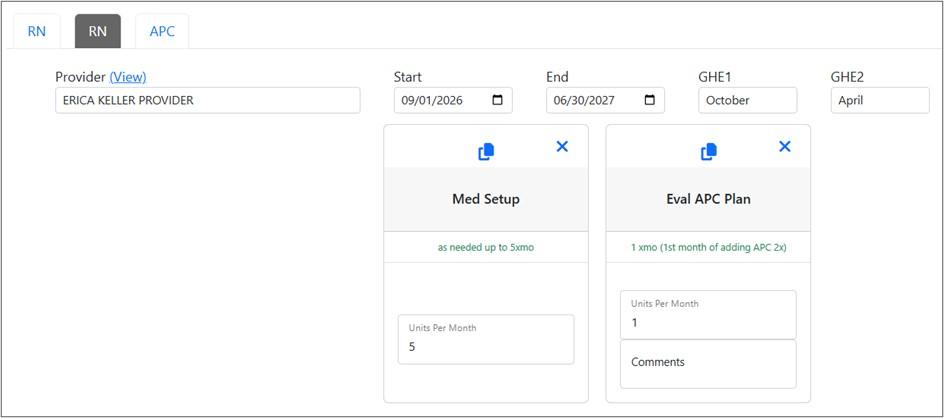
When developing the PCCP, two RN visits must be added as outlined:
- One unit is entered for Train APC and two units for Eval APC
- The Evaluate APC task must be authorized for two units during the first month to allow the provider to bill separately for both the training and the evaluation of the APC aide, as these will occur during two separate visits.
NOTE: To prevent duplicate prior authorizations, the start and end dates of each authorization must not overlap.
Example Of APC Authorization With A Monthly RN Visit
1st RN Authorization

2nd RN Authorization

Example Of APC Authorization With Weekly RN Visit
1st RN Authorization

2nd RN Authorization

Example Of APC Authorization With No Monthly Or Weekly Nurse Visits
1st RN Authorization

2nd RN Authorization