
1.0 Introduction/Roles and Responsibilities
Tuberculosis Case Management Manual
Introduction
This manual contains the policies, procedures, and recommendations of the Bureau of Communicable Disease Control and Prevention of the Missouri Department of Health and Senior Services (DHSS). It is intended as a guide for local public health agencies, district health offices, and other health care professionals who serve those in need of tuberculosis (TB) care. These guidelines were derived from statements and recommendations published by the Centers for Disease Control and Prevention (CDC), the American Thoracic Society (ATS), and the Infectious Disease Society of America (IDSA). This manual should be used to provide patient care and community elimination of tuberculosis throughout Missouri.
The diagnosis and treatment of TB is complex. While the material contained in this manual and the listed guides are extensive, questions may arise that are not fully covered. Further consultation and discussion with the DHSS TB Elimination Program is encouraged.
Mission, Vision and Values Statements
Mission Statement
The Mission of the Bureau of Communicable Disease Control and Prevention (BCDCP) is to prevent, control, and eliminate communicable diseases, including tuberculosis, in Missouri. In cooperation with others, we will lead efforts to:
- Conduct assessments
- Develop policies
- Conduct Surveillance
- Control outbreaks
- Educate health professionals and the public
- Assure treatment,
so that every individual has the opportunity for a healthy life.
Vision Statement
The Vision of the Bureau of Communicable Disease Control and Prevention is that Missouri will be a state of healthy communities with healthy people free from communicable diseases.
Values
The Bureau of Communicable Disease Control and Prevention is dedicated to improving health in Missouri. The staff values honesty, integrity, and respect for the people we serve and with whom we work. We are committed to education as a means of prevention. We are accountable, productive employees who strive for creative approaches and innovative solutions through effective communication and teamwork.
Points of Contact – Telephone Numbers and Addresses
| Point of Contact | Address | Phone | Fax |
|---|---|---|---|
| Bureau of Communicable Disease Control and Prevention (BCDCP) | 930 Wildwood Dr., PO Box 570, Jefferson City, MO 65109 | (573) 751-6113 | (573) 526-0234 |
| John Bos, Bureau Chief | 149 Park Central Square, Ste. 116, Springfield, MO 65806 | (417) 895-6945 | (417) 895-6969 |
| Traci Hadley, RN, BSN, RN Supervisor/Specialist TB Controller/TB Case Management Region A, D, G, H Program Evaluation Focal Point | 1110 East 7th Street, Suite 12, Joplin, MO 64801 | (417) 629-3487 | (573) 526-0234 |
| Terry Eslahi, Senior Epidemiology Specialist TB Surveillance Data Administrator | 930 Wildwood Dr., PO Box 570, Jefferson City, MO 65109 | (573) 522-2728 | (573) 526-0234 |
| Bev Myers, RN, Public Health Senior Nurse TB Case Management Region B, C, E, F, I | 142 Staples Drive, Park Hills, MO 63601 | (573) 518-2697 | (573) 526-0234 |
| Natalie Daugherty, MPH, Epidemiologist Immigrant Health/Interjurisdictional notifications (IJNs)/Contact Investigations Data Quality Assurance/Division Global Migration Health Liaison TB Contact Investigations Region A, D, E, G, H | 500 N. Tower Drive, Columbia, MO 65202 | (573) 751-6496 | (573) 526-0234 |
| Vacant, Health Program Representative/Training Coordinator Diagnostic Services Program Manager, DOT Financial Assistance/TB Education Focal Point | 930 Wildwood Dr., PO Box 570, Jefferson City, MO 65109 | (573) 526-5832 | (573) 526-0234 |
Roles in the Control of Tuberculosis – General Information
Tuberculosis services in Missouri are provided on a cooperative basis by the TB Elimination Program, Bureau of Communicable Disease Control and Prevention (BCDCP) of the Missouri Department of Health and Senior Services (DHSS), health care providers, laboratories, long-term care facilities, home health agencies, local public health agencies, and metropolitan tuberculosis clinics.
Recommendations and guidelines for these services are provided by the Centers for Disease Control and Prevention (CDC), the American Thoracic Society (ATS) and the Infectious Disease Society of America (IDSA).
The CDC provides some funding for tuberculosis elimination. Funds are also provided by the State of Missouri from General Revenue funds for diagnosis and medications for the treatment of tuberculosis as a payor of last resort. Additional funds may also be provided by local public health agencies.
The roles of each entity are explained in the following pages.
Bureau of Communicable Disease Control and Prevention (BCDCP)
The Bureau of Communicable Disease Control and Prevention (BCDCP) has the overall responsibility for surveillance, containment, management and assessment of tuberculosis activities in the state. Specific duties include:
- Formulate and distribute guidelines for tuberculosis elimination in Missouri, utilizing established recommendations of the Centers for Disease Control and Prevention (CDC), the American Thoracic Society (ATS), and the Infectious Disease Society of America (IDSA).
- Provide epidemiological, technical, medical and programmatic consultative services regarding tuberculosis elimination to all health care providers, including local public health agencies (LPHAs), Department of Health and Senior Services (DHSS) District offices, public and private physicians, nurses, and health care facilities.
- Purchase anti-tuberculosis drugs and contract for their distribution when funding is available.
- Implement the Diagnostic Services Program (DSP), which provides funding when available, for medical evaluation for tuberculosis disease and infection, chest x-rays, x-ray interpretation, and sputum induction, if necessary for all residents who need such services, provided that they have no medical insurance and other financial barriers exist.
- Work closely with the Missouri State Public Health Laboratory Tuberculosis Section to ensure quality laboratory services in the state.
- Ensure that reporting regulations are met and assist LPHAs in enforcing commitment laws when necessary.
- Verify and count all new and recurrent cases of tuberculosis disease and known tuberculosis infection within the state, along with identified cases of non-tuberculosis mycobacteria (NTM). The bureau also maintains a register of all persons with confirmed tuberculosis disease or infection.
- Compile and distribute epidemiological data on the incidence and location of tuberculosis disease and infection in Missouri.
- Conduct interstate transfer of information regarding tuberculosis patients and their contacts.
- Conduct semiannual evaluations of program quality indices, which are then forwarded to the CDC, and on-site evaluations of tuberculosis elimination programs as appropriate. Such objective evaluations are used to determine strengths and areas for improvement of State and local program efforts and address them as appropriate.
Health Care Providers
Health Care Providers, including hospital outpatient departments, infirmaries of state and local correctional facilities, mental institutions, federal facilities, local public health agencies (LPHAS), and private providers in the community, are responsible for evaluating, diagnosing, prescribing, and monitoring the medical care of persons with tuberculosis (TB) disease or infection, (https://www.cdc.gov/tb/topic/treatment/default.htm). According to ATS/CDC/ISDA latest recommendations for the Treatment of Tuberculosis “The responsibility for successful treatment is clearly assigned to the public health program or private provider, not to the patient” (https://www.cdc.gov/mmwr/preview/mmwrhtml/rr5211a1.htm).
Physicians, hospitals and laboratories in Missouri are required by state regulation 19 CSR 20- 20.020 to report to the Department of Health and Senior Services (DHSS) or the local health authority, any suspected or confirmed cases of TB disease within twenty-four (24) hours and any TB infection cases within three (3) days.
The reporting of each person with new or recurrent TB disease and each person with TB infection allows the resources of the LPHA/district offices and the Bureau of Communicable Disease Control and Prevention (BCDCP) to be made available to assist the provider in the appropriate management of the patient.
In addition to the Diagnostic Services Program (DSP) (see Section 6 of the TB Manual), epidemiological services are available to identify and examine source cases and contacts. All LPHAs are able to link the health care provider with all services available from DHSS to assist the provider in the treatment and follow-up of each TB patient.
Close Cooperation between health care providers and the LPHA or DHSS is imperative for the optimal outcome for the patient, contacts, and the community as a whole. Physicians and other providers described above are required to cooperate with the LPHA when a report is requested on the follow-up care being given to a patient. Periodic updates are required to monitor the patient’s bacteriologic, x-ray, and chemotherapy status, or preventive treatment status in an instance of TB infection.
Missouri State Public Health Laboratory Tuberculosis Section
The Missouri State Public Health Laboratory (SPHL), Tuberculosis Section, processes clinical specimens submitted by local public health agencies (LPHAs) at no charge to the patient, health care provider, or LPHA. Clinical specimens submitted by private health care providers, health care facilities, or other laboratories, are processed at a nominal fee. The results of acid-fast bacilli (AFB) smears, Mycobacterium tuberculosis complex (MTBC) identification, and molecular and conventional anti-tuberculosis drug susceptibility studies are included in the services provided. The laboratory serves as the Tuberculosis Reference Laboratory for the State of Missouri. A complete listing of services offered can be found on the Department of Health and Senior Services (DHSS) – State Public Health Laboratory website.
The mission of the TB section is to provide mycobacteriology diagnostic laboratory services to all Missouri healthcare providers and LPHAs by providing accurate and timely detection, identification, drug susceptibility testing and genotyping of MTBC in support of the State TB Elimination Program.
The TB section also provides identification of clinically significant nontuberculous mycobacteria (NTM) utilizing Matrix assisted laser desorption ionization time-of- flight (MALDI-TOF), and genetic probe technology.
Specimen collection containers may be obtained at no charge to all healthcare providers by calling (573) 751-4830.
State Public Health Laboratory Website
Private Laboratories
Private Laboratories, in accordance with state regulation 19 CSR 20-20.080, have the responsibility to report the findings of any test that is suggestive of tuberculosis, most specifically positive smears for acid-fast bacilli (AFB) and positive cultures for Mycobacterium tuberculosis. These reports shall be made within twenty-four (24) hours and shall designate the test performed, all results of the test, the name and address of the attending physician, the date the test results were obtained, the name and home address (with zip code) of the patient and the patient’s age, date of birth, sex, race and ethnicity.
In addition, in order to provide epidemiological data and information regarding Tuberculosis (TB) in Missouri, including drug-resistance patterns and clusters found through DNA fingerprinting, all private laboratories are strongly encouraged to provide an isolate of all cultures positive for Mycobacterium tuberculosis to the Missouri State Public Health Laboratory (SPHL), Tuberculosis Unit.
Local Public Health Agencies
Local Public Health Agencies (LPHAs) are a vital link in a successful tuberculosis elimination program. The role of the LPHA in the control of Tuberculosis (TB) is very important, whether the patient is hospitalized or is being treated on an outpatient basis. The LPHA is responsible for instructing the patient in the importance of continuous and uninterrupted drug therapy and precautions to take to prevent the transmission of disease.
Case management for the individual patient, as provided by the LPHA, is the key to successful completion of TB disease and infection treatment. Directly observed therapy (DOT) is the standard of care for all patients with active TB disease. Monthly monitoring of the patients’ clinical status, compliance with antituberculosis medications, side effects of medications, need for additional sputum examinations, liver function studies, if needed, and referral to health care providers as necessary, allow for the outpatient treatment of tuberculosis patients. DOT sheets are submitted monthly to the state TB nurse and updates for active disease cases are conducted with the state nurse.
The LPHA works closely with the physician to maintain standards of care for each patient, and is responsible for contacting any health care provider, including outpatient departments, infirmaries of state and local correctional facilities, mental institutions, federal facilities, and private physicians to monitor the current status of any patient residing in that county.
The LPHA also maintains surveillance for TB within the community and serves as liaison between local health care providers, facilities and the Bureau of Communicable Disease Control and Prevention.
Specific responsibilities include:
Initial Patient Visit
This visit may be in the patient’s home, the hospital, or at the LPHA. The initial visit by the LPHA, in consultation with the primary health care provider, will be made within three (3) business days after receiving the report of a newly diagnosed or suspected case of TB. The initial visit is often the key to securing cooperation, and thus to the eventual successful completion of adequate treatment for the patient. Follow-up of contacts and/or identification of additional contacts are further enhanced by the initial home visit. Reports of a patient with TB disease may come from the Bureau of Communicable Disease Control and Prevention, health care providers or facilities. The tentative diagnosis may be made on the basis of smears that are positive for acid-fast bacilli (AFB), or symptoms and x-ray findings compatible with TB disease. Individuals being treated for suspect/active TB disease should be considered infectious and remain isolated until they meet the CDC criteria to be considered noninfectious see CDC Core Curriculum on Tuberculosis, Sixth edition 2013, Chapter 7, TB infection Control, page 192 Table 7.2.
The health care provider should start the patient on appropriate antituberculosis regimen (see the Core Curriculum on Tuberculosis: What the Clinician Should Know) as soon as TB is suspected.
Contact Identification and Follow-up
It is the responsibility of the LPHA to initiate contact identification and to assure that all contacts are evaluated for TB disease or infection and appropriately managed. Evaluations of high-risk contacts to current infectious cases of pulmonary or laryngeal TB represent the most productive method of case finding. The TBC-13 Worksheet for Contacts of Newly Diagnosed Cases of TB is useful for this process (see the TB Manual; Appendices/Sample Forms).
A contact investigation is indicated if the index patient has confirmed/suspected pulmonary, laryngeal or pleural TB. Contacts of infectious cases should be evaluated within 5-14 days, depending upon the priority level of the contact.
Comprehensive information about the index patient is the foundation for contact investigation. This includes disease characteristics, onset date of illness, names of contacts, exposure locations, and current medical factor (e.g., initiation of effective treatment and drug susceptibility results). Obtaining accurate information is very important, and depends upon establishing trust and rapport. Patients should be interviewed by persons who are fluent in their primary language. If this is not possible, the LPHA should provide interpretation services.
Determining the infectious period helps to focus the investigation on those contacts most likely to be at risk for infection and sets the timeframe for testing contacts. Because the start of the infectious period cannot be precisely determined, a good rule of thumb is to assign a start date 3 months before the diagnosis of TB. However, if the illness has been prolonged, it may be necessary to start further back, as long as over one year in some cases.
The goal of contact investigation is to identify all contacts that have been recently infected and prevent TB disease by evaluating and treating them. In practice, however, contact investigations may identify additional cases of active TB (secondary cases) that will also need treatment and follow up, including a contact investigation.
For additional information, please see CDC “Guidelines for the Investigation of Contacts of Persons with Infectious Tuberculosis."
2.0 Diagnostic Procedure: Testing for LTBI
Tuberculosis Case Management Manual
The Tuberculin Skin Test (TST)
Policy: The TST is one of the current testing methods utilized in Missouri to detect individua ls who may have been infected with Mycobacterium Tuberculosis.
Purpose: To provide basic information concerning the tuberculin skin test.
- The TST detects antibodies produced in individuals infected with M. tuberculosis.
- The skin test is administered intradermally using the Mantoux technique by injecting 0.1 ml of 5 TU (tuberculin unit) purified protein derivative (PPD) solution.
- PPD is available in various strengths, containing one (1) tuberculin unit (TU), 5 TU, and 250 TU.
- Only 5 TU is routinely used in public health and is the only strength of PPD addressed in this manual.
- If a person is infected, a delayed-type hypersensitivity reaction is detectable 2 – 8 weeks after infection.
- Interpretation of TST reactions should be conducted within 48 – 72 hours after administration by a trained health care professional.
- If the test is not read within the 48 – 72 hour window it must be repeated. - Patients or family members should NOT interpret or read TST results.
- Because PPD is light and heat sensitive, when not in use it should be protected from light and stored in a refrigerator at 35 – 46° Fahrenheit.
- While in use in the field the PPD temperature should be maintained.
- PPD should never be transferred from one vial to another.
- Label the PPD vial with the date it was opened. PPD is only good for up to 30 days after it has been opened and any unused PPD after the 30 days should be discarded.
- The TST should not be performed on a person:
- Who has written documentation of either a positive TST result or prior treatment for tuberculosis (TB) disease
- With known blistering at the site of a previous TST
- With known anaphylactic reaction after a previous TST
Note: A repeat TST should be done if there is not written documentation for a patient at risk, unless they have had blistering or an anaphylactic reaction to a previous positive TST. If this is not known then an Interferon Gamma Release Assay (IGRA) should be done instead.
- TB disease must be ruled out before initiating treatment for Latent Tuberculosis Infection (LTBI) to prevent inadequate treatment of TB disease and possible drug resistance.
Targeted Tuberculin Testing
Policy: Targeted testing programs should be conducted among groups at risk for recent infection with M. tuberculosis and those who are at increased risk for progression to active tuberculosis (TB).
Purpose: To identify persons at high risk for TB who would benefit from treatment of LTBI.
Persons at high risk for developing TB disease fall into two broad categories:
- Recently Infected:
The risk of progression is greatest within the first 1-2 years after exposure. Persons likely to have been recently infected with M. tuberculosis include the following:- Close contacts of infectious TB disease cases.
- Recent TST converters.
- Person with baseline testing results that have an increase of 10mm or more in the size of the TST reaction within 2 years of a previously documented negative TST.
- Persons who have emigrated from TB-endemic regions of the world.
- Children <5 years of age who have a positive TST.
- Persons who work or reside in facilities/institutions with people who are at high risk for TB such as hospitals, homeless shelters, correctional facilities, nursing homes, group homes, residential facilities for patients with HIV, or residential substance abuse treatment facilities.
- Clinical conditions associated with progression from LTBI to TB disease:
- HIV Infection
- Injection drug use
- Radiographic evidence of prior healed TB
- Low body weight (>10% below ideal)
- Other medical conditions:
- Silicosis
- Diabetes
- Chronic renal failure or on hemodialysis
- Gastrectomy
- Jejunoileal bypass
- Solid organ transplant
- Head and neck cancer
- Prolonged use of steroids or TNF-a antagonist
Screening of low-risk persons is discouraged because it diverts resources from activities of higher priority. However, low risk persons can be screened if resources allow.
TST testing is also discouraged unless a plan has been developed to complete a course of treatment in persons found to have LTBI. “A decision to test is a decision to treat.”
This would include:
- Arrangements for medical evaluation
- Chest x-rays
- Medical supervision for a course of treatment
- A plan of care for follow up including treatment adherence and addressing missed doses
Screening Foreign-Born Persons
Tuberculosis (TB) cases among foreign-born persons make up a large percentage of the total number of cases in Missouri. In some countries, TB is much more prevalent than it is in the United States; therefore, persons emigrating from TB endemic countries will have a higher prevalence of TB infection and disease.
Statewide Recommendations:
Foreign-Born Students:
As of August, 2013, revised statute 199, section 199.290.1 requires:
- All students and faculty to be screened for TB upon matriculation and those identified with risk factors must be tested.
- Any entering student of an institution of higher education in Missouri who does not comply with the targeted testing program shall not be permitted to maintain enrollment in the subsequent semester at such institution.
Foreign-Born Persons That Have Been in U.S. Less Than Five Years:
Recognizing that recent arrival to the United States from TB-endemic countries is a significant risk factor for the development of TB in foreign-born individuals, it is recommended that these individuals be considered high priority for TB screening and TB infection treatment. Specifically, it is recommended that foreign-born persons (including students, immigrants, and refugees), notably those from endemic countries*, who have TB infection as evidenced by a positive TB test [TST or IGRA] and who have been in the United States less than five years, receive TB infection treatment, regardless of age or BCG vaccination status.
Screening Long-Term Care Facilities
The control and prevention of tuberculosis (TB) in the elderly must be accomplished in order to eliminate TB as a public health problem.
Many of the elderly were infected with TB years ago, with the tubercle bacilli dormant most of the time. When the bacilli occasionally became active and began reproducing, the normal immune system quickly overcame the problem. As the body ages, the immune system becomes less active, and other medical problems may develop that further increase the risk of TB infection becoming active disease. If TB disease is in the lung, which is the most common site, the person may start coughing and expelling the organisms into the air. This can be especially devastating in a longterm care facility, where many susceptible elderly persons are sharing the same air.
It is therefore important for each long-term care facility to have a TB control program in place. This must include the documentation of the TB status of each resident, staff member and volunteer of each long-term care facility. This can best be accomplished by screening residents on admission, and pre-employment and annual testing of employees and volunteers as outlined below.
Missouri State Regulations: 19 CSR 20-20.100 (Appendices).
Recommendations for Residents
All residents new to long-term care who do not have documentation of a previous skin test reaction > 10mm or a history of adequate treatment of TB infection or disease, should have the initial test of a Mantoux PPD two-step test to rule out TB within one month prior to or one week after admission. If the initial result is 0-9mm, the second test, which can be given after admission, should be given at least one week and no more than three weeks after the first test. The results of the second test should be used as the baseline. Documentation of a chest x-ray ruling out active pulmonary TB within one month prior to admission, along with an evaluation to rule out signs and symptoms of TB, may be acceptable by the facility on an interim basis until the Mantoux PPD two-step test is completed.
The two-step test is recommended due to the “booster phenomenon,” which can occur at any age, but is more pronounced with increased age. The body’s response to tuberculin (the antigen in PPD), once that response has been established by infection with TB (or other mycobacteria), may gradually wane over the years. The initial test of two-step test may result in a falsely negative (0 – 9 mm) reading. However, that initial test stimulates the body to respond normally to a subsequent test. This can cause confusion at a later time if the resident is skin tested either as a result of symptoms of TB disease or as a contact to a newly diagnosed infectious person. The “boosted” skin test then may appear to be the result of new infection, which puts the individual at much higher risk of progressing to TB disease. Therefore, it is imperative to purposely elicit this boosted response deliberately in all persons in whom it is important to know their TB status.
All skin test results of 5mm or more for contacts to infectious TB or for an individual who is immunocompromised, or 10mm or more for all others, whether documented in the resident’s medical history, obtained by the first test, or obtained by the second of the two-step test applied by the facility, require a chest x-ray within one week, or a review of the results of a chest x-ray taken within one month prior to admission along with an evaluation to rule out current TB disease. It is important to also perform an evaluation to determine if signs and symptoms of TB (unexplained weight loss, fever, and persistent cough) are present. Once TB disease is ruled out, it is important to record the results of the skin test in millimeters (mm), in a prominent place on the resident’s medical record.
Individuals with a positive finding presenting evidence of a recent, within one month of the date of admission, chest x-ray need not be given a new x-ray. However, the results of the chest x-ray must be reviewed in the light of the additional information of the identification of TB infection as indicated by the Mantoux PPD skin test.
An individual who is skin-test positive with a normal chest x-ray and no signs or symptoms of TB should be considered for preventive (LTBI) medication.
Those who complete a recommended (documented) course of preventive treatment and those for whom preventive treatment is not medically indicated do not need further testing, unless signs and symptoms of TB are present.
Staff persons must be constantly vigilant for signs and symptoms of TB in residents and obtain a medical evaluation, chest x-ray, and sputum for acid-fact bacilli should they appear.
Recommendations for Employees
The results of annual tuberculin testing of employees in a long-term care facility are a good indicator of the extent of transmission of TB within that facility. All new long-term care facility employees and volunteers who work 10 or more hours weekly are required to obtain a Mantoux PPD. (http://s1.sos.mo.gov/cmsimages/adrules/csr/previous/19csr/19csr0806/19c…)
Every facility should have a TB surveillance program that includes the following procedures:
- Initial Examination. Provide a tuberculin skin test (Mantoux, 5 tuberculin units (TU) of purified protein derivative (PPD) to all employees during pre-employment procedures, unless a previous reaction > 10 mm is documented. If the initial skin test result is 0 -9 mm, a second test should be given at least one week and no more than three weeks after the first test. The results of the second test should be used as the baseline in determining treatment and follow-up of these employees. A history of BCG (bacilli Calmette-Guerin) does not preclude an initial screening test, and a reaction of 10 mm or more should be managed as a TB infection. A chest x-ray examination should be provided for employees who have a skin test reaction > 10 mm or who have symptoms compatible with pulmonary TB in order to determine the presence of current disease.
- Repeated Tuberculin Skin Tests. It is required that employees with an initial negative twostep PPD be tested annually with a one-step PPD to prevent them from developing disease and infecting others. Preventive therapy is recommended for all infected employees, unless specifically contraindicated, to prevent them from developing disease and infecting others. Infected employees who are without disease and who do not complete a course of preventive therapy will need an individualized plan of surveillance. Those who are at high risk of developing disease, i.e. converters, should be assigned where they cannot expose small children, immunocompromised patients, and others for whom the consequences of infection may be especially serious.
- Repeat Chest X-Ray. After the initial evaluation of persons with skin test reactions > 10 mm, routine repeated chest x-rays are not recommended. They are neither a substitute for preventive therapy nor vigilance for signs and symptoms of TB disease. Employees who have completed an adequate course of treatment or preventive treatment should be exempt from further chest x-rays unless they become symptomatic.
- Positive Reactors with Symptoms of TB. All persons that test positive, with or without treatment should be instructed to seek immediate medical attention if they develop symptoms of TB disease.
- Contact Investigations. When there is an exposure to a suspected or recently diagnosed case of TB, a contact investigation should be conducted. Each person exposed who previously had a documented negative reaction to the skin test should receive a tuberculin test. Those who are still negative should be retested eight to ten weeks after exposure. Preventive therapy should be given to high-risk contacts (i.e. immunocompromised) with negative skin tests since they may be infected, even though their skin tests have not yet converted.
Chest x-rays should be provided for employees whose skin test reactions increase > 6 mm for < 10 mm to > 10 mm. Treatment for infection or disease should be provided according to the results of the x-ray and the medical evaluation.
All employees or volunteers that were exposed and tested shall have a documented annual evaluation to rule out signs and symptoms of TB. If the employee should develop signs and symptoms of TB they should be seen immediately by a medical provider, obtain a chest x-ray, and sputums for AFB smear and culture to rule out TB. The facility should be in contact with their local public health agency staff for further recommendations. The employee/volunteer should be given a surgical mask and instructed to wear it when being seen for medical evaluation and chest x-ray and should avoid being in public places until further direction by the facility in collaboration with the local health agency. - Evaluation. The data generated from this testing should be analyzed periodically to determine and revise policies. The best index of the effectiveness of the program will be the absence of new infections in employees.
Policy: To ensure that tuberculosis (TB) evaluation and control services are provided for residents and staff of the Missouri Department of Corrections, according to MO 19 CSR 20-20.100.
Purpose: To control TB within the Missouri Department of Corrections by early identification of those persons with infectious TB and providing appropriate isolation and anti-TB medication regimens, early identification of those with TB infection and providing infection treatment, and by rapid contact identification, investigation, evaluation and follow-up for all residents and staff of the Department.
Procedure: Initial Screening
Staff members: Upon employment, all staff members of the Missouri Department of Corrections, including volunteers who spend 10 or more hours weekly within the system, and who do not have documentation a tuberculin skin test reaction of > 10 mm, will be screened for TB, using the Mantoux PPD two (2)-step tuberculin skin test or the Interferon Gamma Release Assay (IGRA). (See Chapter 3 of the Core Curriculum on Tuberculosis: What the Clinician Should Know). This screening may be provided at the local public health agency (LPHA), under contract to the Missouri Department of Corrections, or by the person’s own health care provider. Documentation of the reaction to the tuberculin skin test reported in mm of induration and positive blood assay results must be presented to the TB elimination coordinator of the institution. All positive results must be reported to the Missouri Department of Health and Senior Services TB Elimination Program on Form TBC-4
(See the TB Case Management Manual; Appendices/Sample Forms).
Inmates: Upon entrance into the Department of Corrections system, all residents will be screened for TB, using an approved TB screening test (see Chapter 3 of Core curriculum on TB: What the Clinician Should Know). This screening will be provided at the Department of Correction Reception Centers. Documentation of the reaction to the tuberculin skin test, reported in mm of induration, and positive blood assay results become a part of the resident’s medical record.
All positive reactions to the tuberculin skin test are reported to the Department of Health and Senior Services TB Control Program on Form TBC-4 (see the TB Case Management Manual; Appendices/Sample Forms.)
Annual Screening
Staff members: All staff members with tuberculin skin test reaction < 10 mm will have an annual Mantoux PPD tuberculin skin test, (1) step only or IGRA during each employee’s birth month.
Inmates: All inmates with tuberculin skin test reaction < 10 mm will have an annual Mantoux PPD tuberculin skin test, (1) step only or IGRA during each inmate’s birth month.
For more information on Department of Corrections Guidelines see the American Correctional Association.
Information for School Nurses Kindergarten – 12th Grade
For effective tuberculosis (TB) control among school employees in Missouri, the following policies are recommended:
All personnel, paid and unpaid, who work with children in a school environment shall be certified free from TB in an infectious form prior to beginning employment. This includes an evaluation that indicates no signs or symptoms of infectious TB disease (persistent cough for > 3 weeks, unexplained weight loss, fever, night sweats, general malaise) and one of the situations described below:
- An individual who has documentation of a Mantoux PPD tuberculin skin test reading of 0 – 9 mm within the past month, or a negative IGRA, and no history of contact with a person with TB immediately prior or subsequent to this documentation, shall be considered to be free from TB. No further TB testing shall be necessary except for epidemiologic or diagnostic purposes which may be required by the local public health agency (LPHA) or the Missouri Department of Health and Senior Services.
- If the individual does not have documentation of a Mantoux PPD tuberculin skin test reading of 0 – 9 mm within the past month, or a negative IGRA, and does not have a history of ever having had a Mantoux PPD tuberculin skin test reading of 10 or more mm, or a negative IGRA, the following procedures shall be followed:
- Five tuberculin units (TU) of purified protein derivative (PPD) shall be administered by the Mantoux method and the results read 48 – 72 hours subsequent to the administration of the test.
- If the reading shows an induration of 0 – 4 mm in a person with a recent history of contact with TB or an induration of 5 -9 mm and no history of contact with TB, he/she shall be considered to be free of TB.
- If the reading shows an induration of 5 – 9 mm and there is a history of contact with TB or an induration of 10 or more mm, he/she shall be considered to be a tuberculin reactor and shall be handled as described in number 3 below.
- If the individual is a tuberculin reactor as described in 2.c above or has a history of a Mantoux PPD tuberculin skin test reading of 10 or more mm without documentation of having received an adequate course of preventive therapy, the following procedure shall be followed:
- If the individual has documentation of a normal chest x-ray within the past month, the employee shall be considered to be free from infectious TB.
- If the individual does not have documentation of a normal chest x-ray within the past month, a signs and symptoms review is to be completed. If the individual has symptoms consistent with TB, then a chest x-ray is necessary. Individuals, for whom no TB symptoms exist, no further chest x-rays are required but shall be given preventive therapy.
Individuals described in 3a or 3b above, for whom chest x-rays are normal, shall be considered for preventive therapy. No further chest x-rays are necessary, unless the employee has symptoms consistent with TB, as described in the first paragraph of this subsection. - Individuals with an abnormal chest x-ray indicating current pulmonary disease (TB or other) must be thoroughly evaluated and treated accordingly. Such an evaluation must include, but not be limited to collection of sputum specimens (by induction if necessary) for TB smear and culture. Until infectious TB is ruled out, the individua l should be isolated and should not “share air” with any children, nor with any susceptible adults not already exposed.
- Individuals with an abnormal chest x-ray indicating current pulmonary disease (TB or other) must be thoroughly evaluated and treated accordingly. Such an evaluation must include, but not be limited to collection of sputum specimens (by induction if necessary) for TB smear and culture. Until infectious TB is ruled out, the individual should not “share air” with any children, nor with any susceptible adults not already exposed.
- If the individual has documentation of an adequate course of therapy for TB disease or adequate infection treatment for TB infection AND no current pulmonary symptoms, no further chest x-rays are necessary and the employee shall be considered to be free from TB in an infectious form.
The school should consult with the local public health agency or the Bureau of Communicable Disease Control and Prevention of the Missouri Department of Health & Senior Services for evaluation, management, and surveillance if the individual meets any of the following criteria:- Has a history of TB disease or infection without documentation of adequate treatment as determined by the Unit.
- Is currently being treated for TB disease.
- Has a chest x-ray consistent with pulmonary TB without documentation of adequate treatment.
- Has symptoms consistent with TB.
- Has a history of contact with TB within the past 24 months.
Administering the TST
Policy: Tuberculin skin tests will be administered per CDC recommendations as indicated below.
Purpose: To standardize administration of the tuberculin skin test.
Equipment and Supplies:
- Order for administering TST – either individual’s health care provider or per standing order for the Local Public Health Agency (LPHA).
- Sterile 1 ml tuberculin syringe with 27 gauge blunt beveled 1/4 – 1/2 inch needle
- Syringe and needle technologies continue to evolve to prevent needlestick injuries. The most effective needleless system should be used.
- Institutional policy will determine which device has been approved by your facility.
- Alcohol pads
- 5TU PPD – Properly stored at 2 – 8° C/35 – 46°F; Avoid exposure to light. Label PPD vial with date opened and dispose unused PPD after 30 days from opening.
- Tubersol and Aplisol are two commercially available tuberculin products.
- Compared with the US reference PPD, no difference exists in TST interpretation between the two products.
- Tuberculosis (TB) screening programs should use one antigen consistently.
- Avoid temperature fluctuations: do not store on the refrigerator door.
- Tubersol and Aplisol are two commercially available tuberculin products.
- Cotton balls.
- Sharps disposal container.
- Ruler with mm indicators.
- Signature for informed consent to be tested (the parent or guardian must sign the consent for testing, if the person to be tuberculin skin tested in < 18 years of age).
- Emergency kit and standing orders for use should an anaphylactic reaction occur (extremely rare).
Procedure for Administration of Tuberculin Skin Test:
- Obtain results of all previous TSTs. Ask the patient to describe what the test area looked like 2 -3 days after administration; obtain documentation.
- If documentation cannot be obtained you may repeat the TST.
- A previous positive TST is not a contraindication to a subsequent TST unless the test was associated with a sever ulceration or anaphylactic shock.
- Use appropriate hand hygiene before starting procedure.
- Explain the procedure to the individual:
- How the test is administered
- The need for reading the skin test in 48 – 72 hours
- Make an appointment for the patient to return:
- If the patient cannot return within 48 – 72 hours, do not administer the test.
- Schedule another time that allows for the patient to return at the appropriate time.
- Remove the antigen vial from the refrigerator and confirm that it is the 5 TU PPD antigen.
- Check label and expiration date.
- Mark opening date and initials on vial. If vial has reached expiration or is greater than 30 days since opened, vial should be discarded.
- Clean vial stopper with antiseptic swab.
- Twist needle guard on syringe to ensure tight fit.
- Fill syringe immediately after vial is removed from refrigeration.
- Syringes should be filled immediately prior to administration as the PPD can adhere to the inside of the syringe and affect the potency.
- Insert needle into vial.
- Draw slightly over 0.1 ml of 5 TU PPD while needle remains in vial to avoid wasting of antigen.
- Remove needle from vial.
- Return antigen vial to refrigerator immediately after filling.
Site Selection and Cleaning:
- Select upper third of forearm with palm up > 2 inches from wrist, elbow, or other injection site; if neither arm is available or acceptable for testing, the back of the shoulder is a good alternate site for testing.
- Select site free from veins, lesions, heavy hair, bruises, scars, or muscle ridges
- Traditionally the left arm is used for testing; or standard site for your institution. Clean arm site with antiseptic swab using a circular motion from center to outside.
- Allow site to dry before administering antigen.
TST Administration:
- Rest patient arm on firm, well-lit surface.
- Stretch taut the skin between the thumb and forefinger or pull skin taut from under the arm.
- Hold needle bevel up at 5 – 15 degree angle to skin.
- Insert needle in first layer of skin with tip visible beneath the skin.
- Advance needle until entire bevel is under the first layer of skin.
- Release stretched skin.
- Inject entire dose slowly.
- Form 6 – 10 mm wheal.
- Remove needle without pressing on area – do not apply bandage.
- Activate safety feature of device per manufacturer’s recommendations, if applicable.
- Immediately place used needle and syringe in sharps container; do not recap needle; or if necessary to recap needle, use one handed recapping technique to avoid needlestick injuries.
- A 6 – 10 mm wheal (a pale, raised area with distinct edges) should appear (measure with mm ruler).
- If a 6 – 10 mm wheal was not achieved, repeat TST. Apply the second TST on the other arm or in a different area on the same arm at least 2 inches from first site.
- If blood or fluid is present, blot slightly with gauze or cotton ball, do not apply bandage.
- Record the date, time, location, antigen, and signature of person administering the TST on the TBC-4 or other form per LPHA policy.
- Use appropriate hand hygiene after placing TST.
Care Instructions for Injection Site:
- The wheal (bump) is normal and will remain for about 10 minutes.
- Do not touch the wheal; avoid scratching.
- Avoid pressure or bandage on injection site.
- Rare local discomfort and irritation does not require treatment.
- May wash with soap and water after about 1 hour.
- No lotions or liquids on site, except for light washing, as mentioned above.
- Keep appointment for reading TST.
Note: In rare instances the reaction might be severe: vesiculation, ulceration, or necrosis of the skin. Report severs adverse events to the FDA MedWatch Adverse Events Reporting System (AERS), Telephone: 800-FDA-1078; https://www.fda.gov/medwatch.
Reading the TST
Policy: Tuberculin skin tests will be read as outlined below
Purpose: To provide standardization of reading of tuberculin skin test.
Preliminary:
- Before starting, use appropriate hand hygiene methods and put on gloves.
- Keep fingernails shorter than fingertips to avoid misreading TST result.
- Keep TST reading materials at hand (ballpoint pen and ruler).
- Inspect the site of injection.
Palpate:
- Palpate with arm bent at elbow.
- Lightly sweep 2 inch diameter from injection site in four directions.
- Use zigzag featherlike touch.
Placing marks: (If induration present)
- Use fingertips to find margins of the induration; when palpating for margins, be careful not to confuse a margin of induration with a margin of muscle. To check this, raise the patient’s arm to a 45 degree angle and palpate again. You should still be able to palpate induration.
- Mark the induration (firm swelling) by placing small dots with a pen or marker on both sides of the induration. Mark dots transverse (perpendicular) to long axis of forearm i.e. the direction in which a watchband would lie across the arm.
- Inspect dots, repeat finger movements toward indurated margin, and adjust dots if needed.
- Verify the positive TST by having a second reader immediately measure the same induration using the same procedure to confirm measurement.
Placing and Reading Ruler:
- Place the “0” marking on the ruler inside the edge of the left dot. Read the ruler line inside the right dot edge. Use lower reading if between two gradations on mm scale.
- Use appropriate hand hygiene methods after reading the TST.
Note: Measure with a millimeter ruler only.
Classification of TST Reactions
Policy: Results of tuberculin skin tests will be classified according to the following criteria.
Purpose: To standardize classification of tuberculin skin test results.
A reaction of five (5) or more millimeters of induration is considered positive in:
- HIV-infected persons.
- Recent contacts of infectious tuberculosis (TB) case.
- Persons with fibrotic changes on chest x-ray consistent with prior TB.
- Organ transplant recipients.
- Those who are immunosuppressed for other reasons:
- Taking equivalent of 15mg/day or greater of prednisone for 1 month or more.
- Taking Tumor Necrosis Factor – Alpha (TNF-x antagonists) i.e. Remicade, Enbrel, Humira, etc.
A reaction of ten (10) or more millimeters of induration is considered positive in:
- Recent immigrants (within last 5 years) from high prevalence countries (Regardless of a history of vaccination with BCG).
- Injection drug users.
- Residents, employees, and volunteers of high risk congregate settings (correctional facilities, long-term care facilities, hospitals and other healthcare facilities, residential facilities for patients with HIV and homeless shelters).
- Mycobacteriology laboratory personnel.
- Persons with certain high risk clinical conditions.
- Infants, children and adolescents exposed to adults at high risk for TB disease.
- Children younger than 4 years of age.
A reaction of fifteen (15) or more millimeters of induration is considered positive in:
- Persons with no risk factors.
Note: Routine testing is not recommended for populations at low risk for LTBI.
Skin test conversion:
- For persons with negative TST reactions that undergo repeat TB skin testing (such as health care workers), an increase in reaction size of 10 or greater within a period of 2 years should be considered a skin test conversion indicative of recent infection with M. tuberculosis.
Interferon Gamma Release Assay (IGRA)
Policy: The IGRA is one method currently available for determining exposure to tuberculosis (TB). The Missouri State Public Health Laboratory does not offer IGRA testing.
Purpose: To inform the Local Public Health Agency (LPHA) of all testing methods available for diagnosing LTBI.
- The IGRA tests are blood tests that measure a person’s immune reaction to Mycobacterium TB.
- In a person with LTBI, the blood cells recognize the tuberculin antigen and release interferon-gamma; results are based on the proportion of interferon gamma released.
- There are different IGRA’s currently available:
- Quantiferon Gold
- Quantiferon Gold plus
- T Spot
- Guidelines for using the Quantiferon – TB Gold Test for Detecting Mycobacterium TB Infection available at the CDC website.
Diagnosing LTBI
Policy: To correctly diagnose and offer treatment for individuals classified as a positive diagnostic test.
Purpose: To rule out tuberculosis (TB) disease before treatment for LTBI is initiated; failure to rule out TB disease may result in inadequate treatment and development of drug resistance.
For persons with a diagnostic test classified as positive [see classification of TB Skin Test (TST)], IGRA, or those with negative diagnostic test that have symptoms suggestive of TB disease.
- Obtain a chest x-ray (CXR) as soon as possible:
A chest x-ray helps to differentiate between LTBI and TB disease in persons with positive results. If the patient has had a prior CXR, it must have been performed within the last six months.- The CXR may need to be repeated if the patient has developed any new risk factors or TB symptoms since the previous CXR. Consult with the state TB nurse.
The following guidelines are recommended:- A CXR is indicated with a positive TST or IGRA and treatment for LTBI should be considered, especially for those that are a contact to a recent case of TB or are at an increased risk for developing disease once they are infected (i.e. window prophylaxis in a young child or immunocompromised person).
- Children less than 5 years of age should have both an anterior-posterior and lateral views. o All others should have at least posterior-anterior views.
- Other views or additional studies should be based on the physician’s judgement.
- Persons with nodular or fibrotic lesions consistent with findings of prior TB and a positive TST or IGRA are high-priority candidates for treatment.
- Persons with calcified granulomas only are at low risk for progression to disease.
- For contacts with a documented prior positive TST or IGRA, with or without treatment, shall obtain a chest x-ray to rule out TB disease.
- Periodic follow-up CXRs are not indicated regardless of whether treatment is completed except in unusual circumstances. (Note: For MDR-TB there is usually a follow-up CXR six (6) months and one (1) year after treatment completion.
- The CXR may need to be repeated if the patient has developed any new risk factors or TB symptoms since the previous CXR. Consult with the state TB nurse.
- A physical examination and medical history, including symptoms of TB disease, prior positive TSTs, family history, and risk assessment for liver disease, should be conducted. Written documentation of a previous positive TST or IGRA is required. A patient’s verbal history is not adequate.
- Sputum examination is indicated for persons with a positive result and either an abnormal CXR and/or the presence of respiratory symptoms. If TB disease has been ruled out by the above procedures, treatment for LTBI should be considered. If further assistance is needed regarding sputum collection, please notify the state TB nurse.
For details on the Diagnostic Services Program, see Chapter 6 of the TB Case Management Manual.
Persons at Risk for Progression of LTBI to TB Disease
Persons at increased risk:
- Persons infected with HIV
- Children younger than five (5) years of age
- Persons who were recently infected with M. tuberculosis (within the past 2 years)
- Persons with a history of untreated or inadequately treated TB disease, including persons with fibrotic changes on chest radiograph consistent with prior TB disease
- Persons who are receiving immunosuppressive therapy such as tumor necrosis factoralpha (TNF) antagonists, systemic corticosteroids equivalent to/greater than 15 mg of prednisone per day of immunosuppressive drug therapy follow organ transplantation
- Persons with silicosis, diabetes mellitus, chronic renal failure, leukemia, or cancer of the head, neck, or lung • Persons who have had a gastrectomy or jejunoileal bypass
- Persons who weigh less than 90% of their ideal body weight
- Cigarette smokers and persons who abuse drugs and/or alcohol
- Populations defined as having an increased local incidence of disease due to M. tuberculosis, including medically underserved, low-income populations
Two-Step Testing
Policy: Two-step tests are needed to establish a baseline for persons who will receive serial testing.
Purpose: To prevent misclassifying a positive skin test as a conversion.
Booster Phenomenon:
Some people with LTBI may have a negative reaction to the TB Skin Test (TST) if many years have passed since they became infected. They may have a positive reaction to a subsequent TST because the initial test stimulates their ability to react to the test. This is commonly referred to as the “booster effect” and may incorrectly be interpreted as a skin test conversion (going from negative to positive). For this reason, the “two-step method” is recommended at the time of initial testing for individuals who will be tested periodically (e.g., health care workers). If the first test result in the two-step baseline testing is positive, evaluate the patient for active disease. If active disease is ruled out then the patient should be considered to have LTBI and evaluate and treat the patient accordingly. If the first test result is negative, the second step of the two-step baseline testing should be repeated in 1 – 3 weeks. If the second test result is positive, evaluate the person for active disease. If active disease is ruled out then the patient should be considered to have LTBI and evaluate and treat the person accordingly. However, if both steps are negative, consider the patient uninfected and classify the TST as a negative baseline (see Figure 1).
To estimate the frequency of boosting in a particular setting, a four-appointment schedule of TST administration and reading (appointment for TST administration and reading of both TST results) is necessary, rather than a three-appointment schedule (appointment for the administration of both tests and reading of the second-step test only).
Two-step testing should be used only for baseline screening, not in contact investigations. In a contact investigation, for persons with a negative TST, a follow-up test should be administered 8 – 10 weeks after the end of the exposure (rather than 1 – 3 weeks later, as in two-step testing). In this instance, a change from negative to positive TST result suggests that recent exposure; transmission and infection occurred and should not be interpreted as a booster response. For more information see the CDC website.
Figure 1: Two-Step Tuberculin Skin Test (TST) Method
| 1st TST | If negative → | Repeat TST in 1 – 3 weeks (2nd TST) |
|---|---|---|
| Positive | Refer to medical provider for evaluation | |
| 2nd TST | If negative → | Person probably does not have infection. |
| If positive → | Boosted reaction due to infection in the past. |
Special Considerations When Testing for LTBI
Policy: All persons will receive testing for LTBI as indicated.
Purpose: To be aware of special conditions while testing for LTBI.
Bacille Calmette-Guerin (BCG) Vaccine:
BCG vaccine is currently used in many parts of the world where tuberculosis (TB) is commonly used to protect infants and young children from serious, life-threatening disease, specifically miliary TB and TB meningitis. The WHO (World Health Organization) recommends BCG vaccine once in infancy in TB endemic countries.
The effect of BCG vaccine on TB Skin Test (TST) results often causes confusion. TST reactivity caused by BCG vaccine generally wanes with the passage of time, but periodic skin testing may prolong (boost) reactivity in vaccinated persons. There is no reliable method for distinguis hing between vaccine-related reactions and reactions caused by mycobacterial infections. However, the Interferon Gamma Release Assay (IGRA) tests, which use M. TB specific antigens, are designed to not cross react with BCG and may cause fewer false positive reactions in BCG-vaccinated individuals.
A history of BCG vaccine is not a contraindication for tuberculin skin testing or treatment for LTBI in persons with positive TST results. TST reactions should be interpreted regardless of BCG vaccination history.
HIV Infection:
The risk of progression from LTBI to TB disease is 7% to 10% EACH YEAR for those with both LTBI and Human Immunodeficiency Virus (HIV) infection. Those with LTBI and who are HIVnegative only have a 10% risk over their lifetime. HIV-infected persons may have a compromised ability to react to the TST because of cutaneous anergy associated with progressive HIV immunosuppression; however, the usefulness of anergy testing in tuberculin-negative HIVinfected persons who might benefit from treatment of LTBI has not been demonstrated. These persons should be tested for LTBI as soon as their HIV status becomes known. A negative TST reaction does not rule out LTBI. Annual repeat TST should be considered for HIV-infected persons who are TST-negative on initial evaluation.
Contacts to TB Cases:
- For contacts of an infectious TB case, retesting in 8 – 10 weeks is indicated when the initial TST result is negative.
- Children under the age of 5 years and immunosuppressed persons who have a negative TST result should be treated (window prophylaxed) and another TST performed 8 – 10 weeks after contact has ended.
- If a repeat TST result is positive, treatment should be continued. If a repeat TST is negative, treatment can be discontinued unless the child is less than 6 months of age when the repeat test is completed. The child will need to remain on window prophylaxis until another TST is complete and documented as negative after the child is 6 months of age or older. For HIV positive persons, it may be indicated to treat for LTBI even with a negative TST.
- The second test is needed in case infection occurred but was too early in onset at the time of the first test.
Pregnancy:
- The TST has no adverse effects on the pregnant mother or fetus.
- If a TST is positive, obtain a chest x-ray using proper shielding.
- Consider delay of treatment after 3 months postpartum unless the mother is at higher risk for developing (HIV –infected or recent contact) as there is increased risk of hepatotoxicity during pregnancy and the postpartum period.
Diagnostic Services Program (DSP)
Policy: To provide a medical evaluation for individuals with no health insurance or are underinsured that have been identified as infected with or suspected of having tuberculosis (TB).
Purpose: To ensure that all individuals have access to medical services to rule out active TB disease.
Procedure:
- The patient is identified by the Local Public Health Agency (LPHA) as being tuberculin skin test or IGRA test positive or is suspected of having active TB and:
- Has no medical insurance or is underinsured
- Is not eligible for Medicare
- Is not eligible for Veteran Affairs (VA) benefits
- Has no other means to pay
- A physician is chosen from the list of DSP providers. If there is not a DSP provider listed for the county or community the patient may be referred to a non DSP provider with the understanding that the DSP program will only pay the DSP rates for services received. The patient may receive a bill from the provider of service for any remaining balances.
- The LPHA completes the Diagnostic Service Eligibility/Authorization Form (see the TB Case Management Manual; Appendices/Sample Forms) selecting the type of service(s) requested from the list below, and faxes it to the DSP Manager at: (573) 526-0234.
The available services are:- First Office Visit (99205)
- Subsequent Office Visit (99215)
- Chest X-Ray (71046)
- Chest X-Ray Interpretation (71046A)
- Induced Sputum collection (89220)
Note: Diagnostic services CANNOT pay for Computerized Axial Tomography (CAT or CT) scans. The DSP Program will only pay for Liver Function Tests (LFTs) on a case by case basis, with prior approval by the Department of Health and Senior Services (DHSS) TB Elimination Program.
- TB Elimination Program staff will review for eligibility and assign an authorization number and indicate services authorized, as funding allows. For more details on the DSP Program, see the TB Case Management Manual.
- The TB Elimination Program will fax the authorization form back to the LPHA with the authorization number included.
- The LPHA contacts the DSP Provider and schedules the appointment. An authorization number must be obtained prior to scheduling the appointment.
- The DSP Provider invoices DHSS directly.
Anergy Testing
Policy: Anergy testing in conjunction with a Tuberculin Skin Test (TST) is not recommended.
Purpose: To discourage the use of anergy testing when administering TSTs.
- Anergy testing is a diagnostic procedure used to obtain information regarding the competence of the cellular immune system.
- The use of anergy testing in conjunction with TST is no longer recommended routinely for screening programs for M. tuberculosis infection conducted among HIV–infected persons in the United States.
- For more information go to the CDC website.
Annual Statement for Tuberculin Reactors Form: (see TB Case Management Manual; Appendices/Sample Forms.
References
- Guide for Primary Health Care Providers: Targeted Tuberculin Testing and Treatment of Latent TB Infection, CDC 2005 https://npin.cdc.gov/publication/guide-primary-healthcare-providers-targeted-tuberculin-testing-and-treatment-latent
- Targeted Tuberculin Testing and Treatment of Latent TB Infection, MMWR, June 9, 2000/Vol.49/No. RR-6 https://www.cdc.gov/mmwr/PDF/rr/rr4906.pdf.
- Guidelines for Using the Quantiferon Gold TB Test for Detecting Mycobacterium TB Infection, United States; MMWR December 2005 https://www.cdc.gov/mmwr/preview/mmwrhtml/rr5415a4.htm?s_cid=rr5415a4_e
- Interferon Gamma Release Assay (IGRA) Fact sheet: https://www.cdc.gov/tb/publications/factsheets/testing/igra.htm
- Anergy Skin Testing and Preventive Therapy for HIV I-Infected Persons: Revised Recommendations, MMWR September 5, 1997/Vol46/No. RR-15 https://www.cdc.gov/mmwr/PDF/rr/rr4615.pdf
- TB Associated with Blocking Agents against Tumor Necrosis Factor – Alpha California, 2002 – 2003 https://www.cdc.gov/mmwr/preview/mmwrhtml/mm5330a4.htm
3.0 Diagnosis Procedure: Mycobacteriology
Tuberculosis Case Management Manual
Missouri State Public Health Laboratory TB Section
The Tuberculosis (TB) Section provides mycobacteriology diagnostic laboratory services to all Missouri healthcare providers and public health agencies.
Our mission is to provide accurate and timely detection, identification, drug susceptibility testing and genotyping of Mycobacterium tuberculosis complex (MTBC):
- In support of the State TB Elimination Program.
- To all public health agencies and Missouri healthcare providers.
The TB Section also provides limited identification of clinically significant nontuberculous mycobacteria (NTM) utilizing Matrix-assisted laser desorption/ionization time-of-flight (MALDI-TOF) and genetic probe technology.
- Information on sputum collection and submission (See the Missouri State Public Health Laboratory).
Procedure for Sputum Collection:
Instructions for the patient/applicant:
- Sputum should be collected in the morning, before the patient has eaten.
- Have the person rinse his or her mouth with water before starting to collect the specimen to remove contamination such as food particles and bacteria. Patients with postnasal discharge should clear these passages before beginning sputum collection.
Instruct the patient as follows:
- Cough deeply. The lungs are like a sponge, containing moisture as well as air. Try to squeeze some of this moisture out of the lungs by coughing. Saliva from the mouth or mucous from the nasal or throat areas are not acceptable.
- Take a deep breath, hold your breath for a few seconds, and expel the air slowly. Do this twice. The third time, inhale deeply, hold your breath, and then forcefully blow the air out through your mouth. The fourth time, inhale deeply and cough.
- Hold the sputum container to your lower lip and gently release the specimen from your mouth into the container. After coughing, clear your throat to avoid swallowing the specimen.
4.0 Case Management - Disease
Tuberculosis Case Management Manual
Management of Suspect/Active TB Patients
Policy: The local public health agency (LPHA) is responsible for ensuring that adequate, appropriate diagnostic and treatment services are available, and are also responsible for monitoring the results of therapy. Suspect/active Tuberculosis (TB) patients may be manage in the private sector, by the local public health agency or jointly.
Purpose: To obtain appropriate treatment for the TB patient and to minimize the spread of TB within the community.
Procedure: Upon notification of a suspect/active TB patient the local public health agency should follow the steps identified below. Please notify the state TB nurse initially, and at any point in the process when you need assistance or have a question.
- Regions A, D, E, G, H - Traci Hadley (417) 629-3487
- Regions B, C, F, I – Bev Myers (573) 518-2697
- Upon notification of a patient with any of the following:
- AFB (acid-fast bacillus) positive i.e. smear positive
- Abnormal two-view Chest X-Ray (CXR) consistent with TB; all chest x-rays must be performed within the last six months. Depending on the circumstances with the patient the state TB nurse may request a repeat CXR.
- Physician suspicion of TB
- Positive tuberculosis test (TST, blood test) – all patients with positive tests should be evaluated for TB disease before initiating treatment for Latent Tuberculosis Infection (LTBI). If disease is ruled out please see the section for treatment of LTBI.
- Evaluate the patient for signs/symptoms of TB disease – Tuberculosis Signs and Symptoms Checklist (see the TB Manual; Appendices/Sample forms)
- Ensure a CXR is ordered as soon as possible
- Diagnostic services can be utilized for physician’s visit and CXR if patient has no insurance or means to obtain care, as funding allows.
- Collect 3 sputum specimens; at least one specimen being an early morning specimen and all three specimens collected at least 8 hours apart. The lab must receive the specimens within 72 hours of collection or the specimen will not be processed.
- A physician’s order is not needed to obtain a non-invasive sputum specimen. The specimen can be sent to the State Public Health Laboratory (SPHL) by the local health agency.
- Evaluate the patient for signs/symptoms of TB disease – Tuberculosis Signs and Symptoms Checklist (see the TB Manual; Appendices/Sample forms)
- The local public health agency should:
- Complete patient interview within 3 days of notification of suspect TB.
- It is highly recommended to schedule at least one home visit during the interview process. Follow up interviews are beneficial.
- Initiate airborne isolation precautions immediately. Isolate all pulmonary and extrapulmonary cases until the patient meets the three criteria to be removed from isolation per the CDC Core Curriculum on Tuberculosis, Sixth edition 2013, Chapter 7, TB infection Control, page 192 Table 7.2.
- Collect three sputum specimens with at least one of them being an early morning specimen.
- Obtain a doctor’s order for antituberculosis medications.
- Ensure that an appropriate regimen is ordered. See the ATS/CDC/IDSA Tuberculosis Treatment Guidelines
- Fax prescription and the TB Medication Request (TBC-8 in the Appendices) to the state contracted pharmacy.
- TB medication is provided at no charge by the state to all patients.
Note: If the patient has insurance, please include that information on the pharmacy form and the contract pharmacy can bill the insurance for the processing fee only. The patient will not receive a bill or be penalized by their insurer in any way.
- Discuss Directly Observed Therapy (DOT) with both the physician and the patient. See section 4.04. DOT coupled with individualized case management leads to the best treatment results.
- Assess the patient for risk factors for hepatotoxicity.
- Arrange for liver function tests (LFTs) as ordered by the physician or as appropriate. Missouri Department of Health and Senior Services (MDHSS) will only pay for LFTs due to signs and symptoms of hepatotoxicity from TB medications which are approved by the state TB Nurse and authorized through the Diagnostic Services Program (DSP) Manager on a case by case basis.
Complete Disease Case Report (CD-1) and TB History (TBC-10), (please see TB Manual: Appendices/Sample Forms) - Fax completed forms to the appropriate state TB nurse
- Regions A, D, E, G, H – Traci Hadley (573) 526-0234
- Regions B, C, F, I – Bev Myers (573) 526-0234
- Arrange for liver function tests (LFTs) as ordered by the physician or as appropriate. Missouri Department of Health and Senior Services (MDHSS) will only pay for LFTs due to signs and symptoms of hepatotoxicity from TB medications which are approved by the state TB Nurse and authorized through the Diagnostic Services Program (DSP) Manager on a case by case basis.
- Contact/source case investigation should be initiated.
- See CDC Module #8 “Contact Investigation for Tuberculosis”
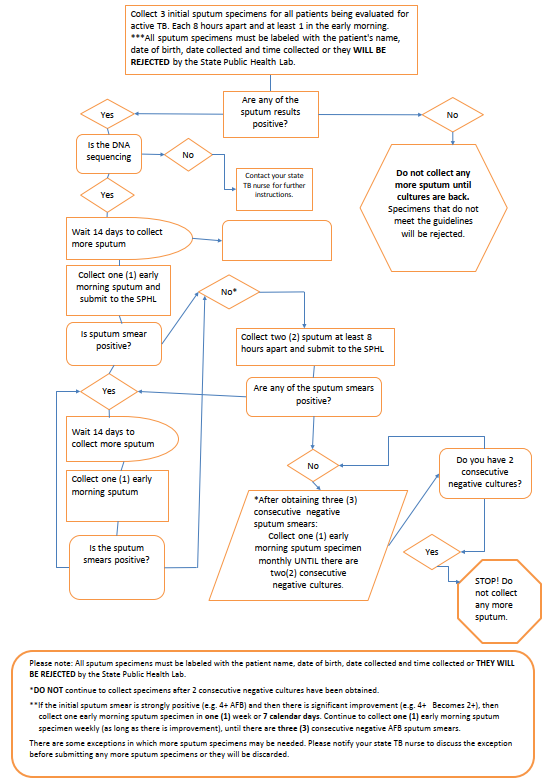
- See instructions for Sputum Specimen Submission to the State Public Health Tuberculosis Lab and the Sputum Specimen Collection Flow Sheet below.
- See CDC Module #8 “Contact Investigation for Tuberculosis”
- Complete patient interview within 3 days of notification of suspect TB.
Please do not collect sputum specimens more frequently than what is recommended below. If the Tuberculosis Unit at the State Public Health Laboratory receives more specimens than what is recommended below, the specimens will not be processed. If the patient is not clinically improving, and additional specimens are needed, please contact the DHSS TB Elimination nurse for your region. All specimens must arrive to the state lab within 72 hours of collection in order to be processed.
- If the patient has a cavitation present on the initial CXR and is culture positive after two months of therapy, the health care provider should be notified and length of treatment should be extended to nine months per ATS/CDC/IDSA recommendations. Morbidity and Mortality Weekly Report (MMWR), “Treatment of Tuberculosis” June 20, 2003, Vol. 52, No. RR-11, pages 7 and 8, Identification and Management of Patients at Increased Risk of Treatment Failure and Relapse, https://www.cdc.gov/mmwr/preview/mmwrhtml/rr5211a1.htm
Instructions for Sputum Specimen Submission to the State Public Health (SPHL) Tuberculosis (TB) Lab
Collect three (3) initial sputum specimens for all patients being evaluated for active TB. All sputum specimens should be collected a minimum of eight (8) hours apart and at least one specimen must be an early morning specimen.
After the specimen is collected label all sputum specimen tubes with the patient’s name, date of birth, date collected and time collected. If this is not done the SPHL will discard the specimen(s).
Submit the sputum specimen to the SPHL, as each one is collected; do not wait until you have all three (3) specimens to submit to SPHL.
- If one (1) of the three (3) sputum smears are Acid Fast Bacilli (AFB) positive DNA Sequencing positive.
- Wait two (2) weeks or 14 calendar days**, then
- Collect one (1) early morning sputum specimen.
- Label the specimen tube with the patient’s name, date of birth, collection date, and collection time Submit to the SPHL for processing.
- Wait for results:
- If negative, see Section 1: collection after AFB smear negative sample
- If initial specimens were 3 or 4+ and now they are 1 or 2+ collect an early morning once weekly until 3 consecutive negative sputum smears
**If the initial sputum smear is strongly positive (e.g. 4+ AFB) and then there is significant improvement (e.g. 4+ becomes 2+), then collect one early morning sputum specimen in one (1) week or 7 calendar days. Continue to collect one (1) early morning sputum specimen weekly (as long as there is improvement), until there are three (3) consecutive negative AFB sputum smears.
Section 1: Collection after AFB smear negative sample
- If the one (1) sputum smear in 1 b above, is AFB negative:
- Collect two (2) more sputum specimens at least eight (8) hours apart.
- Label each sputum specimen tube with the patient’s name, date of birth, collection date, and collection time.
- Submit to the SPHL for processing.
- Wait for results.
- If negative, see Section 1: Collection after AFB smear negative sample
- If positive, see Section 2: Collection after AFB smear positive sample
Do this until there are three (3) consecutive negative sputum smears.
Section 2: Collection after AFB smear positive sample
- If the one (1) sputum smear is AFB positive:
- Wait two (2) weeks, then
- Collect one (1) early morning sputum specimen.
- Label specimen tube with the patient’s name, date of birth, collection date, and collection time.
- Submit to the SPHL for processing.
- Wait for sputum smear results.
- If negative, see Section 1: Collection after AFB smear negative sample
- If positive, see Section 2: Collection after AFB smear positive sample
If the sputum specimen is AFB positive, continue to collect one (1) early morning sputum specimen every two (2) weeks.
Do this until there are three (3) consecutive negative sputum smears, then:
See #3 below for further instructions
- After obtaining three (3) consecutive negative AFB sputum smears:
- Collect one (1) early morning sputum specimen monthly.
- Label the sputum specimen tube with the patient’s name, date of birth, collection date and collection time.
- Submit to the SPHL for processing.
- Wait for the results.
Continue collecting one (1) early morning sputum specimen monthly and submit to the SPHL until there are two (2) consecutive negative sputum cultures.
Then stop collecting!
- There are some exceptions in which more sputum specimens may be needed. Please notify your state TB Elimination program nurse to discuss the exception before submitting any more sputum specimens or they will be discarded.
Do not continue to collect and submit sputum specimens to the SPHL after there are two (2) consecutive negative sputum cultures, they will not be processed.
TB Signs and Symptoms Checklist – (See the TB Manual; Appendices/Other Resources)
Checklist for Active Disease Case: - (See the TB Manual; Appendices/Other Resources)
Sputum Collection Flow Chart
Algorithm for Sputum Collection Submission to the State Public Health (SPHL) Tuberculosis (TB) Lab
Obtaining TB Medications
Policy: To provide medications for the treatment of Tuberculosis (TB) disease as funding allows.
Purpose: To eliminate all barriers in providing TB medications. To facilitate nursing case management of TB patients through the Local Public Health Agency (LPHA).
Procedure:
- The local public health agency should complete the Tuberculosis Medication Request Form, TBC-8, (see appendix) and FAX along with the prescriptions for TB medications to the state contract pharmacy. Mail the original prescription to the pharmacy. A copy should be retained in the patient record.
- The prescription may be written for the entire expected course of treatment. The pharmacy will dispense only ONE MONTH at a time.
- Check the Five “R”s of medication before administering: Right medication, Right dose, Right patient, Right route, and Right time.
- The medication is only to be administered to the patient and/or legal guardian.
- When another health care provider is providing Directly Observed Therapy (DOT), i.e. nursing home, student health center etc., the receiving LPHA nurse signs and accepts responsibility for the TB medications and transfers them to the health care provider.
- The TB medications should be recorded on the tuberculosis drug monitoring record, TBC1 (See appendix). All medications should be documented on the TBC-1.
- Fax the TBC-1 to State TB nurse each month.
- For patients receiving their TB medications from an alternate source, ensure that the patient and physician understands the benefit of receiving the medications from the state pharmacy at no charge to the patient.
- Nursing case management is available through the local public health nurse regardless of where the patient obtains his/her medications.
- If the patient and/or physician decline the use of the state pharmacy, the patient is still the responsibility of the LPHA. The local public health agency should contact the patient and/or their physician at least monthly to monitor their progress.
TB Medication Request Form (TBC-8) – (See the TB Manual; Appendices/Sample Forms)
Treatment for TB Disease
Policy: All individuals taking treatment for Suspect/Active TB Disease should be on a standard treatment regimen as indicated by the CDC/ATS recommendations
Purpose: To ensure safe and appropriate treatment for LTBI
When TB bacteria become active (multiplying in the body) and the immune system can’t stop the bacteria from growing, this is called TB disease. TB disease will make a person sick. People with TB disease may spread the bacteria to people with whom they spend many hours.
It is very important that people who have TB disease are treated, finish the medicine, and take the drugs exactly as prescribed. If they stop taking the drugs too soon, they can become sick again; if they do not take the drugs correctly, the TB bacteria that are still alive may become resistant to those drugs. TB that is resistant to drugs is harder and more expensive to treat.
TB disease can be treated by taking several drugs for 6 to 9 months. There are 10 drugs currently approved by the U.S. Food and Drug Administration (FDA) for treating TB. Of the approved drugs, the first-line anti-TB agents that form the core of treatment regimens are:
- isoniazid (INH)
- rifampin (RIF)
- ethambutol (EMB)
- pyrazinamide (PZA)
Please follow this link to access the recommended dosage and treatment guidelines for drug susceptible or drug resistant cases.
Monthly Patient Monitoring
Policy: All patients receiving medications for tuberculosis (TB) will receive at a minimum, a monthly review by the Public Health Nurse.
Purpose: To evaluate the response to therapy, to identify adherence problems, and monitor for adverse effects of treatment.
Procedure:
- Schedule a visit (clinic or home) with the patient. This should be done at least once per month.
- Monitor/document for medication toxicity utilizing the TBC-1 form. Notify the physician if signs or symptoms of toxicity are noted.
- Assess patient for clinical response to the prescribed regimen. Symptoms should improve within a few days to a few weeks.
- Decrease in frequency of cough
- Less sputum production
- Increased appetite
- Weight gain
- Reduction in fever
- Decrease night sweats
If the patient is not showing the expected clinical response, notify the health care provider promptly.
- If patient is exhibiting signs/symptoms of hepatotoxicity, liver function tests should be drawn.
- If patient has elevated liver enzymes or sign/symptoms of hepatotoxicity contact the health care provider promptly. If the health care provider is unavailable have the patient hold medications until further notice (no more than 2 – 3 days).
- Assess for adherence to the prescribed medication regimen.
- Pill counts – count number of pills left in each medication bottle and document.
- Ask patient how many times medications were forgotten or missed.
- If you believe the patient is non-compliant try and determine reason. Attempt to correct for non-adherence through using incentives/enablers. See section 4.06.
- Directly Observed Therapy (DOT) is the standard of care for tuberculosis.
- Provide patient education: Education should be provided in the patient’s primary language and at an educational level appropriate for the patient. To include at least the following:
- Tuberculosis disease process.
- Expected outcomes of treatment.
- Stress the importance of taking all medications exactly as prescribed. Taking only part of the medication or missing doses may result in drug resistance.
- Benefits/adverse outcomes of drug regimens.
- Discussion of infectiousness and infection control.
- Methods of supervision i.e. DOT, keeping all doctor’s and clinic appointments.
- FAX/mail a copy of the Tuberculosis Drug Monitoring Record (TBC-16) to the state TB nurse each month.
- Patient should be receiving daily DOT; if on eDOT, patient should receive no more than a 30 day supply of medication.
- Medication provided by the state contracted pharmacy may be transferred to another outpatient agency (i.e. school or university) who will be providing DOT for the patient. Medication provided thru the state contracted pharmacy cannot be transferred with a patient being admitted to an inpatient facility (i.e. long-term care facility, detention center). If the patient is transferring out of state, obtain the new address and phone number and notify the state TB Program. Do not send more than a 30 day supply of TB medications with the patient if they are transferring out of state. Notation of the transfer of medication should be documented in the patient record and DHSS’s TB Elimination Program shall be notified. LPHA staff are responsible for monthly follow up of all patients receiving TB treatment.
Tuberculosis Drug Monitoring Record (TBC-1) – (See TB Manual; Appendices/Sample Forms)
Directly Observed Therapy (DOT)
Policy: Directly observed therapy (DOT) is the standard of care for all persons being treated for tuberculosis disease.
Purpose: Standard of care. DOT coupled with individualized case management leads to the best treatment results.
Procedure: DOT involves providing the antituberculosis medications directly to the patient and watching as he/she swallows the medications.
- Initiating DOT
- DOT can be provided daily or intermittently in the office, clinic or in the “field” i.e. patient’s home, place of employment, school, institutional settings such as hospitals, nursing homes and correctional facilities, or any other site that is mutually agreeable.
- Careful attention must be paid to ensuring that medication is, in fact swallowed.
- If the patient misses a scheduled appointment for DOT – the DOT provider must make immediate contact with the patient to schedule the next dose of medication, as soon as possible. This can include calling the patient or making a field visit.
- All patients should continue to be monitored for signs and symptoms of treatment failure, and possible medication side effects.
- Documentation of DOT
- A medication record should be kept on each patient.
- At completion of therapy document the number of DOT doses received.
- Process of DOT
- The local public health agency (LPHA), the observer, and the patient will set a mutually agreed upon schedule and site for observing the actual ingestion of medication(s).
- The observer may be a responsible person other than the patient, or one who is not subservient to the patient. Examples include: school or employee health nurses, work supervisors, clergy, or other responsible person, who does not have strong emotional ties with the patient.
- If the case is a child, the observer cannot be the child’s parent or family member.
- On the last DOT visit, prior to a weekend/holiday, the LPHA shall leave doses for those days only with the patient.
The following steps should occur at each DOT encounter:
- Check for medication side effects. The observer and the patient must be instructed by the local public health agency and have written materials regarding the potential adverse reaction(s) to the medication(s) that the patient is taking. Each time the observer and the patient meet for medication(s), the observer must check for any signs or symptoms of adverse reactions.
- Verify the medication. Each time DOT is administered, the observer should verify that the right medications are administered to the right patient in the right amount. If this cannot be confirmed, do not give the medication to the patient. The local public health agency should be notified.
- Watch the patient take the medications. The observer must actually see the patient swallow the medication(s). The observer should remain with the patient for approximately five (5) minutes after the medication has been ingested, to assure that there is no regurgitation of the medication(s).
- Document the visit. The observer and patient must date and sign/initial for each dose of medication ingested. See medication administration record. This documentation then becomes part of the patient’s medical record.
- The observer must demonstrate understanding of patient confidentiality laws and observe them at all times. Confidentiality statement signed by the observer should be kept on file with the local agency.
- If the patient misses even one (1) appointment to take medication(s), the observer MUST notify the local public health agency immediately. The nurse then MUST immediately try to locate the patient and reinstitute DOT.
- Sample agreements to utilize for DOT are located in the appendix.
Tuberculosis Medication Directly Observed Therapy Form (TBC-16) – (See the TB Manual: Appendices/Sample Forms)
Directly Observed Therapy (DOT) Financial Assistance
Policy: To provide additional funding to Local Public Health Agencies (LPHA) to assist with providing DOT for Tuberculosis (TB) disease patients and or high-risk Latent Tuberculosis Infection (LTBI) patients. Funds are limited and subject to approval.
Purpose: To promote the use of DOT for TB disease patients and high-risk LTBI patients.
Procedure:
- Financial assistance is granted to LPHAs to assist them with the cost of traveling to the patient to provide DOT only, not for the patient to come to the LPHA for DOT.
- Notify the Department of Health and Senior Services (DHSS) TB Elimination Program that the LPHA is interested in participating in the DOT Financial Assistance Program by sending an encrypted email to TBProgram@health.mo.gov.
- If your agency does not have encryption capabilities, please send an email to the email address above, requesting an encryption email be started, to allow you to complete a request for DOT financial assistance.
- Requests for assistance should include the following information:
- Name of the patient
- TB Disease or Infection
- First priority is given to patients with disease.
- Second priority is given to patients with infection who are high risk for developing TB disease or who are a close contact to an active tuberculosis case.
- Planned treatment start date
- Planned completion date
- Frequency of DOT (i.e. daily, twice a week, three times a week).
- Eligibility for DOT financial assistance will not begin until the date of the authorization letter.
- LPHAs that are providing DOT through eDOT are not eligible to receive financial assistance, as there is no travel involved when using eDOT.
- If DOT financial assistance is approved and the patient is switched over to eDOT during the treatment phase, any remaining balances of financial assistance will be canceled.
- The LPHA shall notify the TB Elimination Program/DSP Manager when the patient switches to eDOT.
- DHSS TB Elimination Program will send the signed letter of authorization to the requestor in a reply to the original encrypted email request. The hard copy of the letter will follow via United States Postal Service.
- This program is only available to LPHAs that do not have a TB contract with Missouri Department of Health and Senior Services.
- The LPHA may have up to no more than (4) patients in the program, per calendar year, for a maximum of $700 dollars per patient.
- LPHAs are limited to a maximum of $3,000 dollars in combined financial assistance and incentives/enablers, per calendar year. If completion of DOT is expected to run into the next calendar year, the LPHA will receive authorization for the full amount, with the understanding that financial assistance in the new calendar year is provisional and based on available funding.
- The patient must receive at least 80% of TB medications by DOT provided in the field or location other than at the LPHA, within a 30 consecutive day period, to receive DOT financial assistance.
- The program has a fixed price billing as follows:
| Standard Treatment | 12 Dose Treatment |
|---|---|
| a. $142/month for the first two months (60 days) - $35.50 week | a. $33.33 week/for three months (once weekly for twelve weeks) |
| b. $104/month for the last four months - $26.00 week | b. $400 per patient would be the maximum amount allowed |
| c. $700 per patient would be the maximum amount allowed | n/a |
- LPHA must send a monthly invoice to DHSS TB Elimination Programmonthly, to receive approved DOT financial assistance.
- If DOT ends sooner than the original, expected date of DOT completion, the LPHA must notify the TB Elimination Program DSP manager to cancel any remaining balances for the authorized financial assistance.
- Please see the billing template in this section for instructions for invoicing for services rendered.
- Documentation of the DOT visit must be recorded on the Medication Record (MR). The patient and the nurse each sign the record and then initial each date the medication was given/received.
- The individual observing the DOT has to adhere to all Department of Health and Senior Services (DHSS) policies regarding DOT. Please refer to section 4.0 in the policy manual, subsection DOT.
Directly Observed Therapy (DOT) Billing Template
- The Local Public Health Agency (LPHA) should use the following template when billing for DOT financial assistance from the Department of Health and Senior Services (DHSS). The billing cycle can be any 30-day period.
- Documentation of the DOT visit will be recorded on the Medication Record (MR). The patient and nurse will each sign the record and then initial each date the medication(s) was given/received. Leave patient name on the MR form.
- The MR and billing form shall be sent to the DSP manager via encrypted email to TBProgram@health.mo.gov or by faxing to (573) 526-0234.
- Put the sample paragraph on an agency letterhead.
- Sample paragraph:
The Tuberculosis (TB) disease patient (do not use patient name on this form) residing in (County) received at least 80% of their TB medications by DOT provided in the field or location other than at the LPHA, as validated by the attached medication record (MR).
_______________________________________________
Signature of County Staff or Signature of LPHA
Tuberculosis Incentives and Enablers Program
Policy: To facilitate successful treatment for tuberculosis (TB).
Purpose: To improve compliance with therapy, through the use of incentives/enablers, as funding allows, for those patients with tuberculosis disease or infection.
Incentives are small rewards given to patients to encourage them to keep their clinic and/or field appointments for Directly Observed Therapy (DOT) and medical evaluations.
Examples of Incentives
- Food vouchers for snacks or meals
- Groceries
- Restaurant coupons
- Clothing or personal products (i.e. soap, toothpaste)
- Books
- Retail store gift certificate (can NOT be redeemed for alcohol, cigarettes or ammunition)
Enablers are those things that make it possible or easier for the patients to receive treatment by overcoming barriers such as transportation difficulties.
Examples of Enablers
- Transportation vouchers – cab fare
- Child Care – so patient can attend a doctor appointment
- Adjusted clinic hours and locations
- A person who speaks the languages of the populations served – Provider service
- Gas vouchers
- Health care supplies
Procedure:
- When a patient is identified who could benefit from the use of incentives/enablers, a request for funds should be made through the Missouri TB Elimination Program.
- Make an official written request for funds and send via encrypted email to the TB Elimination Program incentives/enablers manager at TBProgram@health.mo.gov.
- If your agency does not have encryption capabilities, please send an email to the DSP Manager requesting an encryption email be started, to allow you to complete a request for DOT financial assistance, or fax the written request to (573) 526-0234.
- The following information should be included in the request:
- Patient name
- How funds will be used
- If patient has TB disease or infection
- Requested item and cost of item
- Agency and nurse making the request
- How the funds will benefit the patient
- Any additional information as needed
- Date of service
- Upon approval of the request the DSP Manager will prepare a mini initiative to guarantee payment to the requesting agency for the specific items listed in the mini initiative during the specific time period. The requestor should note that these funds may not be expended prior to receiving the signed mini initiative guarantee reimbursement of funds or after the specified time period has expired.
- After expenditures are incurred, the LPHA shall request reimbursement by submitting an invoice, on the LPHAs letterhead, along with all supporting documentation, to the Missouri Department of Health and Senior Services, TB Elimination Program.
- The total of all invoices may not exceed the authorized amount in the mini initiative.
- All invoices must be received by the date indicated in the mini initiative in order to be considered for payment
- Invoices may be submitted by
- Mailing to: PO Box 570, 930 Wildwood Drive, Jefferson City, MO 65102- 0570.
- Attaching to an encrypted email and sending to: TBProgram@health.mo.gov.
- Faxing to: (573) 526-0234
- Annual incentives in excess of $250.00 for an individual patient will generally not be approved. Exceptions can be made in extenuating circumstances with the approval of the TB Program Manager and/or the Bureau Chief.
- First priority is given to purchasing incentives/enablers for patients with disease. Second priority is given to patients with infection who are high risk for breaking down with disease or who are a close contact to a tuberculosis case.
- Incentives should be tailored to the patient’s individual special needs and interests. Incentives are to be utilized to motivate the patient to complete his or her tuberculosis treatment.
HIV/TB Case Supervision
Policy: To provide Human Immunodeficiency Virus (HIV) counseling and testing to all patients presenting with suspect/known Tuberculosis (TB) disease.
Purpose: To ensure appropriate care and services for person co-infected with HIV and TB disease.
Procedure: Upon notification of a suspect/known TB case, the TB control staff person at the local health department will:
- Provide HIV counseling and testing, regardless of patient age.
- Treating a patient with HIV/TB co-infection can alter the course of treatment. It is very important for the physician to know the patient’s HIV status.
- Contact the HIV care coordinator once official notification of a positive HIV test is obtained.
- Coordinate the initial visit so a TB staff person and an HIV care coordinator are both present with the patient at the same time.
- Ensure that HIV care coordinators demonstrate understanding of the TB disease process and appropriate isolation precautions.
- Report all newly diagnosed HIV cases to the Missouri Department of Health and Senior Services (DHSS) on a CD-1 form (see appendix) within 3 days of first knowledge.
- Refer to Subsection 1.0 of this section for other care guidelines.
- Refer to the Morbidity and Mortality Weekly Report (MMWR) “Treatment of Tuberculosis”, June 20, 2003, section 8.0, page 50 for additional information on the treatment of TB/HIV co-infection.
- Updates to HIV/TB treatment guidelines are made frequently. Please check the CDC website for the most recent information on the treatment of HIV/TB co-infection.
Interjurisdictional Transfer
Policy: To provide prompt notification to the state, city, or county when a patient relocates.
Purpose: To ensure continuity of care when Tuberculosis (TB) patients relocate.
Procedure:
- Moving within the state:
- Notify by phone the receiving jurisdiction as soon as possible when a patient is relocating. The receiving county should immediately contact the patient. If the receiving county cannot locate the patient – contact the original county and see if additional information is available.
- Provide a copy of the patient’s record to the receiving health department/
- A signed release is NOT needed to transfer patient information to another health department.
- Notify the state TB Program of the patient relocation.
- Moving outside the state:
- The Local Public Health Agency (LPHA) must notify the Bureau of Communicable Disease Control and Prevention (BCDCP)/TB Elimination Program prior to a patient moving outside the state of Missouri. An Interstate Reciprocal Notification of Disease form will be forwarded to the state to which the patient has moved.
- Moving to Missouri from out of state:
- When a patient moves into Missouri, the state receives the Interstate Reciprocal Notification of Disease form from the originating state. The information will be passed to the LPHA were the patient is moving.
- Patient’s moving to Mexico:
- Contact the BCDCP/TB Elimination Program if a patient is relocating to Mexico.
- CURE-TB is an organization that provides linkage between Mexico and United States health departments. It helps improve continuity of care for TB patients traveling between the US and Mexico.
- For additional information on the Cure-TB Program website.
- Supervision in the county other than residence:
- If a patient receives a service in a LPHA other than his county of residence, notify the State TB Control Program.
Interruption of Therapy – TB Disease
Policy: To provide the patient with the recommended treatment for Tuberculosis disease when interruptions in therapy occur.
Purpose: To provide recommendations on how to assure that the patient receives the recommended amount of medications for TB disease.
Background:
- Interruptions of therapy can occur for many reasons: intolerance of medication, increase in liver enzymes, and non-compliance of the patient ingesting the medication.
- Completion of therapy is based on the total number of doses administered – not on duration of therapy alone.
- Treatment is more important in the initial phase of therapy – when there is a high bacillary number.
- The earlier the break in therapy and the longer its duration, the more serious the effect and the greater need to restart the treatment from the beginning.
Procedure: When the break in therapy occurs during the:
- Initial Phase: First two (2) months
- Lapse > 14 days in duration, treatment should be restarted from the beginning.
- Lapse < 14 days the treatment can be continued.
- In either case the total number of target doses to be given in the initial phase should be given.
- Continuation Phase
- If the patient has received > 80% of the planned total continuation phase doses given by Directly Observed Therapy (DOT), further treatment may not be necessary if:
- Sputum was initially smear negative.
- If sputum smear positive continued treatment is needed.
- If patient received > 80% of the planned total doses:
- Lapse is > 3 months duration – Treatment should be restarted from the beginning.
- Lapse is < 3 months in duration, treatment should be continued to complete a full course.
- If the patient has received > 80% of the planned total continuation phase doses given by Directly Observed Therapy (DOT), further treatment may not be necessary if:
- When the patient returns to treatment in either phase, sputum cultures should be obtained and repeat drug susceptibility testing performed.
- If positive cultures – treatment regimen must be restarted.
- If negative cultures – the patient could be treated as culture-negative TB and given an additional 4 months of combination therapy.
- DOT should be used to ensure completion of therapy. Regardless of timing and duration of therapy interruption.
- If already on DOT additional measures will be necessary to ensure completion of therapy. This could include incentives or involuntary commitment. (See Appendices Missouri Statutes and Regulations Concerning Tuberculosis – Commitment – Definitions (RSMO 199.170-199.350)
- Please see the current 2003 CDC recommendations for “Treatment of Tuberculosis” for further information.
Annual Statement for Tuberculin Reactors Form – (see the TB Manual; Appendices/Sample Forms)
Tuberculosis (Mycobacterium tuberculosis)
- 2009 Case Definition
CSTE Position Statement Number: 09-ID-65 - Clinical description
A chronic bacterial infection caused by Mycobacterium tuberculosis, usually characterized pathologically by the formation of granulomas. The most common site of infection is the lung, but other organs may be involved. - Clinical case criteria
- A case that meets all the following criteria:
- A positive tuberculin skin test or positive interferon gamma release assay for M. tuberculosis
- Other signs and symptoms compatible with tuberculosis (TB) (e.g., abnormal chest radiograph, abnormal chest computerized tomography scan or other chest imaging study, or clinical evidence of current disease)
- Treatment with two or more anti-TB medications
- A completed diagnostic evaluation
- A case that meets all the following criteria:
- Laboratory criteria for diagnosis
- Isolation of M. tuberculosis complex from a clinical specimen, * or
- Demonstration of M. tuberculosis complex from a clinical specimen by nucleic acid amplification test (NAAT), ** or
- Demonstration of acid-fast bacilli in a clinical specimen when a culture has not been or cannot be obtained or is falsely negative or contaminated.
- Case classification
Confirmed: a case that meets the clinical case definition or is laboratory confirmed
Suspect (presumptive): A person with signs and/or symptoms suggestive of active TB that does not yet have a complete diagnostic evaluation.
Comment
A case should not be counted twice within any consecutive 12-month period. However, a case occurring in a patient who had previously had verified TB disease should be reported and counted again if more than 12 months have elapsed since the patient completed therapy. A case should also be reported and counted again, if the patient was lost to supervision for greater than 12 months and TB disease can be verified again. Mycobacterial diseases other than those caused by M. tuberculosis complex should not be counted in tuberculosis morbidity statistics unless there is concurrent tuberculosis.
*Use of rapid identification techniques for M. tuberculosis (e.g., DNA probes and mycolic acid high-pressure liquid chromatography performed on a culture from a clinical specimen) is acceptable under this criterion.
**Nucleic acid amplification (NAA) tests must be accompanied by culture for mycobacteria species for clinical purposes. A culture isolate of M. tuberculosis complex is required for complete drug susceptibility testing and also genotyping. However, for surveillance purposes, CDC will accept results obtained from NAA tests approved by the Food and Drug Administration (FDA) and used according to the approved product labeling on the package insert, or a test produced and validated in accordance with applicable FDA and Clinical Laboratory Improvement Amendments (CLIA) regulations.
References
- CDC (2009, June) CDC Tuberculosis Surveillance Data Training: Report of Verified Case of Tuberculosis (RVCT) Instruction Manual. Atlanta, GA: U.S. Department of Health and Human Services, CDC. (Appendix A – Tuberculosis Case Definition for Public Health Surveillance) https://www.cdc.gov/tb/programs/rvct/instructionmanual.pdf
See also:
- 1996 Case Definition
- 1990 Case Definition
5.0 Case Management - Infection
Tuberculosis Case Management Manual
Patient Pretreatment Evaluation and Monitoring
Policy: Latent Tuberculosis Infection (LTBI) must be diagnosed and active TB Disease ruled out prior to initiating treatment. LTBI patients should be evaluated at least monthly during treatment.
Purpose: To ensure safe and appropriate treatment for LTBI.
Procedure:
- Rule out active TB Disease. Ensure that the client has received a medical evaluation and current anterior/posterior (AP) chest x-ray (CXR) to rule out active TB Disease, prior to beginning treatment for LTBI. Children under 18 years of age need an AP/lateral CXR. The TB signs and symptoms checklist should be completed as soon as possible for each individual with a positive TST or Interferon Gamma Release Assay (IGRA).
If patient is symptomatic, collect three sputums and submit to the Missouri State Public Health Lab for evaluation (see Section 3). The three sputums must be collected at least eight hours apart, with one of the three being an early morning collection. If cultures are pending, wait for results before beginning LTBI treatment, even if sputum results are smear negative. - Clinical Monitoring: Schedule a home or clinic visit with the patient at least once per month to include:
- Brief physical assessment for signs of hepatitis (See Appendix: Urine Chart)
- Assessment of adherence to treatment
- Review of symptoms for possible adverse medication reactions or interactions
- Review of signs and symptoms of TB Disease (Signs and Symptoms Checklist)
- Liver Function (LFT) Testing:
- Baseline AST/SGOT, ALT/SGPT at the start of LTBI therapy is recommended for clients with any of the following:
- Liver disorders
- History of liver disease (hepatitis B or C, alcoholic hepatitis or cirrhosis)
- Regular use of alcohol
- Risks for chronic liver disease
- HIV infection
- Pregnancy or immediate postpartum period (within 3 months of delivery)
- Baseline testing can be considered on an individual basis, especially for patients taking other medications for chronic medical conditions. LFT’s will only be covered by the Diagnostic Services Program (DSP) on a case by case basis, with prior approval by the DHSS TB Elimination Program. (See TB Manual-DSP Program)
- Routine periodic retesting is recommended for individuals with abnormal initial results and other persons at risk for hepatic disease.
- Laboratory testing is recommended for any patient who has symptoms suggestive of hepatitis such as:
Fatigue, weakness, malaise, anorexia, nausea, vomiting, abdominal pain, pale stools, dark urine, chills, or signs of jaundice - AST level 3 or more times the upper limit of normal can be accepted if the patient is free of hepatitis symptoms and up to 3 times the upper limit of normal if there are signs and symptoms of liver toxicity.
Also see MMWR Treatment of Tuberculosis at Page 43 - Section 6.3.4. Hepatitis
- Baseline AST/SGOT, ALT/SGPT at the start of LTBI therapy is recommended for clients with any of the following:
- Patient Education:
- Explain the disease process and rationale for medication in the absence of symptoms or CXR abnormalities.
- Provide patient education, written and verbal instructions, in patient’s primary language, if available.
- Advise the patient to abstain from the consumption of alcohol, to include beer and wine. The combination of alcohol and TB medications together can cause life threatening liver conditions.
- Reinforce patient education at each visit.
- Ensure confidentiality.
- Review the importance of completing treatment for LTBI.
- Patients should be instructed to take the following steps if symptoms of hepatitis develop:
- Immediately stop taking medications and contact Case Manager/clinic. Follow instruction of Case Manager/clinic personnel regarding medical attention.
- If Case Manager/clinic personnel are not immediately available, leave a message notifying of the development of symptoms, then seek emergency medical attention.
- Follow up with Case Manager/clinic regarding continuation or alteration of LTBI treatment regimen
- Assessing Adherence:
- Many variables affect a patient’s adherence to the medication regimen for treatment of LTBI. Episodes of non-adherence should be addressed as soon as possible.
- Adherence Questionnaire:
- When do you take your medicines?
- How do you remember to take your medicines?
- How many pills did you miss?
- How many pills do you have left in your medication bottle?
- When was the last time you missed any of your LTBI medications?
- Request patient to bring medication bottles with them to each clinic visit. Count the remaining pills in each bottle.
- Discuss patient reminders such as pill boxes or calendars to increase adherence to medication regimen.
- Directly Observed Therapy (DOT) should be considered under the following circumstances:
- Medication is prescribed intermittently. There are several treatment regimens available for the treatment of LTBI. Providers should choose the appropriate regimen based on:
- Drug-susceptibility results of the presumed source case (if known);
- Coexisting medical illnesses; and
- Potential for drug-drug interactions.
- For persons who are at especially high risk for TB disease and are either suspected of non-adherence or are given an intermittent dosing regimen, directly observed therapy (DOT) for LTBI should be considered. (For more information on DOT, see the; Case Management: Disease)
This method of treatment is especially appropriate if the person in need of LTBI treatment lives with a household member who is on DOT for TB disease, or lives in an institution or facility where treatment for LTBI can be observed by a staff member. It is necessary to exclude TB disease before starting LTBI treatment. - The patient is high risk (HIV positive, TB contact or child less than 5 years of age).
- Medication is prescribed intermittently. There are several treatment regimens available for the treatment of LTBI. Providers should choose the appropriate regimen based on:
- Dispensing TB Medications:
- Ensure the five rights of medication administration are followed: Right patient, right medication, right time, right dose, and right route.
- Check patient allergies.
- Do not issue more than a 30-day supply of medication at each monthly clinic visit.
- Medication provided by the state contracted pharmacy may be transferred to another outpatient agency (i.e. school or university) who will be providing DOT for the patient. Medication provided thru the state contracted pharmacy cannot be transferred with a patient being admitted to an inpatient facility (i.e. long-term care facility, detention center). If the patient is transferring out of state, obtain the new address and phone number and notify the state TB Program. Do not send more than a 30 day supply of LTBI medications with the patient if they are transferring out of state. Notation of the transfer of medication should be documented in the patient record and DHSS’s TB Elimination Program shall be notified. LPHA staff are responsible for monthly follow up of all patients receiving LTBI treatment.
- Documentation of Clinic Visit:
- If it is not documented, it did not happen.
- Signs/symptoms of adverse reactions must be documented with actions taken in the patient record.
- Information can be entered into the encounter page of the WebSurv program.
- Information is to be documented on page 2 (backside) of the TBC-4.
- Send a copy of the completed TBC-4 to the DHSS’s TB Elimination Program if not entered in WebSurv.
Obtaining TB Medications
Policy: To provide medications for the treatment of Latent Tuberculosis Infection (LTBI) as funding allows.
Purpose: To eliminate all barriers in providing LTBI medications to patients that are at increased risk for progression of LTBI to TB disease. To facilitate nursing case management of LTBI patients through the Local Public Health Agency (LPHA).
Procedure:
- If the patient meets any of the eligibility criteria from the CDC Core Curriculum on Tuberculosis, sixth edition 2013, page 32, Table 2.6
The LPHA should complete the LTBI Medication Authorization (TBC-9) and FAX, or send encrypted email to TBProgram@health.mo.gov, with a copy of the CXR report, Tuberculin Testing Record (TBC-4), and the prescriptions (see appendix for forms) to the state TB program. Copies should be retained in the patient record. Once the state nurse has reviewed the documents and authorized the TBC-9 it will be faxed back to the LPHA. The LPHA should fax the authorized TBC-9 along with the prescription(s) to the state contracted pharmacy (see TBC-9 for pharmacy fax number).- State TB Program Fax number: (573) 526-0234
- The prescription may be written for the entire expected course of treatment. The pharmacy will dispense ONE MONTH at a time.
- Check the Five “R”s of medication before administering: Right medication, Right dose, Right patient, Right route, and Right time.
- The medication is only to be given to the patient and/or legal guardian in which the medication bottle is labeled and for whom the prescription is written.
- The LPHA should see the patient at least monthly to monitor for adverse effects to the medications, evaluate for signs and symptoms of TB and document the monthly finding on the back of the TBC-4. If the patient reports any adverse effects or signs and symptoms of TB disease, then HOLD the patient’s medications, and notify the medical provider immediately for further direction. If it is an emergency refer the patient to the closest emergency room.
If the health care provider chooses to evaluate the patient monthly, instead of the LPHA, then the LPHA is responsible for calling the health care provider monthly (See Introduction/Roles and Responsibilities). Complete the back of the TBC-4 for each monthly call and document the follow up. Once the patient has completed treatment FAX the completed, front and back, of the TBC-4 to the state TB program.
LTBI Treatment Regimens
Policy: All individuals taking treatment for LTBI should be on a standard treatment regimen as indicated by the CDC/ATS recommendations
Purpose: To ensure safe and appropriate treatment for LTBI.
| Drug(s) | Duration | Dose | Frequency | Total Doses |
|---|---|---|---|---|
| Isoniazid (INH)* and Rifapentine (RPT | 3 months | Adults and Children aged 12 years and older: INH: 15mg/kg rounded up to the nearest 50 or 100 mg; 900 mg maximum RPT: 10-14.0 kg 300 mg 14.1-25.0 kg 450 mg 25.1-32.0 kg 600 mg 32.1-49.9 kg 750 mg ≤50.0 kg 900 mg maximum Children aged 2 – 11 years: INH*: 25 mg/kg; 900 mg maximum RPT† : as above | Once weekly | 12 |
| Rifampin (RIF)§ | 4 months | Adults:10 mg/kg Children: 15–20 mg/kg• Maximum dose: 600 mg | Daily | 120 |
| Isoniazid (INH)* and Rifampin)§ | 3 months | Adults: INH*: 5 mg/kg; 300 mg maximum RIF§: 10 mg/kg; 600 mg maximum Children: INH*: 10-20 mg/kg; 300 mg maximum RIF§: 15-20 mg/kg; 600 mg maximum | Daily | 90 |
| Isoniazid (INH) | 6 months | Adults: 5 mg/kg Children: 10–20 mg/kg¶ Maximum dose: 300 mg | Daily | 180 |
| Adults:15 mg/kg Children:20–40 mg/kg¶ Maximum dose: 900 mg | Twice weekly‡ | 52 | ||
| 9 months | Adults:5 mg/kg Children:10–20 mg/kg¶ Maximum dose: 300 mg | Daily | 270 | |
| Adults: 15 mg/kg Children: 20–40 mg/kg¶ Maximum dose: 900 mg | Twice weekly‡ | 76 |
Reference: Core Curriculum on Tuberculosis: What the Clinician Should Know. Sixth Edition 2013. Chapter 5, Treatment of LTBI.
https://www.cdc.gov/tb/topic/treatment/ltbi.htm
*Isoniazid(INH); Rifampin (RIF); Rifapentine (RPT)
**updated age recommendations: CDC website
Peripheral Neuropathy
- Uncommon at doses of 5 mg/kg
- Those at risk may also be given pyridoxine (vitamin B6)
- Persons at high risk for neuropathy (e.g., diabetes, uremia, alcoholism, malnutrition, HIV infection)
- Pregnant women
- Persons with a seizure disorder
- Patients who develop signs and symptoms of peripheral neuropathy
Medication Fact Sheets: (see the TB Manual; Appendices/Educational Materials)
Checklist for Latent TB Infection – (see TB Manual; Appendices/Other Resources)
LTBI Medications – Adverse Effects
Policy: To educate the patient concerning the adverse effects of medications used for the treatment of LTBI.
Purpose: To ensure the patient has education concerning the adverse effects of TB medications and what action to take.
Note: Patients should be instructed initially and at each monthly visit to stop taking TB medications and to seek medical attention immediately if symptoms of hepatitis (liver toxicity) develop and not to wait until a clinic visit to stop medications.
Three of the first line anti-tuberculosis drugs, INH, Rifampin, and PZA, can cause drug-induced liver injury. If the LFT (liver function tests) AST level is three or more times the upper limit of normal in the presence of hepatic symptoms, or five or more times the upper limit of normal in the absence hepatic symptoms. The medications should be stopped immediately and the patient should be evaluated by a medical provider. If the AST is less than 5 times the upper limit of normal, toxicity can be considered mild, an AST level of 5-10 times normal defines moderate toxicity, and AST level of greater than ten times normal (i.e., greater than 500 IU) is severe. It is important to note that an asymptomatic increase in AST concentration occurs in nearly 20% of patients being treated with the standard four-drug regimen. In the absence of clinical and laboratory monitoring should be increased.
Possible adverse effects of INH:
- Risks of fulminant INH-related hepatitis appear to be greatest if INH is continued after onset of symptoms of hepatotoxicity. (In one study, 7 of 8 patients requiring INH related liver transplant continued taking INH for at least 10 days after onset of symptoms.
- In addition to clinical monitoring, it is essential to educate patients about the symptoms of hepatotoxicity and instructing them to stop treatment immediately if such symptoms occur and report to the clinician for evaluation.
- Clinical hepatitis occurs in 0.1% to 0.15% of people taking INH, and is more common when INH is combined with other agents. Factors that may increase either these rates or the severity of the hepatitis include:
- alcohol consumption,
- underlying liver disease
- use of other medications which are metabolized in the liver such as Acetaminophen.
- Peripheral neuropathy, caused by interference with metabolism of Vitamin B6 (pyridoxine) can occur in less than 0.2% of people taking INH at regular doses (300 mg a day), and is more likely in the presence of other conditions associated with neuropathy such as diabetes, HIV, renal failure and/or alcoholism. 10-50 mg of Vitamin B6 (pyridoxine) supplementation is recommended for:
- Pregnant or breastfeeding women.
- Individuals with seizure disorders.
- Patients with conditions in which neuropathy is common (e.g. diabetes, uremia, alcoholism, malnutrition, HIV infection).
Recommended dosage for adults 5 mg/kg daily (300 mg per day maximum) or 15 mg/kg 2 – 3 times weekly (up to 900 mg maximum), as prescribed by the physician.
Patients unable to tolerate INH can often tolerate Rifampin.
Possible adverse effects of Rifampin:
- Hepatotoxicity may occur in 0.6% of persons taking Rifampin. Hepatitis is more likely when combined with INH.
- Cutaneous skin reactions, such as flushing and itching with or without a rash, may occur in 6% of persons taking Rifampin. It is generally self-limiting and may not be a true hypersensitivity; continue treatment if possible.
- Gastrointestinal symptoms such as nausea, anorexia, diarrhea and abdominal pain are rarely severe enough to discontinue treatment.
- Reddish orange to reddish brown discoloration of body fluids (urine, stool, saliva, sputum, sweat and tears) is expected and harmless, but patients should be advised and prepared to see this side effect. Soft contact lenses may be permanently stained.
- Rifampin interacts with a number of drugs. It is known to reduce concentrations of oral hypoglycemic agents, methadone, warfarin, oral contraceptives and phenytoin. Women using oral or other systemic hormonal contraceptives are at greater risk of becoming pregnant during Rifampin therapy therefore these patients should use a backup barrier form of contraception, such as condoms, to avoid pregnancy during treatment.
If patient thinks they have become pregnant during treatment, stop treatment and notify physician. - All drugs in treating TB can cause a rash. The response to a patient with a rash depends on its severity. Thrombocytopenia (low platelets) is a possible adverse reaction to Rifampin. A baseline complete blood count (CBC), including platelet count should be obtained for all adults. A petechial rash may suggest thrombocytopenia (dangerously low blood count) in patients taking Rifampin. If a petechial rash occurs the platelet count should be checked and, if low, Rifampin hypersensitivity should be presumed to be the cause. Rifampin should be stopped and the platelet count monitored until it returns to baseline; Rifampin should not be restarted. If the rash is generalized, especially associated with fever and/or mucous membrane involvement, all drugs should be stopped immediately and the physician should be notified. If emergency the patient should seek immediate medical attention. If the patient has been assessed by their medical provider and the rash has substantially improved, the medications can be restarted one by one, at intervals of 2-3 days. Rifampin should be restarted first, followed by INH, and EMB or PZA. If the rash recurs the last drug added should be stopped. If no rash appears after the first three drugs have been restarted, the fourth drug should not be restarted unless the rash was relatively mild and the fourth drug is considered essential for therapy.
- Rifampin is contraindicated in HIV infected patients being treated with certain protease inhibitors (PI) or nonnucleoside reverse transcriptase inhibitors (NNRTI). In the situation, Rifabutin may be substituted for Rifampin.
Interruption of Therapy
Policy: To provide the patient with the recommended treatment for LTBI when interruptions of therapy occur.
Purpose: To provide recommendations to ensure the patient receives the recommended doses of medication to complete therapy.\
Procedure:
- Completion of therapy is based on the total number of doses administered – not on the duration of therapy alone.
- The 4-month regimen of daily Rifampin (RIF) consists of 120 doses, at minimum, administered within 6 months.
- The 3-month regimen of INH and RIF (3HR) consists of 90 doses, at minimum, administered within 4 months.
- The 12 dose once weekly regimen of INH/Rifapentine (3HP) consists of 12 doses, 11 doses at minimum, administered within 16 weeks (there must be 3 days minimum between doses).
- The 6 month regimen of daily INH consists of 180 doses, at minimum, administered within 9 months. Twice weekly INH for 6 months consists of 52 doses, at minimum, administered within 9 months and must be given by DOT.
- The 9 month regimen of daily INH consists of 270 doses, at minimum, administered within 12 months. Twice weekly INH for 9 months consists of 76 doses, at minimum administered within 12 months and must be given by DOT.
- Ideally, the patient should receive medication on a regular dosing schedule until completion of the indicated course of therapy. However, in practice some doses may be missed, requiring the course to be lengthened.
- When restarting therapy for patients who have interrupted treatment, clinicians may need to continue the regimen originally prescribed or restart (renew the entire regimen if interruptions were frequent enough to preclude treatment doses as recommended above) the entire treatment regimen depending upon the length of the interruption and if there is sufficient time for the patient to complete the recommended doses within the recommended length of time (e.g. 4 month regimen of RIF within 6 months and complete 120 doses or a 6 month regimen of INH within 9 months and complete 180 doses).
- If greater than a 2-month interruption of therapy occurs, a medical examination to rule out active TB disease is indicated.
*Intermittent regimen should be given utilizing DOT.
**12 dose regimen must be given by DOT.
Special Considerations in Treatment of LTBI
Policy: To provide appropriate treatment for LTBI for all individuals.
Purpose: To address special conditions while treating individuals for LTBI.
Contacts to Cases:
- Contacts are those with recent, prolonged exposure to a person with known or suspected infectious TB. They should be evaluated immediately for TB disease and LTBI.
- If TST or IGRA is positive, LTBI treatment guidelines should be followed, after ruling out active TB disease.
- If TST or IGRA is negative, the contact should be retested in 8 – 10 weeks to allow time for the contact’s immune response to TB infection to be detectable.
- Window Treatment:
- If a contact is a child less than 5 years of age, or an immunocompromised person of any age, they should have a TST or IGRA, medical evaluation and an anterior/posterior (AP), chest x-ray (CXR). The CXR for children should include a lateral view. If they are all negative, then treatment with daily RIF (preferred) should by initiated immediately until the 2nd follow up TST or IGRA is done in 8- 10 weeks. (If the child is less than 6 months of age, the follow-up TST or IGRA should be done after the child is over 6 months of age, due to possible anergy). If the follow-up TST or IGRA is negative, no further treatment is needed for LTBI. If the follow-up TST or IGRA are positive, then treatment should be continued as an LTBI, until they have completed 4 months (120 doses) of RIF within 6 months. If it is known that the disease case is resistant to RIF then INH can be given. Please contact the State TB nurse for guidance if needed.
- DOT is recommended for infected contacts of active disease cases, especially children under 5 years of age and any individual that is immunocompromised.
Re-Infection:
In general, TST or IGRA positive contacts with a documented history of prior adequate treatment for LTBI do not need to be retreated. Re-treatment may be indicated for persons at high risk of becoming infected and progressing to TB disease again, such as immunocompromised persons.
HIV-Positive Individuals:
- HIV infected individuals should be treated with a 9-month regimen of daily INH.
- Rifampin is contraindicated in HIV-infected person being treated with certain combinations of antiretroviral drugs. In those cases, Rifabutin may be substituted for Rifampin. See CDC website.
- If TST or IGRA is negative, treat if person has recent, prolonged exposure to infectious TB or if there is ongoing risk for exposure.
Pregnancy:
- Consider immediate treatment for LTBI if the woman is HIV-infected or is a recent contact to TB disease case.
- In the absence of risk factors for active TB, wait until three months post-partum to avoid administering medication during pregnancy.
- INH daily or twice weekly by DOT is the preferred regimen.
- Supplementation with 50 mg daily, of vitamin B6 is recommended.
Breastfeeding:
- Breastfeeding is not contraindicated in women taking INH.
- Supplementation with 50 mg daily, of vitamin B6 is recommended for nursing women and breastfed infants.
- Amount of INH in breast milk is inadequate for treatment of infants exposed to TB.
Infants and Children:
- Infants and children under 5 years of age with LTBI have been recently infected and, therefore, are at high risk for progression to disease.
- Risk of INH-related hepatitis in infants, children and adolescents is minimal.
- Routine monitoring of serum liver enzymes is not necessary.
- DOT is the standard of care.
Post-Treatment Follow-Up
Policy: All individuals completing a course of treatment for LTBI will be provided documentation of that treatment.
Purpose: To ensure that the patient has a record of LTBI treatment for any future medical care.
Procedure:
- Patient should receive documentation of TST/IGRA results and treatment completion that includes: names and doses of medications, date of test, administered and read, date of CXR and date started treatment and completed. A copy of the TBC-18 and letter of treatment completion should be given to the patient for their records. In addition, a copy of the TBC-19 may be given to the patient.
See the TB Manual; Appendices/Sample Forms. - The patient should be instructed to present this documentation in lieu of a TB test any time future testing is requested of the patient. See *Annual Statement for Tuberculin Reactors Form.
- Patients should be re-educated about the signs and symptoms of TB disease and told to contact his/her medical provider or local health department should any of these symptoms develop.
- Routine CXRs are NOT needed, regardless of whether the client completes treatment for LTBI. An annual signs and symptom review should be done in place of a CXR. A CXR is only indicated if the patient develops signs or symptoms of TB Disease.
Declining Treatment for LTBI
Policy: Treatment for latent TB infection (LTBI) is recommended to every person who is diagnosed with LTBI.
Purpose: To ensure that each person has access to education to make an informed decision about receiving treatment for LTBI.
Procedure:
- Ensure the patient has received a medical evaluation and CXR to rule out active TB disease.
- Educate the patient concerning the risks and benefits of receiving LTBI treatment.
- Provide written TB educational materials for the patient, in their primary language, if available. Contact the TB Elimination Program for assistance in obtaining such materials.
- Allow the patient an opportunity to ask questions and keep lines of communication open. It is important to build trust, so that the patient feels comfortable to ask questions or discuss concerns, which could prevent possible future issues.
- Have the patient sign the document: “Declining Treatment for LTBI”, and place this document in the patient’s record. If the client agrees to take the treatment, have them sign the Corresponding Medication Fact Sheet and keep in the patient’s record also give the patient a copy to take with them. See the TB Manual; Appendices/Sample Forms.
If after starting treatment the patient decides they no longer wish to take the medication, have them sign the Declining Treatment for LTBI and attach to the signed INH Medication Fact Sheet and place in patient’s record. - Explain to the patient that if they change their mind concerning taking treatment for LTBI, they should contact their local health department. If this occurs, please notify the State TB nurse.
Latent Tuberculosis Infection Case Definition
Clinical criteria:
- Clinical criteria alone are not sufficient to classify a case of TB Infection. Clinical criteria to confirm a suspected case of TB Infection are as follows:
- No clinical evidence compatible with TB Disease including:
- No signs or symptoms consistent with TB Disease, and
- Chest imaging without abnormalities consistent with TB (chest radiograph or CT scan), or
- Abnormal chest imaging that could be consistent with TB Disease with microbiologic testing that is negative for M. tuberculosis complex AND where TB Disease has been clinically ruled out
- No signs or symptoms consistent with TB Disease, and
- No clinical evidence compatible with TB Disease including:
Laboratory Criteria for Diagnosis:
- Laboratory/diagnostic criteria alone are not sufficient to confirm a case of TB Infection. Laboratory criteria to identify suspected cases of TB Infection are as follows:
- A positive tuberculin skin test (TST), * or
- A positive interferon gamma release assay (IGRA)
Criteria to Distinguish a New Case from an Existing Case
- A new case is an incident TB Infection case that meets the suspected or confirmed case criteria and has not previously been diagnosed or treated for TB Infection OR previously treated for TB Disease
Case Classification
- Suspect**
- A case that meets one or more of the laboratory criteria, and
- M. tuberculosis complex was not isolated from a clinical specimen, if a specimen was collected
- Confirmed
- A case that meets one of the laboratory criteria for TB Infection, and
- M. tuberculosis complex was not isolated from a clinical specimen, if a specimen was collected, and
- Meets the clinical criteria for TB Infection as listed above
*See “Classifications of TST Reactions” in Section 2 of the Tuberculosis Case Management Manual for more information.
**Entered as “NON-LTBI” in Websurv
References
- Council of State and Territorial Epidemiologists (CSTE). Public Health Reporting and National Notification for Tuberculosis. CSTE Position statement 09-ID-65. Available from: https://www.cste.org/resource/resmgr/PS/09-ID-65.pdf
- Centers for Disease Control and Prevention (CDC). Latent Tuberculosis Infection: A Guide for Primary Health Care Providers. Available from https://www.cdc.gov/tb/publications/ltbi/diagnosis.htm (Accessed February 2017)
- Centers for Disease Control and Prevention (CDC).TB Fact Sheet on Tuberculin Skin Testing Available from: https://www.cdc.gov/tb/publications/factsheets/testing/skintesting.htm (Accessed February 2017)
- Centers for Disease Control and Prevention (CDC). TB Fact Sheet on IGRA Blood Tests for TB infection Available from: https://www.cdc.gov/tb/publications/factsheets/testing/igra.htm (Accessed February 2017)
- Lewinsohn DM, Leonard MK, LoBue PA et al. Official American Thoracic Society/Infectious Diseases Society of America/Centers for Disease Control and Prevention Clinical Practice Guidelines: Diagnosis of Tuberculosis in Adults and Children. Clin Inf Dis 2017: 64 (2): 111-5. https://wwwn.cdc.gov/nndss/conditions/latenttb/case-definition/2018/
Interjurisdictional Transfer
Policy: To provide prompt notification to the state, city, or county when a patient relocates
Purpose: To ensure continuity of care when Tuberculosis (TB) patients relocate.
Procedure:
- Moving within the state:
- Notify by phone the receiving jurisdiction as soon as possible when a patient is relocating. The receiving county should immediately contact the patient. If the receiving county cannot locate the patient – contact the original county and see if additional information is available.
- Provide a copy of the patient’s record to the receiving health department/
- A signed release is NOT needed to transfer patient information to another health department.
- Notify the state TB Program of the patient relocation.
- Moving outside the state:
- The Local Public Health Agency (LPHA) must notify the Bureau of Communicable Disease Control and Prevention (BCDCP)/TB Elimination Program prior to a patient moving outside the state of Missouri. An Interstate Reciprocal Notification of Disease form will be forwarded to the state to which the patient has moved.
- Moving to Missouri from out of state:
- When a patient moves into Missouri, the state receives the Interstate Reciprocal Notification of Disease form from the originating state. The information will be passed to the LPHA were the patient is moving.
- Patient’s moving to Mexico
- Contact the BCDCP/TB Elimination Program if a patient is relocating to Mexico.
- CURE-TB is an organization that provides linkage between Mexico and United States health departments. It helps improve continuity of care for TB patients traveling between the US and Mexico.
- For additional information on the Cure-TB Program, visit the website.
- Supervision in the county other than residence:
- If a patient receives a service in a LPHA other than his county of residence, notify the State TB Control Program.
References
- Centers for Disease Control (CDC) Website: https://wwwn.cdc.gov/pubs/CDCInfoOnDemand.aspx
- CDC. Targeted Tuberculin Testing and Treatment of Latent TB Infection. MMWR 2000; 49 (No. RR-6)
- Adherence to Treatment for Latent Tuberculosis Infection: A Manual For Health Care Providers; Charles P Felton National Tuberculosis Center. 2005.
Website: https://www.heartlandntbc.org/ - CDC. Updated guidelines for the Use of Rifamycins for the Treatment of Tuberculosis among HIV-infected patients taking Protease inhibitors or nonnucleoside reverse transcriptase inhibitors. MMWR 2004; 53(2):37.
- Website: National Center for HIV/AIDS, Viral Hepatitis, STD, and TB Prevention (NCHHSTP) | CDC
6.0 Diagnostic Services Program
Tuberculosis Case Management Manual
Policy: To provide tuberculosis evaluation services for those who have been identified as infected with or suspected of having tuberculosis and are without health insurance or are underinsured.
Purpose: To control and eliminate tuberculosis through a comprehensive system of diagnostic evaluation, appropriate and effective treatment, consultation, technical assistance, and education.
Procedure:
- The patient is identified by the Local Public Health Agency (LPHA) as being tuberculin skin test positive, and is not covered by health insurance, or is underinsured, preventing the patient from accessing diagnostic medical evaluation for tuberculosis.
- The Missouri Department of Health and Senior Services (DHSS) TB Elimination Program determines eligibility at the request of the LPHA, as funding allows.
- The LPHA chooses a physician from the Diagnostic Services Providers list located in the TB Manual; Appendices/Other Resources
- The LPHA completes the Diagnostic Services Eligibility/Authorization Form and sends the form to the DHSS TB Elimination Program for authorization.
- The LPHA should indicate the services requested for the patient, prior to faxing the form to the program, only if they are requesting services other than an initial office visit (OV), chest x-ray (CXR), and interpretation of the CXR.
- The Diagnostic Services Program Manager assigns a prior-authorization number, indicates which services are approved and faxes the signed form and billing instructions for the provider back to the LPHA.
- The LPHA schedules an appointment for the patient, faxes a copy of the approved authorization form to the provider(s), and ensures that appropriate follow-up takes place.
- If TB medications are prescribed for the patient, the physician sends a copy of the prescription for the entire prescribed course of medications to the LPHA.
- The LPHA sends the prescriptions to the DHSS TB Elimination Program State TB nurse for authorization of medications to be provided by the TB Elimination Program.
- Upon receipt of the State TB nurse’s authorization of the medication request, the LPHA faxes the prescription and authorization form to the contract pharmacy.
- The LPHA provides the medications and routine patient monitoring on a monthly basis.
For more information see the TB Manual; Case Management; Disease/Obtaining Medications
- The LPHA provides the medications and routine patient monitoring on a monthly basis.
- All bills for services provided through the DSP program are to be submitted to the Missouri Department of Health and Senior Services, TB Elimination Program, not to the LPHA, or patient.
- All clinical specimens for diagnostic tests are to be sent to the State Public Health Laboratory (SPHL)/TB Unit so that there will be no costs incurred by either the participating physician or the patient.
Program Guidelines
An increased demand for outpatient services for tuberculosis has been experienced by the Local Public Health Agencies (LPHA). One of the shortcomings of public health is the difficulty in accessing care. With the help of the Diagnostic Services Program (DSP), uninsured and underinsured patients can seek the diagnosis and treatment they need.
General Program Guidelines:
- The rate of reimbursement shall be the established rate listed under the service description at the end of this section.
- Prior to providing program services, providers shall assure that the client has been authorized to receive services from the Missouri Department of Health and Senior Services (DHSS) TB Elimination Program. DHSS will not reimburse providers for services that are provided prior to authorization.
- Prior to the LPHA making an appointment with a DSP provider, the LPHA must request authorization from the DHSS TB Elimination Program. The LPHA provides the following information in the request:
- Patient’s name
- Date of birth
- Social Security Number
- Telephone number
- Address
All providers may submit bills on any standard invoice or billing form. The procedure codes and pre-authorization number listed on the Diagnostic Services Eligibility/Authorization form must be included. Providers shall not submit results of the lab work, progress notes, or any other type of medical information. Bills should be submitted in an encrypted email to: TBProgram@health.mo.gov or faxed to (573) 526-0234. Bills may also be mailed to:
Missouri Department of Health and Senior Services
TB Elimination Program
P.O. Box 570
Jefferson City, MO 65102- The DHSS will not make payment for any items or services to the extent that payment has been made, or can reasonably be expected to be made, under any state compensation program, including Medicaid or Medicare, any insurance policy, any federal or state health benefits program, or by an entity that provides health services on a prepaid basis. DHSS is unable to pay the co-pay portion or deductible portion of any public or private compensation programs in which the patient is enrolled.
- DHSS has the authority to review patient records and provider billings to assure that program guidelines as written herewith are followed.
- The program shall be conducted in accordance with all state and federal nondiscrimination requirements. The standards for eligibility and participation in this program shall be the same for all regardless of race, creed, color, national origin, handicap, sexual orientation, or gender.
- DHSS reserves the right to limit or deny services to clients in order to adhere to budgetary limitations of the program.
Eligibility Requirements
Purpose: To ensure proper identification of patients who are eligible for services under the Diagnostic Services Program (DSP).
Procedure: The Missouri Department of Health and Senior Services (DHSS) TB Elimination Program determines eligibility at the request of the local public health agency (LPHA).
- The patient is identified by the Local Public Health Agency (LPHA) as being tuberculin skin test positive, and is uninsured or underinsured by health insurance, preventing the patient from accessing diagnostic medical evaluation for tuberculosis.
- The LPHA shall complete a Diagnostic Services Eligibility/Authorization Form and send it to the TB Program email account at TBProgram@health.mo.gov prior to scheduling any services for the patient.
- All requests for DSP services must be in writing, verbal authorization will not be provided.
- All requests for DSP services must be in writing, verbal authorization will not be provided.
- The patient must not have the ability to obtain the services from any other public or private health insurance program.
- This program will not cover the deductible portion of any insurance program.
- Services are not available to residents of penal institutions, however, services are available to eligible parolees and those who have completed their sentence.
- Confidentiality of names and identifying characteristics will be carefully guarded and only given to the provider of services.
Health Services
Services provided under the DSP, as funding allows, include office visits, clinical procedures, chest x-rays, and chest x-ray interpretation.
- Office Visits and Diagnostic Services
- Participating medical providers must hold a current license with the Missouri Board of Healing Arts and must have a current participation agreement with the Missouri Department of Health and Senior Services.
- Reimbursement amounts for diagnostic tests will be the established state rate:
- Initial Office Visit - $100
- Subsequent office visit (SOV) - $70 per visit (maximum of eight SOV)
- Chest x-ray (CXR) - $75
- Chest x-ray interpretation - $36
- Induced sputum collections - $10.83 per collection (maximum of six collections)
- Authorizations for diagnostic tests are made under the procedure codes listed on the last page of this subsection. Invoices should be submitted using the specific code for the test.
- The total allowable amount per patient will be $836:
Service Maximum allowed Price per unit of service Total Initial office visit 1 $100 $100 Subsequent office visit 8 $70 $560 Chest x-ray 1 $75 $75 X-ray interpretation 1 $36 $36 Induced sputum collection 6 $10.83 $65 Total allowable per patient $836 - Subsequent office visits (SOVs) will be authorized after initial office visit and physician determines the need for follow up.
- SOVs will be authorized in increments of two visits per request, until the maximum allowable eight visits have been used.
- Participating physicians must be willing to provide office visits for diagnosis of tuberculosis, and must have prior arrangements for patient chest x-rays.
- Physicians must also be willing to order induced sputum collection for patients who cannot produce sputum on their own, and clinical proof of sputum conversion is needed.
Diagnostic Services Program Provider Listing is located in the TB Manual; Appendices/Sample Forms at: Tuberculosis Case Management Manual | Health & Senior Services.
- Physician Ordered Treatments
Treatment of tuberculosis and tuberculosis infection in adults and children is to be in accordance with the American Thoracic Society (ATS), the Centers for Disease Control and Prevention (CDC) and Infection Disease Society of America (IDSA) recommended regiments as endorsed by the Missouri Department of Health and Senior Services, TB Elimination Program.
Billing Instructions for DSP Providers
Patients may not be charged a co-payment for authorized services
- Prior Authorizations
- Upon identification of a patient that may qualify for assistance through the Diagnostic Services Program (DSP), the LPHA will send the completed Diagnostic Services Eligibility/Authorization form in an encrypted email to the TB Elimination Program at: TBProgram@health.mo.gov or fax to (573) 526-0234. The DSP manager will assign a prior-authorization number, indicate which services are authorized, and return the signed authorization form and provider billing instructions to the LPHA in an encrypted email.
- Providers will not be reimbursed for services that were provided to a client prior to receiving authorization for the service from the DSP.
- Prior authorization will list services authorized per client. The initial authorization will be for one chest x-ray, one interpretation, and the initial office visit. A second authorization is required prior to provision of subsequent TB diagnostic services.
- Prior authorization questions should be addressed to the DSP Manager at (573) 526- 5832.
- Invoice Forms
- Invoice(s) may be submitted on any facility standard bill form. Include patient’s name(s), procedure code, amount for the procedure, and the authorization number.
- Invoices must show the specific date of service and number of services delivered on that date.
- All invoices for services provided to DSP approved patients must be submitted no later than 60 days following the date of service.
Invoices can be submitted in one of three ways.- Mail to:
Missouri Department of Health and Senior Services (DHSS)
TB Elimination Program
PO Box 570
Jefferson City, MO 65102
or - Encrypted email:
Attach the invoice in an encrypted email and send to: TBProgram@health.mo.gov
or - Fax to (573) 526-0234
- Mail to:
- Final invoices for services must be submitted no later than January 31, of the following year.
- Questions regarding how to submit invoices should be directed to the DSP Manager at (573) 526-5832.
- Denial of Payment
- Services will be paid only if prior authorization for the services has been authorized by the DSP.
- The decision to pay an invoice is based on information taken from the written prior authorization. If a service is denied for payment, completely or partially, a denial letter will be sent to the provider.
- Failure to invoice within 60 days following the date of service may result in denial of payment.
- Questions regarding authorization or billing may be addressed to the DSP Manager at (573) 526-5832.
Participation Agreement for Diagnostic Services Provider
All participating providers must have a current Diagnostic Services Program (DSP) agreement with the Missouri Department of Health and Senior Services (DHSS).
The provider’s printed name, name of authorized representative, signature of provider or representative with date, social security or federal tax identification number, payment mailing address, state license number, telephone number, and primary contact person’s email address must be completed on all participation agreements. In addition, providers who are not already registered as a vendor should register in the MissouriBUYS system. Failure to complete the registration process may result in delay of payment for invoices received from unregistered vendors.
- Log on to the MissouriBUYS webpage
- Under the Registration Help tab, locate the vendor registration checklist and ensure all required information is readily available to complete the registration process.
- Vendor registration instructions are also available under the Registration Help tab.
- Questions regarding technical difficulties with the webpage should be directed to the helpdesk listed under the Contacts tab.
- Complete the Vendor Input/ACH-EFT application, and fax it to (573) 526-9813 or mail to:
Office of Administration/Accounting
PO Box 809
Jefferson City, MO 65102
All copies of the signed participation agreement should be submitted to the DSP Manager either by faxing the signed agreement to (573) 526-0234 or mailing it to:
Missouri Department of Health and Senior Services
TB Elimination Program
PO Box 570
Jefferson City, MO 65102-0570
After approval by DHSS, a copy of the fully executed agreement will be sent to the provider.
Provider Monitoring
The DSP has the right to monitor providers with current DSP agreements. The provider will be contacted by phone in order to schedule a date for a review. A list of client records that will be reviewed will be included with a follow up letter which will be mailed within 5 business days of the scheduling phone call.
Follow up visits may be indicated if problems are identified that require corrective action. Questions regarding provider monitoring reviews may be addressed to the DSP manager.
Records will be reviewed for:
- Prior authorization of services;
- Physician orders, when indicated;
- Services were delivered within the date range stated on the prior authorization;
- Billed services match delivery dates of services;
- Services delivered coincide with services billed.
Health Procedure Codes and Rates
| Service | Procedure Code | Rate | Maximum Allowed |
|---|---|---|---|
| Office Visit: | |||
| Office Visit (Initial) | 99205 | $100/Visit | 1 |
| Office Visit (Subsequent) | 99215 | $70/Visit | 8 |
| Clinical Procedures: | |||
| Induced Sputum Collection | 89220 | $10.83/specimen | 6 |
| X-ray: | |||
| Chest, Posterior-Anterior and Lateral View | 71046 | $75 | 1 |
| Interpretation | 71046A | $36 | 1 |
7.0 Court Force Handbook
Tuberculosis Case Management Manual
Introduction
Missouri statutes have been developed to meet the need for more comprehensive and specific TB control measure to:
- Help ensure that potentially infectious TB cases are made non-infectious as quickly as possible,
- Help ensure that TB cases complete a prescribed regimen, and
- Prevent the emergence and spread of multidrug-resistant TB (MDR-TB).
When infectious TB patients are not complying with treatment regimens or following other protocols (such as isolation) to ensure that they do not infect others, public health agencies must consider committing them to a facility that provides treatment. Committing an infectious TB patient to a treatment facility requires collaboration between courts and public health agencies to minimize the spread of TB. This collaboration assures TB cases are made non-infectious as quickly as possible.
This manual shows how the courts can assure the public’s health by restricting movements of infectious persons. It contains sample documents that can be used during the commitment process, a fact sheet on tuberculosis for officers of the court and transporters of TB patients, definitions, as well as Missouri statues and regulations that pertain to TB.
7.02 Sample Documents and the Commitment Process
Sample forms and guidelines that can be used in the commitment process are provided in the handbook. The following outline describes the process and when to use the forms.
- TB patient is identified.
The patient responsibility notification is completed (see example 7.02.1). The local public health agency (LPHA) initiates this notification when the patient is identified. At this time, the nurse informs the patient of their responsibility to adhere to the treatment plan. The nurse also informs the patient that they could be involuntarily committed to a facility designated by the Missouri Department of Health and Senior Services (DHSS) for treatment if they do not follow the plan. - TB patient is not complying with treatment plan.
If the patient does not comply with the treatment plan (not taking medications, not making appointments for directly observed therapy (DOT), not appearing for follow-up doctor’s appointments, etc.) or if they are infectious and refuse to stay at home or wear a mask, the nurse informs the director of the LPHA who prepares and sends a warning letter to the patient (see example 7.02.2). All instances of noncompliance shall be documented and maintained in the patients chart. - TB patient still is not complying with the treatment plan.
If the patient is still not complying with the treatment plan or if an infectious patient is not complying with orders to stay at home and wear a mask when appropriate, the LPHA prepares an affidavit (see example 7.02.3). The LPHA also notifies DHSS, which prepares the certification for the nurse (see example 7.02.4). The nurse collects all the available documentation of noncompliance. The evidentiary tuberculosis information sheet for attorneys lists different types of appropriate evidence (see example 7.02.5). The certification state that the records that are transferred from DHSS are bona fide records. The LPHA then contacts the prosecuting attorney and sends all of the documentation. - The prosecuting attorney at this point should prepare the petition to the court and present it to the court for a hearing date (see example 7.02.6).
- The petition is also used for 96-hour emergency commitment. Emergency commitment is utilized for a contagious noncompliant individual while the court date for commitment is being scheduled.
Definitions of Terms in This Guide
7.04.1 Missouri Revised Statutes on TB
Missouri Revised Statutes
Chapter 192
Department of Health and Senior Services
Section 192.005.1
May 29, 2020
Department of health and senior services created--division of health abolished--duties.
192.005. Department of health and senior services created — division of health abolished — duties. — There is hereby created and established as a department of state government the “Department of Health and Senior Services”. The department of health and senior services shall supervise and manage all public health functions and programs. The department shall be governed by the provisions of the Omnibus State Reorganization Act of 1974, Appendix B, RSMo, unless otherwise provided in sections 192.005 to 192.014. The division of health of the department of social services, chapter 191, this chapter, and others, including, but not limited to, such agencies and functions as the state health planning and development agency, the crippled children's service*, chapter 201, the bureau and the program for the prevention of developmental disability, the hospital subsidy program, chapter 189, the state board of health and senior services, section 191.400, the student loan program, sections 191.500 to 191.550, the family practice residency program, the licensure and certification of hospitals, chapter 197, the Missouri chest hospital, sections 199.010 to 199.070**, are hereby transferred to the department of health and senior services by a type I transfer, and the state cancer center and cancer commission, chapter 200, is hereby transferred to the department of health and senior services by a type III transfer as such transfers are defined in section 1 of the Omnibus State Reorganization Act of 1974, Appendix B, RSMo Supp. 1984. The provisions of section 1 of the Omnibus State Reorganization Act of 1974, Appendix B, RSMo Supp. 1984, relating to the manner and procedures for transfers of state agencies shall apply to the transfers provided in this section. The division of health of the department of social services is abolished.
(L. 1985 S.B. 25 § 1, A.L. 1993 S.B. 52, A.L. 2011 H.B. 555 merged with H.B. 648, A.L. 2018 S.B. 843)
*Section 201.020 as amended in H.B. 1270, 2010, changed the name to the “Children's Special Health Care Needs Service”.
**Section 199.070 was repealed by S.B. 19, 1985.
7.04.2 Missouri Revised Statutes on TB
Missouri Revised Statutes
Chapter 192
Department of Health and Senior Services
Section 192.067.1
May 29, 2020
Patients' medical records, department may receive information from--purpose-- confidentiality--immunity for persons releasing records, exception--penalty--costs, how paid.
192.067. Patients' medical records, department may receive information from — purpose — confidentiality — immunity for persons releasing records, exception — reimbursement of costs of abstracting data — penalty. —
- The department of health and senior services, for purposes of conducting epidemiological studies to be used in promoting and safeguarding the health of the citizens of Missouri under the authority of this chapter is authorized to receive information from patient medical records. The provisions of this section shall also apply to the collection, analysis, and disclosure of nosocomial infection data from patient records collected pursuant to section 192.667 and to the collection of data under section 192.990.
- The department shall maintain the confidentiality of all medical record information abstracted by or reported to the department. Medical information secured pursuant to the provisions of subsection 1 of this section may be released by the department only in a statistical aggregate form that precludes and prevents the identification of patient, physician, or medical facility except that medical information may be shared with other public health authorities and coinvestigators of a health study if they abide by the same confidentiality restrictions required of the department of health and senior services and except as otherwise authorized by the provisions of sections 192.665 to 192.667, or section 192.990. The department of health and senior services, public health authorities and coinvestigators shall use the information collected only for the purposes provided for in this section, section 192.667, or section 192.990.
- No individual or organization providing information to the department in accordance with this section shall be deemed to be or be held liable, either civilly or criminally, for divulging confidential information unless such individual organization acted in bad faith or with malicious purpose.
- The department of health and senior services is authorized to reimburse medical care facilities, within the limits of appropriations made for that purpose, for the costs associated with abstracting data for special studies.
- Any department of health and senior services employee, public health authority or coinvestigator of a study who knowingly releases information which violates the provisions of this section shall be guilty of a class A misdemeanor and, upon conviction, shall be punished as provided by law.
(L. 1988 H.B. 1134 § 3, A.L. 2004 S.B. 1279, A.L. 2019 S.B. 514)
7.04.3 Missouri Revised Statutes on TB
Missouri Revised Statutes
Chapter 199 Rehabilitation Center--Head Injury--Tuberculosis Testing and Commitment
Section 199.170.1
May 29, 2020
Definitions.
199.170. The following terms, as used in sections 199.170 to 199.350, mean:
- "Active tuberculosis", tuberculosis disease caused by the mycobacterium tuberculosis complex that is demonstrated to be contagious by clinical, bacteriological, or radiological evidence. Tuberculosis is considered active until cured;
- "Cure" or "treatment to cure", the completion of a recommended course of therapy as defined in subdivision (11) of this section and as determined by the attending physician in conjunction with the local public health authority or the department of health and senior services;
- "Department", the department of health and senior services;
- "Directly observed therapy" or "DOT", a strategy in which a health care provider or other trained person watches a patient swallow each dose of prescribed antituberculosis medication;
- "Facility", any hospital licensed under chapter 197, any public nonlicensed hospital, any long-term care facility licensed under chapter 198, any health care institution, any correctional or detention facility, or any mental health facility approved by the local public health authority or the department;
- "Immediate threat", a rebuttable presumption that a person has active tuberculosis and:
- Is not taking medications as prescribed;
- Is not following the recommendations of the treating physician, local public health authority, or the department;
- Is not seeking treatment for signs and symptoms compatible with tuberculosis; or
- Evidences a disregard for the health of the public;
- "Isolation", the physical separation in a single-occupancy room to isolate persons with suspected or confirmed infectious tuberculosis disease. An isolation should provide negative pressure in the room, an airflow rate of six to twelve air changes per hour, and direct exhaust of air from the room to the outside of the building or recirculation of the air through a high efficiency particulate air (HEPA) filter;
- "Latent tuberculosis infection", infection with mycobacterium tuberculosis without symptoms or signs of disease. Patients with such infection do not have tuberculosis disease, are not infectious and cannot spread tuberculosis infection to others;
- "Local public health authority", any legally constituted local city or county board of health or health center board of trustees or the director of health of the city of Kansas City, the director of the Springfield-Greene County health department, the director of health of St. Louis County or the commissioner of health of the City of St. Louis, or in the absence of such board, the county commission or the county board of tuberculosis hospital commissioners of any county;
- "Potential transmitter", any person who has the diagnosis of pulmonary or laryngeal tuberculosis but has not begun a recommended course of therapy, or who has the diagnosis of pulmonary tuberculosis and has started a recommended course of therapy but has not completed the therapy. This status applies to any individual with tuberculosis, regardless of his or her current bacteriologic status;
- "Recommended course of therapy", a regimen of antituberculosis chemotherapy in accordance with medical standards of the American Thoracic Society, the Centers for Disease Control and Prevention, the Infectious Diseases Society of America, or the American Academy of Pediatrics;
- "Targeted testing program", a program that screens all faculty and students to identify those at high risk for latent tuberculosis infection and persons at high risk for developing tuberculosis disease, and includes testing of identified high-risk populations to determine those that would benefit from treatment. Screening shall require the completion of a tuberculosis risk assessment questionnaire form recommended by the American College of Health Association or the Centers for Disease Control and Prevention. High-risk populations include students from countries where tuberculosis is endemic or students with other risk factors for tuberculosis as identified by the Centers for Disease Control and Prevention.
(L. 1961 p. 518 § 1, A.L. 1986 H.B. 1554 Revision, A.L. 1990 H.B. 1739 merged with S.B. 742, A.L. 1999 H.B. 721 merged with S.B. 261, A.L. 2001 S.B. 266, A.L. 2013 S.B. 197)
7.04.4 Missouri Revised Statutes on TB
Missouri Revised Statutes
Chapter 199
Rehabilitation Center--Head Injury--Tuberculosis Testing and Commitment
Section 199.180.1
May 29, 2020
Local health agency may institute proceedings for commitment--emergency temporary commitment permitted, when.
- A person found to have tuberculosis shall follow the instructions of the local public health authority or the department, shall obtain the required treatment, and shall minimize the risk of infecting others with tuberculosis.
- When a person with active tuberculosis, or a person who is a potential transmitter, violates the rules, regulations, instructions, or orders promulgated by the department of health and senior services or the local public health authority, and is thereby conducting himself or herself so as to expose other persons to danger of tuberculosis, after having been directed by the local public health authority to comply with such rules, regulations, instructions, or orders, the local public health authority may institute proceedings by petition for DOT or commitment, returnable to the circuit court of the county in which such person resides, or if the person be a nonresident or has no fixed place of abode, then in the county in which the person is found. Strictness of pleading shall not be required and a general allegation that the public health requires DOT or commitment of the person named therein shall be sufficient.
- If the public health authority determines that a person with active tuberculosis, or a person who is a potential transmitter, poses an immediate threat by conducting himself or herself so as to expose other persons to an immediate danger of tuberculosis, the public health authority may file an ex parte petition for emergency temporary commitment pursuant to subsection 5 of section 199.200.
(L. 1961 p. 518 § 2, A.L. 1990 H.B. 1739 merged with S.B. 742, A.L. 1999 H.B. 721 merged with S.B. 261, A.L. 2001 S.B. 266, A.L. 2013 S.B. 197)
7.04.5 Missouri Revised Statutes on TB
Missouri Revised Statutes
Chapter 199
Rehabilitation Center--Head Injury--Tuberculosis Testing and Commitment
Section 199.190.1
May 29, 2020
Patients not to be committed, when.
199.190. No potential transmitter who in his or her home or other place obeys the rules and regulations of the public health authority or the department of health and senior services, and the policies of the treating facility, for the control of tuberculosis or who voluntarily accepts care in a tuberculosis institution, hospital, home, or other place and obeys the rules and regulations of the public health authority or the department of health and senior services for the control of contagious tuberculosis shall be committed under the provisions of sections 199.170 to 199.350.
(L. 1961 p. 518 § 8, A.L. 1990 H.B. 1739 merged with S.B. 742, A.L. 2013 S.B. 197)
7.04.6 Missouri Revised Statutes on TB
Missouri Revised Statutes
Chapter 199
Rehabilitation Center--Head Injury--Tuberculosis Testing and Commitment
Section 199.200.1
May 29, 2020
Procedure in circuit court--duties of local prosecuting officers--costs--emergency temporary commitment, procedures.
- Upon filing of the petition, the court shall set the matter down for a hearing either during term time or in vacation, which time shall be not less than five days nor more than fifteen days subsequent to filing. A copy of the petition together with summons stating the time and place of hearing shall be served upon the person three days or more prior to the time set for the hearing. Any X-ray picture and report of any written report relating to sputum examinations certified by the department of health and senior services or local public health authority shall be admissible in evidence without the necessity of the personal testimony of the person or persons making the examination and report.
- The prosecuting attorney or the city attorney shall act as legal counsel for their respective local public health authorities in this proceeding and such authority is hereby granted. The court shall appoint legal counsel for the individual named in the petition if requested to do so if such individual is unable to employ counsel.
- All court costs incurred in proceedings under sections 199.170 to 199.350, including examinations required by order of the court but excluding examinations procured by the person named in the petition, shall be borne by the county in which the proceedings are brought.
- Summons shall be served by the sheriff of the county in which proceedings under sections 199.170 to 199.350 are initiated and return thereof shall be made as in other civil cases.
- Upon the filing of an ex parte petition for emergency temporary commitment pursuant to subsection 3 of section 199.180, the court shall hear the matter within ninety-six hours of such filing. The local public health authority shall have the authority to detain the individual named in the petition pending the court's ruling on the ex parte petition for emergency temporary commitment. If the petition is granted, the individual named in the petition shall be confined in a facility designated by the department of health and senior services in accordance with section 199.230 until a full hearing pursuant to subsections 1 to 4 of this section is held.
(L. 1961 p. 518 § 3, A.L. 2001 S.B. 266, A.L. 2010 S.B. 1007, A.L. 2013 S.B. 197)
7.04.7 Missouri Revised Statutes on TB
Missouri Revised Statutes
Chapter 199
Rehabilitation Center--Head Injury--Tuberculosis Testing and Commitment
Section 199.210.1
May 29, 2020
Rights of patient, witnesses--order of court--transportation costs--department may contract for care.
- Upon the hearing set in the order, the individual named in the order shall have a right to be represented by counsel, to confront and cross-examine witnesses against him or her, and to have compulsory process for the securing of witnesses and evidence in his or her own behalf. The court may in its discretion call and examine witnesses and secure the production of evidence in addition to that adduced by the parties; such additional witnesses being subject to cross-examination by either or both parties.
- Upon a consideration of the petition and evidence, if the court finds that the person named in the petition is a potential transmitter and conducts himself or herself so as to be a danger to the public health, an order shall be issued committing the individual named in the petition to a facility designated by the department of health and senior services and directing the sheriff to take such individual into custody and deliver him or her to the facility or designated pickup location. If the court does not so find, the petition shall be dismissed. The cost of transporting the person to the facility or pickup location designated by the department of health and senior services shall be paid out of general county funds.
- The department may contract for the care of any tuberculosis patient. Such contracts shall provide that state payment shall be available for the treatment and care of such patients only after benefits from all third-party payers have been exhausted.
(L. 1961 p. 518 § 4, A.L. 1971 H.B. 581, A.L. 1985 S.B. 19, A.L. 1990 H.B. 1739 merged with S.B. 742, A.L. 1996 S.B. 540, A.L. 2010 S.B. 1007, A.L. 2013 S.B. 197)
7.04.8 Missouri Revised Statutes on TB
Missouri Revised Statutes
Chapter 199
Rehabilitation Center--Head Injury--Tuberculosis Testing and Commitment
Section 199.220.1
May 29, 2020
Order appealable.
199.220. The order shall be subject to review at the instance of either party, as in other civil cases.
(L. 1961 p. 518 § 5)
7.04.9 Missouri Revised Statutes on TB
Missouri Revised Statutes
Chapter 199
Rehabilitation Center--Head Injury--Tuberculosis Testing and Commitment
Section 199.230.1
May 29, 2020
Confinement on order, duration.
199.230. Upon commitment, the patient shall be confined in a facility designated by the department of health and senior services until such time as the patient's discharge will not endanger public health.
(L. 1961 p. 518 § 6, A.L. 1971 H.B. 581, A.L. 1985 S.B. 19, A.L. 1996 S.B. 540, A.L. 1999 H.B. 721 merged with S.B. 261, A.L. 2010 S.B. 1007)
7.04.10 Missouri Revised Statutes on TB
Missouri Revised Statutes
Chapter 199
Rehabilitation Center--Head Injury--Tuberculosis Testing and Commitment
Section 199.240.1
May 29, 2020
Consent required for medical or surgical treatment.
199.240. No person committed to a facility designated by the department of health and senior services under sections 199.170 to 199.350 shall be required to submit to medical or surgical treatment without such person's consent, or, if incapacitated, without the consent of his or her legal guardian, or, if a minor, without the consent of a parent or next of kin, unless authorized by a written order of the circuit court under section 199.200 or as otherwise permitted by law.
(L. 1961 p. 518 § 9, A.L. 1971 H.B. 581, A.L. 1983 S.B. 44 & 45, A.L. 1985 S.B. 19, A.L. 1996 S.B. 540, A.L. 2010 S.B. 1007, A.L. 2013 S.B. 197)
7.04.11 Missouri Revised Statutes on TB
Missouri Revised Statutes
Chapter 199
Rehabilitation Center--Head Injury--Tuberculosis Testing and Commitment
Section 199.250.1
May 29, 2020
Facilities, contracts with, costs, how paid.
- The department of health and senior services may contract for such facilities as are necessary to carry out the functions of sections 199.010 to 199.350. Such contracts shall be exempt from the competitive bidding requirements of chapter 34.
- State payment shall be available for the treatment and care of individuals committed under section 199.210 only after benefits from all third-party payers have been exhausted.
(L. 1961 p. 518 §§ 10, 11, A.L. 1971 H.B. 581, A.L. 1985 S.B. 19, A.L. 1991 H.B. 218 merged with S.B. 125 & 341, A.L. 1996 S.B. 540, A.L. 2010 S.B. 1007, A.L. 2013 S.B. 197)
7.04.12 Missouri Revised Statutes on TB
Missouri Revised Statutes
Chapter 199
Rehabilitation Center--Head Injury--Tuberculosis Testing and Commitment
Section 199.260.1
May 29, 2020
Apprehension and return of patient leaving rehabilitation center without discharge.
199.260. Any person committed under the provisions of sections 199.170 to 199.350 who leaves the facility designated by the department of health and senior services without having been discharged by the director of the facility or other officer in charge or by order of court shall be taken into custody and returned thereto by the sheriff of any county where such person may be found, upon an affidavit being filed with the sheriff by the director of the facility, or duly authorized officer in charge thereof, to which the person had been committed. The action may be prosecuted under section 199.275, if appropriate.
(L. 1961 p. 518 § 12, A.L. 1971 H.B. 581, A.L. 1985 S.B. 19, A.L. 1996 S.B. 540, A.L. 2010 S.B. 1007, A.L. 2013 S.B. 197).
7.04.13 Missouri Revised Statutes on TB
Missouri Revised Statutes
Chapter 199
Rehabilitation Center--Head Injury--Tuberculosis Testing and Commitment
Section 199.270.1
May 29, 2020
Proceedings for release of patient.
199.270. Any time after commitment, the patient or, if incapacitated, the patient's legal guardian, or if a minor, a parent or next of kin having reason to believe that such patient no longer has contagious tuberculosis or that his or her discharge will not endanger public health, may institute proceedings by petition, in the circuit court of the county that originally issued the order for commitment, whereupon the court shall set the matter down for a hearing before the court within fifteen days requiring the local public health authority to show cause on a day certain why the patient should not be released. The court shall also require that the patient be allowed the right to be examined prior to the hearing by a licensed physician of the patient's own choice, if so desired, and at the patient's own personal expense. Thereafter all proceedings shall be conducted the same as on the proceedings for commitment with the right of appeal by either party as herein provided; provided, however, such petition for discharge shall not be brought or renewed more than once every six months.
(L. 1961 p. 518 § 7, A.L. 2013 S.B. 197)
7.04.14 Missouri Revised Statutes on TB
Missouri Revised Statutes
Chapter 199
Rehabilitation Center--Head Injury--Tuberculosis Testing and Commitment
Section 199.275.1
May 29, 2020
Active tuberculosis, infected persons, unlawful acts--violation, penalty.
- It shall be unlawful for any person knowingly infected with active pulmonary or laryngeal tuberculosis to:
- Act in a reckless manner by exposing another person to tuberculosis without the knowledge and consent of such person to be exposed to tuberculosis; or
- Report to work with active contagious tuberculosis. The person may report to work if adhering to his or her prescribed treatment regimen and is deemed noninfectious by the attending physician in conjunction with the department or the local public health authority; or
- Violate the requirements of a commitment order.
- Any person who violates subdivision* (1), (2), or (3) of subsection 1 of this section is guilty of a class B misdemeanor unless the victim contracts tuberculosis from such contact, in which case it is a class A misdemeanor.
(L. 2013 S.B. 197)
*Word "subdivisions" appears in original rolls.
7.04.15 Missouri Revised Statutes on TB
Missouri Revised Statutes
Chapter 199
Rehabilitation Center--Head Injury--Tuberculosis Testing and Commitment
Section 199.280.1
May 29, 2020
Department authority in response to outbreaks.
199.280. The department retains all powers granted under section 192.020 in responding to tuberculosis cases, outbreaks, and tuberculosis disease investigations.
(L. 2013 S.B. 197)
7.04.16 Missouri Revised Statutes on TB
Missouri Revised Statutes
Chapter 199
Rehabilitation Center--Head Injury--Tuberculosis Testing and Commitment
Section 199.290.1 May 29, 2020
Mandatory testing of health care facility workers--higher education, students and faculty, testing program required--rulemaking authority.
- All employees and volunteers of a health care facility shall receive a tuberculin skin test or interferon gamma release assay (IGRA) test upon employment as recommended in the most recent version of the Centers for Disease Control and Prevention (CDC) Guidelines for Preventing Transmission of Mycobacterium Tuberculosis in Health Care Settings. If the screening test is positive, appropriate evaluation and follow-up shall be done in accordance with such CDC guidelines. This provision shall not be construed to prohibit any institution from establishing requirements for employees or volunteers that exceed those stated in the CDC guidelines.
- All institutions of higher education in Missouri shall implement a targeted testing program on their campuses for all on-campus students and faculty upon matriculation. If an institution does not have a student health center or similar facility, such person identified by the targeted testing program to be at high risk for latent tuberculosis infection or for developing tuberculosis disease shall be referred to a local public health agency for a course of action consistent with sections 199.170 to 199.350.
- Any entering student of an institution of higher education in Missouri who does not comply with the targeted testing program shall not be permitted to maintain enrollment in the subsequent semester at such institution.
- Any rule or portion of a rule, as that term is defined in section 536.010, that is created under the authority delegated in this section shall become effective only if it complies with and is subject to all of the provisions of chapter 536 and, if applicable, section 536.028. This section and chapter 536 are nonseverable and if any of the powers vested with the general assembly pursuant to chapter 536 to review, to delay the effective date, or to disapprove and annul a rule are subsequently held unconstitutional, then the grant of rulemaking authority and any rule proposed or adopted after August 28, 2013, shall be invalid and void.
(L. 2013 S.B. 197)
7.05.17 Missouri Revised State Rules
Missouri Revised Statutes
Chapter 199
Rehabilitation Center--Head Injury--Tuberculosis Testing and Commitment
Section 199.350.1
May 29, 2020
Nursing homes and correctional centers, authority to promulgate rules for testing.
199.350. The department shall have the authority to promulgate rules and regulations which require the preadmission testing for tuberculosis of all residents in nursing homes in the state and the annual testing of all health care workers and volunteers in nursing homes in the state, and residents and staff of state correctional centers. The department shall annually issue screening guidelines on other groups determined by the department to be at high risk for tuberculosis.
(L. 1992 S.B. 511 & 556 § 2)
7.06 Information Contacts
Here is the text formatted beautifully for a Drupal rich text editor using structured headings and clear visual blocks. The original text, names, numbers, and spelling have been preserved exactly as requested.
Traci Hadley, RN, BSN, TB Controller
Public Health Consultant Nurse Missouri Department of Health and Senior Services
TB Elimination Program
1110 East 7th Street, Suite 12
Joplin, MO 64801
(417) 629-3487
Bev Myers, RN,
Public Health Senior Nurse Missouri Department of Health and Senior Services
TB Elimination Program
930 Wildwood Dr., PO Box 570
Jefferson City, Mo 65109
(573) 518-2697
Terry Eslahi, TB Program Manager
Missouri Department of Health and Senior Services
TB Elimination Program
930 Wildwood Dr., PO Box 570
Jefferson City, Mo 65109
(573) 522-2728
Diana Winder, MPA, BAA, AA
Health Program Representative/DSP Manager Missouri Department of Health and Senior Services
TB Elimination Program
930 Wildwood Dr., PO Box 570
Jefferson City, MO 65109
(573) 526-5832
Miranda Schloman, MPH, MPA
Epidemiology Specialist Missouri Department of Health and Senior Services
TB Elimination Program
930 Wildwood Dr., PO Box 570
Jefferson City, Mo 65109
(573) 751-6411
Opeyemi Faseyitan, MBBS, MPH
Epidemiology Specialist Missouri Department of Health and Senior Services
TB Elimination Program
930 Wildwood Dr., PO Box 570
Jefferson City, Mo 65109
(573) 751-6496
A brochure presenting facts about Tuberculosis to officers of the court and transporters.
8.0 Missouri Tuberculosis (TB) Protocol and Guidance for Higher Education Institutions
Tuberculosis Case Management Manual
Contact Information
Phone: 573-751-6113
Fax: 573-526-0234
24 Hour Emergency Response Phone: 800-392-0272
This document provides guidance for the collaboration of higher education and local and state public health institutions in Missouri to prevent the spread of tuberculosis among students, faculty, and staff of Missouri higher education institutions.
Testing for Tuberculosis (TB) in a College Setting, Quick Reference
- All students complete a risk assessment on matriculation
- Students with risk factors identified are referred for testing
- Skin testing (TST)/IGRA are performed (recommend completing Appendix A at this visit)
- Negative TST/IGRA: no additional follow up
- Positive TST/IGRA: referral for medical evaluation and chest x-ray (CXR). If symptomatic, ensure patient wears a mask and the facility performing the CXR knows the purpose of the visit prior to the appointment.
- CXR negative (normal): consider treatment for TB infection (see Appendix C)
- CXR abnormal (Cavitary, nodular infiltrates, pneumonia, densities are some examples but not a complete list): proceed to Medical Guidance for Healthcare Providers
Medical Evaluation Guidance for Healthcare Providers
Patients Presumed to have or Diagnosed with Active Tuberculosis
Definitions of frequently used terms:
| Active TB case | Illness caused by Mycobacterium tuberculosis, in which TB bacteria are multiplying and attacking parts of the body, most commonly the lungs. Patients are capable of spreading disease to others |
|---|---|
| Clinical case | All bacteriology is negative but patient improved on treatment. Patient has a positive TST/IGRA and one of the following: abnormal radiography or symptoms consistent with TB disease (cough, fever, night sweats, weight loss, hemoptysis, etc.) |
| Lab confirmed case | Laboratory confirmation of tuberculosis by nucleic acid amplification (NAA) test and/or isolated from culture. |
| Physician diagnosed case | Bacteriology is negative; no indication of TB (TST/IGRA negative) but, physician feels TB is likely and treats accordingly. |
| Presumed (suspected) Case | Clinical findings indicate tuberculosis is likely (abnormal radiography, symptomatic). This term is used while a person is under evaluation for TB disease. |
| Tuberculosis infection | Person is infected with TB bacteria, but TB disease has not developed. Patients are not considered infectious. |
Assessment:
- Review CXR to ensure a 2 view CXR was completed. If the patient is less than 18 years of age, then obtain a PA/AP and lateral. If the CXR is abnormal per physician assessment (e.g. cavity/Cavitary lesion, cavitation, infiltrate(s), nodule(s), granuloma, etc) isolate the patient and notify the LPHA. If unsure if patient needs to be isolated, consult the LPHA.
- Assess for signs and symptoms of tuberculosis disease (fever, fatigue, night sweats, loss of appetite, unexplained weight loss, coughing lasting three (3) weeks or longer, chest pain). If symptoms are present, determine the duration and if there has been known exposure to a person with infectious TB. (refer to Appendix A)
Note: not all persons with TB disease have symptoms. - f the patient is symptomatic:
- Isolate the patient in a location without a shared ventilation system. They should not return to a dormitory, or multi-person dwelling.
- Collect 3 sputum specimens with at least one early morning collection. All specimens should be collected a minimum of eight (8) hours apart, and tubes should be labeled with the patient’s name, date, and time of collection. One sputum specimen should be observed (preferably initial specimen) to ensure proper specimen collection. Subsequent specimen collection does not need to be observed by health care personnel unless there is a concern that the patient will not send subsequent specimens for testing.
- Send specimens to the State Public Health Laboratory (SPHL) by courier through the Local Public Health Agency (LPHA) the same day that they are received from the patient. Do not hold specimens past a courier pick up time to group them together. For example: George gives you a specimen on Monday. He is planning to collect a specimen again on Tuesday and Wednesday. Send the sample collected on Monday with the courier on Monday. Do not wait until all three samples are collected. (If George collected 2 samples in one day, then they could be sent together with the courier.) Specimens must arrive at the SPHL within 72 hours of collection or they will not be processed.
- Refrigerate all specimens until courier pick up time to help decrease overgrowth of normal bacteria from the respiratory tract.
- Notify the LPHA within 24 hours when a patient is presumed to have active TB. If the LPHA is unavailable, please notify the Missouri Department of Health and Senior Services (MDHSS), TB Elimination Program, 573-751-6113.
- Assess for medical conditions that could increase the patient’s risk for progression to disease if they are infected. See Figure 1
- Review TB risk assessment, note risk factors, and provide a copy to the LPHA.
- Review Appendix A and assess for previous treatment. Please send a copy of Appendix A to the LPHA.
- Provide a copy of the CXR report to the LPHA.
- Provide medical evaluation to LPHA if completed on campus. Please include weight.

Treatment:
- Start approved treatment regimen for active disease if the student is suspected of having or a laboratory has confirmed TB and maintain patient isolation (see below for regimen).
- Directly Observed Therapy (DOT) should be initiated. This is the method whereby a trained healthcare or other trained designated person (approved by the TB Elimination Program) watches a person swallow each dose of anti-TB medications and documents it. DOT increases adherence to therapy and decreases drug-resistance, treatment failure, or relapse after the end of treatment. DOT is the standard of care for all active TB cases.
- Standard drug regimens are given by weight in milligrams (mg)/kilogram (kg) unless drug resistance is suspected/known or the patient has had any previous known issues with the medications. See Appendix A to determine if patient has suspected drug –resistance. Please see Multi-Drug Resistant TB Protocol for College Students. Otherwise, the standard four (4) drug regimen should be started. (Note: the following are adult dosages, if pediatric dosing is required, please call the LPHA for assistance)
- Isoniazid (INH) 5 mg/kg daily
- Rifampin (RIF) 10 mg/kg daily
- Pyrazinamide (PZA) given by weight:
- 40-55 kg: 1000 mg daily
- 56-75 kg: 1500 mg daily
- 76-90 kg: 2000 mg daily
- Ethambutol (EMB) given by weight:
- 40-55 kg: 800 mg daily
- 56-75 kg: 1200 mg daily
- 76-90 kg: 1600 mg daily
Centers for Disease Control and Prevention Core Curriculum on Tuberculosis, Sixth Edition 2013, Chapter 6, Treatment of TB Disease, page 155, Table 6.4 Dosage Recommendations for the Treatment of TB in Adults and Children. See also Table 6.3 Drug Regimens for Pulmonary TB in Adults Caused by Drug-Susceptible Organisms (No suspicion for drug resistance): https://www.cdc.gov/tb/education/corecurr/default.htm
Release from Isolation:
Patients are considered noninfectious and can leave isolation when they meet certain criteria. See Figure 2.

Protocol for Multi-Drug Resistant TB Case Management
Multi-drug resistant TB (MDR-TB) is defined as resistance to isoniazid and Rifampin. MDR TB is a complex disease that requires expert consultation and intervention. Many adjustments may be made over the course of treatment, which can last from 18-24 months depending on the patient’s response to treatment. Management of MDR-TB cases is extremely challenging and certain treatment elements/recommendations can vary among national experts. These variances include but are not limited to:
- Duration of daily aminoglycoside/capreomycin therapy
- Dosing of aminoglycoside/capreomycin
- Total duration of injectable drug therapy
- Number of drugs included in the regimen
- Use of therapeutic drug monitoring
- Duration of therapy
- Treatment of MDR TB infection and the use of window prophylaxis for MDR-TB contacts
Please note: Consultation with Missouri’s national MDR experts (Heartland National TB Center) may yield different recommendations than those published in Drug-Resistant Tuberculosis: A Survival Guide for Clinicians, 2nd Edition. Care of MDR patients is individualized based on the patient’s response to treatment and their unique resistance patterns. While each patient’s treatment plan is tailored to fit his or her illness, certain actions are taken for each patient and will be addressed in this protocol.
Please see Appendix A for questions to ask your patient to help determine risk for drug resistance when the patient is initially diagnosed with TB.
Diagnosis:
- Refer to the MDDR/Pyrosequencing Protocol for information on when samples will be tested. If any of the following occurs, notify Local Public Health Agency (LPHA) for assistance:
- MDDR testing indicates a mutation to any medication.
- Pyrosequencing indicates resistance to any medication.
- Phenotypic drug susceptibility testing (DST) indicates resistance to any medications.
- Second line medications will be requested in collaboration with the LPHA, Missouri TB Elimination Program, and the Missouri State Public Health Laboratory (SPHL)
Isolation:
Isolation protocol may vary once consultation is sought with Heartland National TB Center and/or the Centers for Disease Control and Prevention based upon the individual’s risk of infectiousness. (See Multi-Drug Resistant TB Flow Chart for Isolation and Medication: Appendix B)
- A patient that is smear positive is still considered infectious and is not permitted to relocate outside of the state until they have been released from isolation by the LPHA and the Missouri Department of Health and Senior Services (MODHSS).
- Refer to the protocol for isolation of drug-susceptible TB for initial recommendations. Please note: patients with MDR TB are usually in isolation for long periods (2 months or longer). If the patient is:
- Still in isolation, then they should remain in isolation until 3 consecutive negative CULTURES are obtained.
- Out of isolation, then they should be returned to isolation until 3 consecutive negative CULTURES are obtained.
Treatment: (See Appendix B)
- Treatment is individualized based on the patient’s medical conditions, resistance patterns, tolerance of medications, and MDR-TB experts’ medical judgement. If the patient is:
- On the standard 4 drug regimen, hold all medications until expert medical consultation can be obtained
- Not on any medications, obtain expert medical consultation BEFORE starting a medication regimen.
Additional notes:
- Directly Observed Therapy (DOT) is the standard of care for all patients with active TB and is especially important in patients with MDR TB. DOT helps prevent further resistance by ensuring that the patient takes all of the medications as prescribed. Patients with MDR TB require frequent monitoring for medication side effects. DOT visits allow for opportunity to monitor for side effects. The local public health nurse or state TB nurse can assist with monitoring tools.
- Patients with MDR TB are often isolated for long periods of time. Assistance with activities of daily living is needed, such as arrangements for food delivery and laundry services.
- The mental health status of all MDR patients should be observed and documented. Medications and isolation can lead to depression.
Protocol for Contact Investigation in a College Setting
In the event that a TB contact investigation involves college students, staff, or faculty, this protocol is meant to guide collaboration between the college and local public health agency (LPHA). Different resources exist at colleges/universities throughout the state and at each LPHA, so the protocol is not meant to include all possible scenarios that may be encountered. The Missouri Department of Health and Senior Services (MDHSS) encourages LPHAs in jurisdictions with colleges or universities to create a TB response plan designating the responsibility of each entity prior to cases being identified. Please contact MDHSS, TB Elimination Program for more information (573-751-6113).
- College notifies local public health agency (LPHA) about presumed or active tuberculosis (TB) case, or vice versa. LPHA notifies Missouri Department of Health and Senior Services (MDHSS) about presumed or active TB case.
- A contact investigation should be initiated for any presumed or lab-confirmed pulmonary, laryngeal, or pleural TB case. Refer to CDC’s 2005 MMWR, vol. 54, no. RR-15: Guidelines for the Investigation of Contacts of Persons with Infectious Tuberculosis: Recommendations from the National Tuberculosis Controllers Association and CDC for detailed guidance regarding initiating and conducting a contact investigation. An online copy can be found here.
- The need for a contact investigation should be discussed with all involved partners including the LPHA, college health services, college administration, and MDHSS. This can be done via conference call. MDHSS can assist in setting this up.
- The LPHA is the lead agency in a contact investigation and will ensure that the contacts are identified, tested and when necessary treated, and the test results are sent to MDHSS. The LPHA, in consultation with MDHSS, will provide guidance to the college on how to identify close contacts that need to be tested.
- The college, in collaboration with the LPHA and MDHSS, is responsible for identifying individual students, staff, and faculty at their college that meet the description of a close contact, as determined by the LPHA and MDHSS, and may assist in contacting those identified and evaluating/testing these contacts. If the college completes testing as part of the contact investigation, results must be submitted to the LPHA in a timely manner.
- Open communication between the college, LPHA, and MDHSS is key to ensuring that all contacts are identified and properly evaluated according to CDC guidelines.
- Common contacts in a college setting may include, but are not limited to, friends, significant others, roommates, classmates, study group members, extracurricular activity group members, advisors, instructors, etc.
- Before contacts are notified, the college, in collaboration with the LPHA and MDHSS, should identify a space to perform testing. This can usually be done at the student health center and may provide the best access for students. However, large scale testing may require a larger space. The college, LPHA, and/or MDHSS should also assign responsibility to nursing and/or administrative staff to record contact attempts, testing, and follow-up. Contacts should be tracked using the MDHSS TBC-13 form or other form that captures the same information. The form must include which of the tested contacts are high, medium, or low priority contacts as defined by the investigation.
- Contacts can be notified in several ways: phone call, letter, or in-person meeting. A minimum of three failed contact attempts is recommended before listing the contact as “lost to followup”.
- Notification by e-mail is not recommended due to confidentiality concerns. However, the college can e-mail a contact to notify them that they have an important and confidential message. The contact should be directed to the student health center to pick up a letter outlining that they have been identified as part of a TB contact investigation.
- With all forms of contact notification, confidentiality of the index case must be maintained.
- Nursing staff should be available to answer any questions the contact may have. Nursing staff should discuss TB transmission, signs and symptoms, initial and followup testing, latent tuberculosis infection (LTBI) versus active TB, and treatment.
- Contacts should be evaluated according to CDC guidelines.
- If there is a recent (within 1 to 2 weeks of initial evaluation) tuberculin skin test (TST) or Interferon Gamma Release Assay (IGRA) result on record for a contact, it can be used as the initial baseline TB test. The contact will still need to be evaluated 8 to 10 weeks after their last exposure to the index case. Most individuals will have a detectible immune response by 8 weeks, but some may take up to 10 weeks.
- MDHSS may be able to provide TST for medium and high priority contacts, if funding is available. Contact MDHSS to discuss if assistance is available.
- The college should notify the LPHA of all contact testing results both negative and positive as soon as they are available. If any contacts have a positive TB test, the LPHA will contact the college to instruct them on additional testing or next steps required for those individuals and discuss any assistance needed by the college.
- The LPHA in conjunction with MDHSS will determine if the contact investigation needs to be expanded. If the contact investigation does need to be expanded, the LPHA will notify the college with guidance on who should be identified for the next round of contact testing and discuss any assistance needed by the college.
- If contact testing is conducted by the college, the college should send the TBC-13 form containing the results of the initial testing and the plan for 8 to 10 week follow-up testing to the LPHA. The LPHA should forward this on to MDHSS.
- If contact testing is conducted by the college, the college should conduct 8 to 10 week postexposure follow-up evaluations according to CDC guidelines. The college should notify LPHA of all contact testing results both negative and positive should be sent to the LPHA as soon as they are available. If any contacts have a positive TB test the LPHA will contact the college to instruct them on additional testing or next steps required for those individuals.
- The college should send an updated TBC-13 form containing the final testing results to the LPHA. The LPHA should forward this on to MDHSS.
- In some instances, a public information release may be necessary to help identify contacts or to notify a large group of people of the need for testing. An example of this would be an instance in which a large group of people have an exposure of concern, but not all members of the group can be identified by available information sources. Information released to the public regarding a contact investigation should:
- protect the health information of the TB case. Even if the case is not identified by name, some characteristics, locators, or aspects of personal history may make the case identifiable to the public.
- be coordinated between the local and/or state public health agencies and the college to ensure consistent messaging.
Protocol for MDDR Testing in College Populations
If a sputum specimen is sent to the state TB lab an MDDR will be run on those that meet all of the following criteria:
- Student has an acid-fast bacilli (AFB) positive smear
- Student has a positive Nucleic Acid Amplification (NAA) test for M. Tuberculosis complex
- Student is from a high burden multi-drug resistant TB (MDR TB) country as defined by the World Health Organization (WHO)**
Testing may be performed under the following circumstances when the patient does not meet the above criteria and with consultation from the Missouri TB Elimination Program:
- Student previously received inadequate treatment for TB disease
- Student has multiple treatment attempts for TB disease
- Student is a contact to an MDR-TB case
- Student is significantly immunocompromised (e. g. HIV positive, cancer treatment)
DNA Pyrosequencing at the State Public Health Laboratory (SPHL)
Pyrosequencing will be performed on all TB isolates (cultures) unless drug susceptibility testing has been completed by a private reference laboratory. If any mutation is detected, the sample will be forwarded to the CDC for confirmation testing and second-line drug susceptibilities.
The SPHL Pyrosequencing will sequence specific DNA segments of the entire TB genome to identify common mutations associated with drug resistance to the following four drug classes: isoniazid (katG, inhA, and ahpC), rifampin (rpoB), fluoroquinolones (gyrA), and second-line injectable drugs (Amikacin, Kanamycin, and Capreomycin) (rrs). The CDC MDDR testing provides an expanded service to detect mutations conferring phenotypic drug resistance to first and second line medications commonly used to treat TB. The segments of DNA sequenced by the CDC include the SPHL targeted sections of DNA and additional drug classes such as ethambutol (embB) and pyrazinamide (pncA). Two additional targeted sections of DNA for second-line injectable drugs (eis and tlyA) are sequenced by the CDC to increase the tests sensitivity.
**The WHO updates the countries that are considered high burden with MDR-TB. We will automatically test samples from the top thirty countries on their list. Note: this list may change.
Available Resources
Department of Health and Senior Services (DHSS), Tuberculosis (TB) Elimination Program
Medications are available for treating individuals that meet defined CDC high risk criteria and for all individuals with TB disease. They are provided free of charge to patients whose insurance will not cover the cost through their local public health agency (LPHA), and the patient meets high risk criteria as defined by CDC for progression of LTBI to disease, dependent on availability of funds. (Core Curriculum on TB, Sixth ed. 2013, Chapter 2, page 32, Table 2.6).
Diagnostic Services Program (DSP) – this program is to provide diagnostic tuberculosis evaluation services for those economically disadvantaged patients who have been identified as infected with or suspected of having tuberculosis. The LPHA chooses a physician from among the list of DSP providers.
The patient is identified by the LPHA as eligible if:
- Patient’s tuberculin skin test or IGRA positive.
- Patient has no health insurance coverage or is underinsured.
- Patient is without financial capability of accessing diagnostic medical evaluation for tuberculosis.
The eligibility of a client to participate in the DSP Program is determined by the LPHA and DHSS and must be determined prior to client accessing services.
- Availability of DSP services is dependent upon the availability of funds.
Incentives – these are small rewards given to patients to encourage them to keep their clinic or field Directly Observed Therapy (DOT) appointments in order to facilitate successful treatment for TB disease. Reimbursement for incentives is dependent upon the availability of funds.
- Examples of Incentives
- Food vouchers for snacks or meals
- Groceries
- Restaurant coupons
- Clothing or personal products (i.e. soap, toothpaste)
- Books
Enablers - those things that make it possible or easier for the patients to receive treatment by overcoming barriers such as transportation difficulties. Reimbursement for enablers is dependent upon the availability of funds.
- Examples of Enablers
- Transportation vouchers – cab fare
- Child Care – so patient can attend a doctor appointment
- Adjusted clinic hours and locations
- A person who speaks the languages of the populations served – Provider service
Training –onsite training is available for tuberculosis infection (TBI) and TB disease upon request. There must be a minimum of 6 attendees to justify travel costs. To request training, please contact TB Elimination Program.
- Examples of Trainings
- TB or Not TB: Case Management in Missouri - The target audience is public health staff and other medical providers who are actively engaged in the identification, diagnosis, management and treatment of patients with tuberculosis infection and disease. The training provides an overview of TBI, TB disease, identification, diagnosis, case management, TST practicum, case studies and resources available for patient care and treatment (Two 8 hour days)
- TB Contact Investigation Training - The Tuberculosis Contact Investigation Training is a skill-building two day training intended to improve the abilities of staff that are responsible for conducting TB contact investigation interviews. The training will provide an overview of the contact investigation process, basic communication and interviewing skills. (Two 8-hour days)
Consultative Services - Onsite consultation for Colleges and Universities is available as needed and upon request. Please notify the LPHA, which will notify the TB Elimination Program. Contact Investigation assistance as needed for 50 + contacts to an active disease case. DHSS staff member(s) will come and assist with the contact investigation depending on the need. Please notify the LPHA, who will notify the TB Elimination Program.
Contact Investigation assistance – If MDHSS staff are available, they may be able to provide assistance with a large scale (50+ contacts) contact investigation for an active disease case. Please notify the LPHA, who will notify the state TB Elimination Program.
9.0 Electronic Directly Observed Therapy (eDOT)
Tuberculosis Case Management Manual
Introduction
eDOT Protocol Requirements
Electronic Directly Observed Therapy (eDOT)
Policy: eDOT is a method to provide directly observed therapy (DOT) that can be used to enhance services provided to tuberculosis (TB) patients in Missouri.
Purpose: The purpose of this protocol is to provide local public health agencies in Missouri guidance on using eDOT to ensure medication adherence of TB patients.
- eDOT is the use of electronic technologies to remotely monitor TB patients ingesting their medication, either in real-time or via recordings.
- eDOT provides flexibility for both the provider and patient for DOT because in-person visits are only required once per month. Video sessions can be recorded at any time during the day and eliminate the need to have scheduled appointments for DOT sessions. This may increase medication adherence for some patients.
- The only in-person visits required for eDOT are for monthly patient monitoring (see Section 4.03), medication resupply, and follow up visits as needed. For this reason, travel costs for provider and patient are greatly reduced once a patient is enrolled in eDOT.
- eDOT is a more private way to monitor medication adherence, as the DOT provider will not be observed by others to be routinely visiting the patient.
EDOT Protocol
Policy: The Missouri TB Elimination Program provides eDOT system access at no charge for all local public health agencies (LPHAs). eDOT is one of many tools for TB case management, and is provided as an option for LPHAs that wish to use it for their TB clients.
Purpose: To provide eDOT protocols for use with Missouri TB Elimination sponsored eDOT resources.
- Equipment
- Equipment used for eDOT may include the patient’s personal property, such as a smart phone, at the discretion of the LPHA. If the patient is to use their personal mobile device for eDOT, the patient must agree to pay the cost of data required to transmit videos and text message reminders.
- The Missouri TB Elimination Program may provide smartphones for the exclusive purpose of eDOT, if funding is available. LPHAs should request smartphones through Tuberculosis Incentives and Enablers Program processes, as outlined in Section 4.06.
- The minimum free memory needed to upload each video for purposes of eDOT through Missouri TB Elimination Program contractor software is 300MB.
- Data plans for equipment must be sufficient for full eDOT functionality.
- Confidentiality Provisions
- All eDOT processes and procedures must preserve confidentiality of patient health information.
- The Missouri TB Elimination Program eDOT Contractor software is HIPAA compliant and secure.
- The Missouri TB Elimination Program eDOT Contractor software does not allow access to videos from the mobile device used for eDOT recordings.
- Patient Agreement and Consent
- The LPHA must obtain signed and dated eDOT Patient Consent Form (Appendix A) prior to beginning eDOT using the Missouri TB Elimination Program’s Contractor software, to be retained in the patient’s file.
- Monthly in Person DOT/Patient Monitoring
- At a minimum, the patient must have one in-person DOT session per month.
During this visit, staff shall:- Give the patient one month of medications and observe the patient taking that day’s doses
- Answer patient questions and address concerns
- Assess patient response to treatment and address adverse effects iv. Conduct monthly patient monitoring (see Section 4.03)
- At a minimum, the patient must have one in-person DOT session per month.
Patient Eligibility for eDOT
Policy: Patients who elect to participate in eDOT must meet minimum qualifications to ensure standards of care and medication adherence.
Purpose: To establish patient eligibility criteria for eDOT participation.
- Patient Qualifications
Each patient must be assessed to determine eligibility for eDOT participation. At a minimum, the patient must:- Have drug susceptible TB disease or be on a 3HP regimen for latent TB infection (LTBI) or is a contact to a current active disease case or have LTBI and be approved by the state TB nurse. A patient with MDR or XDR TB is not eligible for eDOT.
- Be 15 years of age or older (children under 15 years of age must be approved by the state TB Program nurse). For patients younger than 18, a legal guardian must co-sign the consent form and equipment use agreement, if applicable.
- Have a positive attitude toward treatment and be motivated toward treatment completion as determined by LPHA DOT staff.
- Be at low risk for poor adherence. Factors that influence adherence include, but are not limited to: homelessness, a history of recent substance abuse, previous non-compliance to treatment, and memory impairment.
- Have stable housing or other designated eDOT location with a quiet area to minimize distractions during eDOT sessions, a well-lit recording area, and a secure place to store medications.
- Be able to communicate in a common language with DOT staff (some exceptions may apply but must be discussed and approved by the state TB Program nurse) or have an interpreter available during eDOT sessions. Family members cannot be named as interpreters for purposes of medical case management, including eDOT.
- Be able to accurately identify medications and prepare them for eDOT sessions.
- Be able to communicate if they are having any adverse reactions (ill, sick).
- Be able to take all medications in an allotted time frame as determined by the LPHA.
- Demonstrate skill in operating eDOT equipment and software (see 3. Patient Training below)
- Patient Disqualifications
Some patients may need to be disqualified from eDOT after they begin participation. Disqualifying events include:- Illegal activities taking place in the patient’s designated eDOT location as reported to law enforcement or observed on eDOT recordings, including indecent conduct.
- The patient loses access to designated eDOT location with no available alternative location.
- The patient can no longer accommodate use of eDOT in confidential setting or maintain utility service so that adequate lighting is available for eDOT sessions
- The patient misses 1 intermittent or 2 or more daily eDOT session(s) without notifying case manager.
- The patient misses monthly in-person DOT appointment. f. The patient is no longer able to use eDOT equipment for any reason.
- Loss of interpreter, if applicable.
- Patient is not adhering to the eDOT protocol, signed patient agreement, confidentiality, HIPPA compliance or no longer has access to required equipment.
- Patient Training
Each patient that wishes to participate in eDOT must successfully complete training to correctly use eDOT equipment and/or software. Training allows the patient to ask questions and practice eDOT under the supervision of a qualified DOT staff member. Patient training must include the following:- A visit to the patient’s residence to record an eDOT session is required.
- During the visit, the patient will receive education about the use of equipment. The patient will also sign the eDOT Patient Consent Form (Appendix A) and perform the first eDOT session. The patient will complete a practice recording under the supervision of DOT staff. A second recording must be completed while the patient is taking their medications (eDOT), without assistance. After a successful eDOT session is complete and recorded, then notify the state TB Program nurse to approve the session. The patient and DOT staff agree on days and times for eDOT sessions. Some flexibility in eDOT times may be permitted at the discretion of the LPHA, such as allowing evening dose times for patients with family or work obligations during the day.
- A second visit may be offered if the patient or DOT staff believes it is warranted.
- Patient should be instructed to hold the medications if they experience adverse effects and to seek emergency care if needed. They should notify
- their medical provider and the LPHA for further direction as soon as possible.
- A patient script, or cue card, may be helpful for patients to follow during eDOT sessions. A sample training procedure with patient script is included as Appendix B. Also included with Appendix B is a quick reference tool for the patient, which includes a common symptoms list with emergency contact information on one side and a pill form to help them count out their pills. Both the patient script and quick reference tool can be provided to the patient as laminated forms for use for the duration of treatment.
- A visit to the patient’s residence to record an eDOT session is required.
DOT Staff Training and Responsibilities
Policy: Local public health agencies (LPHAs) shall provide adequate staff education about eDOT procedures and requirements prior to enrolling patients in eDOT.
Purpose: To ensure standards of care for TB patients enrolled in eDOT.
- Staff Training/System Access
Because eDOT is a newer strategy to ensure TB patient medication adherence, most DOT staff members will require training on eDOT prior to its implementation.- LPHA staff that will be using the Missouri TB Elimination Program eDOT software must take the following steps to ensure adequate training:
- Review the Missouri TB Elimination Program eDOT Protocol Requirements section of the Missouri Tuberculosis (TB) Case Management Manual.
- Watched the required eDOT training videos
- Once LPHA staff have reviewed the required protocols and watched the required eDOT training videos, then send a request for Patient Manager access to the software system by sending an email to: EDOT@health.mo.gov and copy the state TB Program nurse.
- LPHA staff that will be using the Missouri TB Elimination Program eDOT software must take the following steps to ensure adequate training:
- DOT Staff Responsibilities
- For LPHAs using Missouri TB Elimination Program sponsored software, patient dose calendars will be monitored and downloaded by program staff, so TBC-16 forms are not required unless issues are noted.
- DOT staff must agree to a plan for in-person assessment if the patient experiences side effects.
- If medications are held, the reason(s) must be entered for that dose within the eDOT system.
- In the event of equipment failure, DOT staff must complete a home visit for an inperson DOT session within 24 hours.
Appendices
Tuberculosis Case Management Manual
1.01 Missouri Statutes and Regulations Concerning Tuberculosis
Click on the link after the title of the statue to access the complete text from the Revised Statues of the State of Missouri on the Missouri General Assembly’s internet site.
Contagious Diseases Excluded from School (RSMo 167.191)
Commitment and Hospitalization of Tuberculosis Patients – Rehabilitation-Head Injury – TB Testing
- Definitions (RSMo 199.170 – 199.350)
- Local health agency may institute proceedings for commitment (RSMo 199.180)
- Patients not to be committed when (RSMo 199.190)
- Procedure in circuit court—duties of local prosecuting officers—costs (RSMo 199.210)
- Rights of Patient, witnesses—order of course—transportation costs (RSMo 199.210)
- Order appealable (RSMo 199.220)
- Confinement on order, duration (RSMo 199.230)
- Consent required for medical or surgical treatment (RSMo 199.240)
- Facilites to provided—costs, how paid (RSMo 199.250)
- Apprehension and return of patient leaving rehabilitation center without discharge (RSMo 199.260)
- Proceedings for release of patient (RSMo 199.270)
- Tuberculosis Screening for Residents and Workers in Nursing Homes (RSMo 199.350)
1.02 Missouri Statutes and Regulations Concerning Tuberculosis
The Code of State Regulations, or rules, is available on the Missouri Secretary of State’s web site in PDF format. Regulations are organized by title, division, chapter, and section. For example, 19 CSR 20-20.020 refers to Title 19, Division 20, Chapter 20, Section 020. The links that follow take the user to the appropriate division and chapter of the regulations. Scroll to the specific section number.
- 19 CSR 20-20.010 Definitions Relating to Communicable, Environmental and Occupational Diseases
- 19 CSR 20-20.020 Communicable, Environmental and Occupational Diseases
- 19 CSR 20-20.030 Exclusion from School and Readmission
- 19 CSR 20-20.040 Measure for the control of Communicable, Environmental and Occupational Diseases
- 19 CSR 20-20.050 Quarantine or Isolation Practices and Closing of Schools and Places of Public and Private Assembly
- 19 CSR 20-20.070 Duties of Local Health Departments
- 19 CSR 20-20.080 Duties of Laboratories
- 19 CSR 20.20.090 Contact with Communicable Diseases by First Responders or Emergency Medical Persons and Mortuary Personnel
- 19 CSR 20.20.100 Tuberculosis Testing for Residents and Workers in Long-Term Care Facilities and State Correctional Centers
https://www.sos.mo.gov/cmsimages/adrules/csr/current/19csr/19c20-20.pdf
Chapter 61--Licensing Rules for Family Day Care Homes
- 19 CSR 30-61.010 Definitions
- 19 CSR 30-61.125 Medical Examination Reports
https://s1.sos.mo.gov/cmsimages/adrules/csr/current/19csr/19c30-61.pdf
Chapter 62—Licensing Rules for Group Day Care Homes and Child Day Care Centers
- 19 CSR 30-62.010 Definitions
- 19 CSR 30-62.122 Medical Examination Reports
https://s1.sos.mo.gov/cmsimages/adrules/csr/current/19csr/19c30-61.pdf
2.01 Educational Materials
Ordering Educational Materials
Educational materials may be ordered through the Section for Disease Prevention, Bureau of Communicable Disease Control and Prevention. To place an order, call the Bureau at (573) 526-5832.
To order literature from the Department of Health and Senior Services warehouse, go to the DHSS website.
CDC Educational Material and Internet Resources
The CDC has prepared a useful list of education resources. You can access it at the CDC website.
2.02 Medication Fact Sheet – Isoniazid (INH)
It is important to take this medication for the full time of treatment. It is important that you do not miss any doses. If you do miss a dose, take it as soon as possible. However, if it is almost time for your next dose, skip the missed dose and go back to your regular schedule. Do not double dose.
To store medication:
- Keep out of the reach of children
- Store away from heat and direct light
- Do not store in the bathroom, near the kitchen sink, or in damp places. Heat or moisture may cause the medicine to break down
How to take this medication:
- Take on an empty stomach with a glass of water.
- The tablet may be crushed in applesauce
- Do not drink alcohol of any type, including wine or beer.
- Do not take antacids one hour before or after taking INH
Tell your doctor, nurse or pharmacist if you take ANY other medication; especially medication for seizures.
Possible drug effects:
- Tiredness
- Change in color of urine or stool
- Weakness
- Sore muscles
- Fever
- Tingling or numbness of fingers or toes
- Loss of appetite
- Vision changes
- Nausea Rash
- Vomiting
- Weight loss
- Diarrhea
- Yellow skin or eyes
The information on the action and possible side effects of this medication prescribed by the doctor has been explained to me and I understand. I will call the doctor or nurse if I have any questions or symptoms. If you experience any adverse effects from this medication, stop taking the medication immediately and notify your physician and/or your medical provider. Seek emergency help if you have any signs of an allergic reaction: hives, difficulty breathing, and swelling of the face, lips, tongue, or throat.
Name:___________
Date:___________
Witness:___________
What Should I Avoid While Taking Isoniazid?
Avoid alcohol while taking isoniazid. Alcohol will increase the risk of damage to the liver during treatment with this medication.
Use caution with the foods listed below. They can interact with isoniazid and cause a reaction that includes a severe headache, large pupils, neck stiffness, nausea, vomiting, diarrhea, flushing, sweating, itching, irregular heartbeats, and chest pain. A reaction will not necessarily occur, but eat these foods with caution until you know if you will react to them. Call your doctor immediately if you experience any of these symptoms.
Eat the following foods with caution:
- Cheeses, including American, Blue, Boursault, Brick, Brie, Camembert, Cheddar, Emmenthaler, Gruyere, Mozzarella, Parmesan, Romano, Roquefort, Stilton, and Swiss;
- Sour cream and yogurt;
- Beef or chicken liver, fish, meats prepared with tenderizer, bologna, pepperoni, salami, summer sausage, game meat, meat extracts, caviar, dried fish, herring, shrimp paste, and tuna;
- Avocados, bananas, figs raisins, and sauerkraut;
- Soy sauce, miso soup, bean curd, and fava beans;
- Yeast extracts;
- Ginseng;
- Chocolate;
- Caffeine (coffee, tea, cola, etc.); and
- Beer (alcoholic and nonalcoholic), red wine (especially Chianti), sherry, vermouth, and other distilled spirits
2.03 Medication Fact Sheet – Rifampin (RIF)
It is important to take this medication for the full time of treatment, even if you begin to feel better after a few weeks. It is important you do not miss any doses. If you do miss a dose, take it as soon as possible. However, if it is almost time for your next dose, skip the missed dose and go back to your regular schedule. Do not double dose.
To store medication:
- Keep out of reach of children
- Store away from heat and direct light
- Do not store in the bathroom, near the kitchen sink, or in damp places. Heat or moisture may cause the medicine to break down.
How to take this medication:
- Take on an empty stomach with a glass of water
- If stomach irritation occurs, take with food
This drug will turn your urine, stool, sputum, and tears orange and can stain contact lenses. Tell your doctor, nurse, or pharmacist if you are taking ANY medications, even drugs you can buy without a prescription. In particular tell them if you take birth control pills, Coumadin, warfarin, theophylline, methadone, Dilantin, digoxin, or medicine for HIV infection, seizures or heart problems.
Possible drug effects:
- Tiredness
- Rash
- Itching
- Stomach pain
- Sore muscles
- Fever
- Vomiting
- Weight loss
- Diarrhea
- Yellow skin or eyes
- Chills
- Bone or muscle pain
- Loss of appetite
- Nausea
If you experience any adverse effects from this medication, stop taking the medication immediately and notify your physician and/or your medical provider. Seek emergency help if you have any signs of an allergic reaction: hives, difficulty breathing, and swelling of the face, lips, tongue, or throat. The possible side effects of this medication prescribed by the doctor, has been explained to me and I understand. I will call the doctor or nurse immediately if I have any questions or symptoms.
Name:___________
Date:___________
Witness:___________
2.04 Medication Fact Sheet – Pyrazinamide (PZA)
It is important to take this medication for the full time of treatment, even if you begin to feel better after a few weeks. It is important that your do not miss any doses. If you do miss a dose, take it as soon as possible. However, if it is almost time for your next dose, skip the missed dose and go back to your regular schedule. Do not double dose.
To store medication:
- Keep out of the reach of children
- Store away from heat and direct light
- Do not store in the bathroom, near the kitchen sink, or in damp places. Heat or moisture may cause the medicine to break down.
How to take this medication:
- It is okay to take PZA with food
Tell your doctor, nurse, or pharmacist if you are taking ANY medication, even drugs you can buy without a prescription. If you are diabetic, check with your doctor before changing your diet or dose of medication for diabetes. PZA may cause false positive results with urine ketone test.
Possible drug effects:
- Tiredness
- Weakness
- Fever
- Nausea
- Vomiting
- Weight loss
- Yellow skin or eyes
- Change on color of urine or stool
- Loss of appetite
- Joint pains, especially in the big toe
If you experience any adverse effects from this medication, stop taking the medication immediately and notify your physician and/or your medical provider. Seek emergency help if you have any signs of an allergic reaction: hives, difficulty breathing, and swelling of the face, lips, tongue, or throat.
The possible side effects of this medication prescribed by the doctor, has been explained to me and I understand. I will call the doctor or nurse immediately if I have any questions or symptoms.
Name:__________
Date:__________
Witness:__________
2.05 Medication Fact Sheet – Ethambutol (EMB)
It is important to take this medication for the full time of treatment, even if you begin to feel better after a few weeks. It is important that your do not miss any doses. If you do miss a dose, take it as soon as possible. However, if it is almost time for your next dose, skip the missed dose and go back to your regular schedule. Do not double dose.
To store medication:
- Keep out of the reach of children
- Store away from heat and direct light
- Do not store in the bathroom, near the kitchen sink, or in damp places. Heat or moisture may cause the medicine to break down.
How to take this medication:
- It is okay to take Ethambutol with food
Tell your doctor, nurse, or pharmacist if you take ANY other medication; especially medication for seizures.
Possible drug effects:
- Weakness
- Stomach pain
- Vision changes
- Nausea
- Eye pain
- Vomiting
- Nervousness
- Yellow skin or eyes
- Dizziness
- Change in color of urine or stool
- Headache
- Light headedness
- Loss of appetite
- Joint pains
- Weight loss
If you experience any adverse effects from this medication, stop taking the medication immediately and notify your physician and/or your medical provider. Seek emergency help if you have any signs of an allergic reaction: hives, difficulty breathing, and swelling of the face, lips, tongue, or throat.
The possible side effects of this medication prescribed by the doctor, has been explained to me and I understand. I will call the doctor or nurse immediately if I have any questions or symptoms.
Name:__________
Date:__________
Witness:__________
2.06 Medication Fact Sheet – Pyridoxine (B6)
Other Names: Vitamin B6
It is important to take this medication for the full time of treatment, even if you begin to feel better after a few weeks. It is important that your do not miss any doses. If you do miss a dose, take it as soon as possible. However, if it is almost time for your next dose, skip the missed dose and go back to your regular schedule. Do not double dose.
To store medication:
- Keep out of reach of children
- Store away from heat and direct light
- Store in a cool (15 – 30°C) dry place in a tightly-closed container
How to take this medication:
- Take with a glass of water
- The tablet may be crushed in applesauce
- Some medicines or medical conditions may interact or decrease the effectiveness of some drugs with this medicine
- Do not take large doses of vitamins (mega doses or megavitamin therapy) while taking this medicine
- If stomach irritation occurs take with food
Tell your doctor, nurse or pharmacist if you take ANY other medication; especially medication for Parkinson’s disease, seizures and or arthritis.
Possible side effects of medication:
- Nausea
- Itching
- Stomach Upset
- Tingling or numbness of the skin
- Headache
- Swelling
- Drowsiness
- Dizziness
- Rash
- Trouble breathing
If you experience any adverse effects from this medication, stop taking the medication immediately and notify your physician and/or your medical provider. Seek emergency help if you have any signs of an allergic reaction: hives, difficulty breathing, and swelling of the face, lips, tongue, or throat.
The possible side effects of this medication prescribed by the doctor, has been explained to me and I understand. I will call the doctor or nurse immediately if I have any questions or symptoms.
Name:__________
Date:__________
Witness:__________
2.07 Medication Fact Sheet – Rifapentine (RPT)
It is important to take this medication for the full time of treatment, even if you begin to feel better after a few weeks. It is important that you do not miss any doses. If you do miss a dose, take it as soon as possible. However, if it is almost time for your next dose, skip the missed dose and go back to your regular schedule. DO NOT double dose.
To store medication:
- Keep out of the reach of children
- Store away from heat and direct light
- Do not store in the bathroom, near the kitchen sink, or in damp places. Heat or moisture may cause the medicine to break down
How to take this medication:
- Take on an empty stomach with a glass of water
- If stomach irritation occurs, take with food
This drug will turn your urine, stool, sputum, and tears orange and can stain contact lenses and dentures. Tell your doctor, nurse, or pharmacist if you are taking ANY medications, even drugs you can buy without a prescription. In particular, tell them if you take birth control pills, Coumadin, Warfarin, Theophylline, Methadone, Dilantin, Digoxin, or medicine for HIV, seizures, or heart conditions, and or arthritis. Before taking Rifapentine, tell your doctor if you have porphyria.
Possible side effects of medication:
- Tiredness
- Rash
- Itching
- Stomach pain
- Sore muscles
- Fever
- Vomiting
- Weight loss
- Diarrhea
- Yellow skin or eyes
- Chills
- Bone or muscle pain
- Loss of appetite
- Nausea
- Pale Skin
- Easy Bleeding or Bruising
If you experience any adverse effects from this medication, stop taking the medication immediately and notify your physician and/or your medical provider. Seek emergency help if you have any signs of an allergic reaction: hives, difficulty breathing, and swelling of the face, lips, tongue, or throat.
The possible side effects of this medication prescribed by the doctor, has been explained to me and I understand. I will call the doctor or nurse immediately if I have any questions or symptoms.
Name:__________
Date:__________
Witness:__________
2.08 Medication Fact Sheet – Levofloxacin (LFX)
It is important to take this medication for the full time of treatment. It is important that you do not miss any doses. If you do miss a dose, take it as soon as possible. However, if it is almost time for your next dose, skip the missed dose and go back to your regular schedule. Do not double dose.
To store medication:
- Keep out of the reach of children
- Store at room temperature
- Do not store in the bathroom, near the kitchen sink or in damp places
How to take this medication:
- Do not take milk-based products, antacids (especially aluminum containing), mineral supplements such as iron or magnesium, or multivitamins within 2 hours of this medication.
- Avoid caffeinated foods and beverages
- May take with food
- Drink plenty of beverages
- May cause sun sensitivity; use sun screen
Tell your doctor if you have any renal diseases.
Possible drug effects:
- Pain, swelling, or tearing of the tendon (such as the back of your ankle, elbow), muscle or joint pain
- Rashes or hives
- Bruising or blistering
- Trouble breathing or tightness in your chest
- Diarrhea
- Yellow skin or eyes
- Anxiety, confusion, or dizziness
If you experience any adverse effects from this medication, stop taking the medication immediately and notify your physician and/or your medical provider. Seek emergency help if you have any signs of an allergic reaction: hives, difficulty breathing, and swelling of the face, lips, tongue, or throat.
The possible side effects of this medication prescribed by the doctor, has been explained to me and I understand. I will call the doctor or nurse immediately if I have any questions or symptoms.
Name:__________
Date:__________
Witness:__________
2.09 Reference Complete List of TB Medication Fact Sheets
The Curry TB Center
For a complete list of TB Medication Fact Sheets, please visit The Curry TB Center.
2.10 Tuberculosis Elimination Fact Sheet
Reporting
Active tuberculosis disease or disease suspect – Report within 24 hours to your local public health agency or to the Missouri Department of Health and Senior Services at (573) 751-6113 or (866) 628-9891. Tuberculosis infection/non-tuberculous bacterium (NTMs) – Report within three days to your local public health agency or the Missouri Department of Health and Senior Services at (573) 751-6113 or (800) 392- 0272
Prompt reporting triggers the following services as needed at no cost to the patient:
Medications
Anti-tuberculous medications including Isoniazid, Rifampin, Pyrazinamide, Ethambutol, Vitamin B6 and other antibiotics used to treat active TB disease, including second-line medications, may also be available as funding allows.
Lab Services
The state tuberculosis laboratory is in Jefferson City, Missouri and is one of the best TB labs in the country. Diagnostic and routine laboratory services may be available through the patient’s local public health agency, (e.g. liver enzymes, PPDs).
Contact Investigations and Case Management
Local public health agencies have staff trained to conduct contact investigations of communicable disease, including tuberculosis. A report of a suspect TB case will trigger a contact investigation and 3-month follow-up.
Tuberculosis disease and infection cases are managed through local public health agencies. Management includes a monthly clinical evaluation, patient education, directly observed therapy (DOT is the standard of care for active disease), liver enzymes (LFT) and sputum sampling as recommended per CDC.
Consultation
The Tuberculosis Elimination Program employs staff that oversees case management of all active disease cases and suspects in Missouri. They are current on tuberculosis prevention, treatment and control and are available for consultation as needed. Medical consultation is available through the TB Elimination Program nurse.
Other Services
Diagnostic Services Program pays for office visits and chest x-rays for those TB infection and disease patients who have no health insurance or are underinsured.
Incentive Program helps ensure compliance with treatment orders and helps ensure treatment completion. Incentives include expenses such as cab fare or bus tokens. Incentive funds are available through your local public health agency.
Texas Center for Infectious Disease (TCID) – Texas Center for Infectious Disease maintains a state-of-the-art care and isolation of tuberculosis patients. Texas Center for Infectious Disease is located in San Antonio, Texas. This facility only receives those TB patients that are most difficult to treat or are noncompliant with their treatment. TCID accepts patients by a court order through a local public health agency (see 7.0 Court Force Handbook). TCID does not take patients on a voluntary basis. The state TB program must be notified immediately, if the LPHA is considering a court order for TCID.
Resources – the Tuberculosis Elimination Program houses a library with the latest treatment information for tuberculosis and other mycobacterial diseases. CDC, ALA, American Thoracic Society and other publications, videotapes and guidelines regarding the treatment of TB disease and infection are available upon request Material Available from the DHSS Warehouse | Health & Senior Services
We view TB Elimination as a team approach. One person cannot do it alone, but one person can make a difference. We need your help if we are to reach our goal of eliminating TB in Missouri.
Tuberculosis Elimination Program
Phone: (573) 751-6113 or (800) 392-0272
Fax: (573) 526-0234
3.01 Tuberculosis Forms and Documentation
The following forms can be found in the Missouri Department of Health and Senior Services Tuberculosis Case Management Manual Section Appendices/”Sample Forms”
The TB Case Management manual can be found at the DHSS Website.
Required Forms:
LTBI:
- Tuberculin Testing Record (TBC-4) preferably or Disease Case Report (CD-1). TB Infection is reportable to the TB Elimination Program, so this should be faxed to the State TB nurse, regardless where the patient is receiving their medications.
- TB Signs and Symptoms Checklist (Review with the patient). If the patient is having any signs or symptoms of tuberculosis collect sputum. (See the sputum collection instruction and algorithm in Section 4, TB Disease). Do not start patient on treatment for LTBI until all cultures (not smears) are negative.
- LTBI Medication Authorization (TBC-9). This completed form should be faxed to the State TB nurse for patients that qualify for obtaining medications thru the TB Elimination Program. A copy of the completed TBC-4, current CXR/CT chest report, and a copy of the prescriptions need to be faxed with the completed LTBI Medication Authorization form to the State TB nurse.
- INH/Rifapentine – 12 dose/3HP (TBC-7). This completed form should be faxed to the State TB nurse for patients that qualify for obtaining medications thru the TB Elimination Program. A copy of the completed TBC-4, current CXR/CT chest report, and a copy of the prescriptions need to be faxed with the completed LTBI Medication Authorization form to the State TB Nurse. This regimen must be given by Directly Observed Therapy (DOT). The LPHA nurse must fax a copy of the completed 3 HP Regimen Form (TBC-7) to the State TB Nurse weekly. If the patient declines treatment of LTBI, complete the Decline Treatment of LTBI document (TBC-2) and have the patient sign. Fax a copy of the TBC-2 and TBC-4 to the TB Elimination Program to be entered into WebSurv if the LPHA is not entering the information.
TB Disease:
- CD-1. Notify the State TB nurse and fax a copy of the completed form as soon as you have been notified.
- TB Signs and Symptoms Checklist (Review with the patient).
- TB History (TBC-10),complete the PDF form including the patient’s current weight and fax the completed form to the State TB Nurse as soon as the patient interview has been completed (interview the patient within 3 business days).
- Tuberculosis (TB) Patient Responsibilities Notification (located in the TB Case Management Manual, 7.0 Court Force Handbook). The LPHA nurse should go over this form with the patient and the patient should sign and date it, along with the LPHA nurse witnessing the patient’s signature. Give a copy of the signed form to the patient and keep the original in the patient’s chart.
- TB Worksheet for Contacts of Newly Diagnosed Cases (TBC-13). Fax the completed form to the TB Elimination Program at the beginning of the contact investigation and at completion, as well as when there are new contacts added to the form.
- TB Medication Request Form (TBC-8). This must be faxed along with a copy of the prescriptions to the state contract pharmacy. (Verify with the State TB Nurse that the prescriptions are correct prior to faxing the medication request to the pharmacy).
- TB Medication Record (TBC-16). This must be faxed at the end of each completed month of medication to the State TB Nurse.
- Cohort Presentation (MO 580-2826) Save a copy of this PDF fillable form and begin filling it out as soon as you receive notification of a case. The form can be filled in as the case progresses through treatment to completion. The cohort is done bi-annually. You will receive a letter from the TB Elimination Program if you have a case to be cohorted. The completed form will need to be faxed to (573) 526-0234 upon notification that the case will be cohorted.
Required Documentation:
- CXR/CT scan report – fax to the State TB nurse
- Lab results – fax a copy of all labs, such as sputum smears/cultures, Liver function results (LFT), TST/IGRA (T Spot or Quantiferon Gold); biopsy report, etc. to the State TB Nurse
- Copy of Prescriptions (TB medications) must be faxed to the State TB Nurse. Resubmit if there are any medication changes.
- Copy of the History/Physical, emergency room note, Pulmonology or Infectious Disease Consult note, if patient was hospitalized or seen by a physician. Fax a copy to the State TB nurse.
The above documentation must be faxed to your State TB Elimination Program nurse.
Traci Hadley: (573) 526-0234 for regions A, D, E, G, H
Bev Myers: (573) 526-0234 for regions B, C, F, I
Additional Forms (keep in patient’s record):
- TBC-8 (TB Medication Request Form) - If patient has private insurance, Medicaid or Medicare, please complete the insurance portion on the form.
- TBC-DSP: Only completed if patient has no insurance or is underinsured. Please complete and fax to DSP Manager at (573) 526-0234. Liver Function Tests (LFTs) must be approved by your State TB elimination program nurse prior to testing. Please contact your State TB elimination program nurse for approval of LFTs for any other medical issues.
- Checklist for Active Tuberculosis (very helpful when following an active TB case) Progress Notes Tuberculosis Signs and Symptoms Checklist (All LTBI and TB Disease cases need to be assessed for signs and symptoms)
Helpful TB web addresses:
3.02 Urine Chart

3.03 Checklist for Latent TB Infection Cases
3.04 Tuberculosis Signs/Symptoms Checklist
3.05 Checklist for Active TB Disease
3.06 Case Classification
| Class | Type | Classification |
|---|---|---|
| 0 |
|
|
| 1 |
|
|
| 2 |
|
|
| 3 |
|
|
| 4 |
|
|
| 5 | TB Suspected |
|
Comments:
| ||
Case/Contact Follow up and Control Measures:
- A person suspected of having TB disease (pulmonary or extra-pulmonary) should be isolated either in their home or in the hospital until they have met the following CDC criteria:
- Compliant, on an adequate treatment regimen for two weeks or longer
- Clinical symptoms are improved
- and three consecutive negative AFB sputum smears
3.07 DSP Provider Listing
DSP Provider Listing For Each Missouri County.
4.01 Annual Statement for Tuberculin Reactors
This Missouri DHSS form tracks symptoms and treatment completion status for tuberculin reactors.
4.02 CD-1 Disease Case Report
4.03 TBC-1 Tuberculosis Drug Monitoring
4.04 TBC-2 Document to Decline Treatment of Latent TB Infection (LTBI)
4.05 TBC-4 Tuberculin Testing Record
4.06 TBC-7 3HP Regimen Form
4.07 TBC-8 TB Medication Request Form
4.08 TBC-9 LTBI Medication Authorization Form
4.09 TBC-10 Tuberculosis History
4.10 TBC-13 TB Worksheet for Contacts of Newly Diagnosed Cases
4.11 TBC-15A TB Case Register Card
4.12 TBC-16 TB Medication Record
4.13 TBC-18 TB Skin Test Record
4.14 TBC-19 Certificate of Completion of TB Treatment
4.15 TBC-DSP Diagnostic Services Eligibility authorization Form